


- You are here:
-
Sights by Regions

- Zaporizhia region
Zaporizhia region





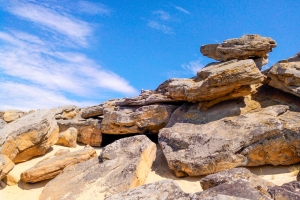

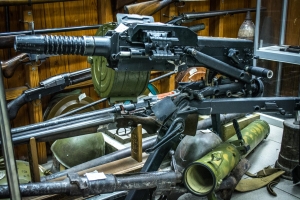


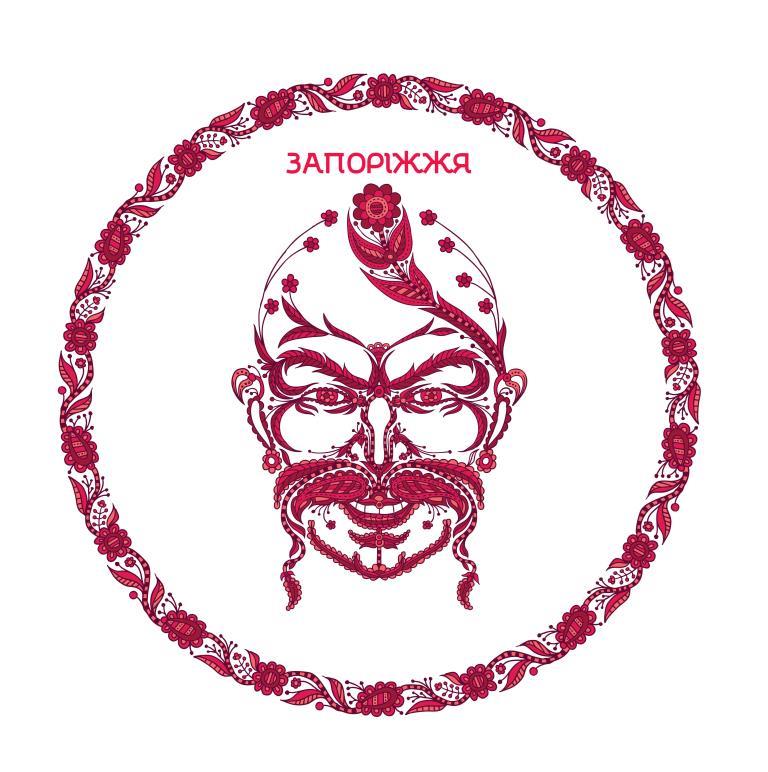
Zaporizhzhia Region is the heartland of Ukrainian Cossackdom, a region with the oldest statehood tradition on the territory of modern Ukraine. This is where the Zaporizhzhian Sich stood, where Khmelnytsky assembled his forces, where the Cossacks wrote their famous letter to the Turkish sultan. Everything one learned about the Cossacks at school — geographically happened in this oblast.
Since 24 February 2022, Zaporizhzhia Region has been living in a divided state: the northern part (Zaporizhzhia city, Khortytsia, Vasylivka) — is under Ukrainian control and relatively functional despite regular shelling. The southern and central parts (Melitopol, Berdiansk, Enerhodar with the ZNPP, Tokmak, Kyrylivka) — are under Russian Federation occupation. This is the most starkly divided oblast in Ukraine today.
Important. The Ukrainian-controlled part of Zaporizhzhia Region (Zaporizhzhia city, Khortytsia, northern and western districts) is a frontline zone subject to regular missile and drone strikes. The southern and eastern parts (Melitopol, Berdiansk, Enerhodar, Tokmak, Kyrylivka, the Sea of Azov coast) have been temporarily occupied since 2022. Travel to the occupied territories without official authorisation is impossible and dangerous.
Region at a glance
| Administrative centre | Zaporizhzhia |
| Area | 27 183 km2 |
| Population | ~1.6 million (pre-2022); actual population in controlled territory is significantly lower |
| Historical land | Zaporizhzhia (Sich), Northern Azov Region, Wild Field (Dyke Pole) |
| Main rivers and sea | Dnipro (with Khortytsia Island), Molochna, Berda; Sea of Azov (coastline occupied) |
| Current status | Divided oblast: north is under Ukrainian control (frontline area); south and east have been occupied since 2022 |
| Best time to visit | Controlled area — with caution, year-round for Khortytsia and Zaporizhzhia city; Sea of Azov coast is currently inaccessible |
In this article
- What kind of region is this and why people come here
- Geography, landscape, climate
- History
- Legends and mysteries
- Temporarily occupied territories
- Top sights (controlled area)
- Day trips and weekend itineraries
- Must-do
- FAQ
What kind of region is this and why people come here
Zaporizhzhia Region is the cradle of Ukrainian statehood. Not Kyivan Rus, which Moscow appropriated. Not the Principality of Galicia-Volhynia, which became part of Lithuania and Poland. But the Cossack Zaporizhzhian Sich — a self-governing military republic that lasted over 200 years (1556–1775) and became the most important precursor of the modern Ukrainian nation.
People come here for three reasons. The first is Khortytsia: the largest island in the Dnipro and a national nature reserve with a reconstructed Sich, museums, and ancient sanctuaries. The second is industrial Zaporizhzhia: the DniproHES dam, the engineering heritage of the 1920s–30s, and Mennonite architecture. The third — currently inaccessible — is the Azov coast with the resorts of Kyrylivka and Berdiansk, and Kamyana Mohyla near Melitopol.
Geography, landscape, climate
The oblast breaks into two natural zones. The north and centre are the steppe of the Wild Field (Dyke Pole) — a lowland between the Dnipro and the Sea of Azov with a moderately hot, dry climate. Steppe, ploughed fields, the Molochna and Berda rivers, Scythian burial mounds. The south is the Azov coast: Berdiansk Spit, Obytichna Spit, the beaches of Kyrylivka. The sea here is shallow, warm, with a clean sandy bed — before 2022 this was one of the country's main beach destinations.
A phenomenon unique to Zaporizhzhia Region is Khortytsia: a 12-kilometre island in the middle of the Dnipro with unique flora and fauna. The island straddles the boundary between the forest-steppe and the steppe, between the Right and Left Banks of Ukraine. It is cut through by rocky outcrops, caves and ravines; it has 8 protected areas and more than 100 listed monuments. In 2009 Khortytsia was named one of the Seven Wonders of Ukraine.
When to visit. The controlled part of the oblast is accessible year-round for Khortytsia and Zaporizhzhia city, but with awareness of air alerts and regular strikes. The best months are May (steppe in bloom) and September (mild weather without the heat). In summer the steppe bakes at 35+ degrees and walking around Khortytsia in July is hard.
History in brief
Khortytsia has been inhabited since the Bronze Age. The Scythians left burial mounds here, the Greeks knew it as the Sacred Island, and Prince Sviatoslav was killed nearby in 972 in battle with the Pechenegs. In the mid-16th century, Cossacks built the first Zaporizhzhian Sich here — a fortified military centre with an elected leader. Over the next 200 years the Sich moved location several times, but the one on Khortytsia was the first and most famous.
In 1775, Russian Empress Catherine II dissolved the Sich; some Cossacks dispersed, others moved to the Kuban (where they founded the Black Sea Cossack Host). The 19th century brought colonisation of the Wild Field by German Mennonites (who founded the Khortytsia colony-Zaporizhzhia), Bulgarians and Greeks. In the 1820s the modern city of Zaporizhzhia emerged on the territory of the former Great Meadows.
1932 — the launch of the DniproHES: the largest hydroelectric power plant in Europe at the time and a symbol of Soviet industrialisation. The DniproHES flooded the legendary Dnipro Rapids, which for millennia had made navigation on the Dnipro dangerous. In 1941 Soviet authorities blew up the dam (as the Wehrmacht approached), killing tens of thousands of civilians in Zaporizhzhia and downstream. After the war the power station was rebuilt.
2022. On 24 February Russian forces moved out of Crimea and within days seized a large part of Zaporizhzhia Region, including Enerhodar and the Zaporizhzhia Nuclear Power Plant — the largest nuclear power station in Europe. The ZNPP remains under occupation, posing an unprecedented nuclear threat to the entire continent. Zaporizhzhia city withstood the siege; the front line settled 30–50 km away. The southern and central districts (Melitopol, Berdiansk, Kyrylivka, Tokmak) remain occupied.
The Zaporizhzhia Nuclear Power Plant in Enerhodar is the largest nuclear power station in Europe (6 reactors). Since March 2022 it has been under Russian occupation, with staff working essentially as hostages. This is an unprecedented situation in the history of nuclear energy: no nuclear power plant anywhere in the world had previously been in an active war zone.
Legends and mysteries of the region
1. Zaporizhzhian Cossacks and the kharakternyky
Among the Zaporizhzhian Cossacks, legends about kharakternyky — warrior-sorcerers who could stop bullets, transform into wolves, walk on water and know what an enemy had planned a thousand miles away — were very much alive. The most famous kharakternyk was Ivan Sirko, Sich ataman of the 17th century, feared by Crimean Tatars and Poles alike. They say that after his death, the Poles carried a mummified hand of Sirko into battle for seven years, as "it brought victory." The Historical and Cultural Complex "Zaporizhzhian Sich" on Khortytsia keeps this tradition alive through re-enactment festivals.
2. The 700-year-old oak — witness to Cossack councils
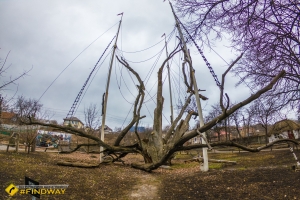
In the village of Verkhniya Khortytsia stands the 700-year-old Zaporizhzhian Oak — one of the oldest living trees in Ukraine. According to legend, it was under this tree that the Cossacks wrote their famous letter to the Turkish sultan (the one painted by Illia Repin). Cossack councils were said to have been held beside the oak, and atamans swore in new Sich recruits here. The tree still stands today, propped and tended — a genuine living monument to history that Zaporizhzhia treats as a national shrine.
3. Kamyana Mohyla and the Book of Genesis
Kamyana Mohyla (Stone Grave) near Melitopol is a hill of sandstone blocks whose ceilings bear petroglyphs up to 25,000 years old. Some researchers regard them as one of the oldest "writing systems" in human history. Local legend holds that Stone Age shamans communicated with spirits on this hill — which is why the walls and ceilings are covered in images. Before 2022 the site was part of a reserve open to tourists. The territory is now under occupation; the Kamyana Mohyla Reserve is described as a category on the site, but physical access to the site is currently impossible.
Temporarily occupied territories
Southern and central Zaporizhzhia Region has been under Russian occupation since 2022. Travel there without serious risk is impossible. But these places remain part of the national landscape, and their history is important to know.
Melitopol. The second-largest city in the oblast, before 2022 the hub of southern Zaporizhzhia and famous for its cherry orchards. Nearby is the Kamyana Mohyla Reserve with the oldest petroglyphs in Europe. Occupied since February 2022.
Berdiansk. A seaside city on the Azov coast, the summer resort capital of Zaporizhzhia Region. Berdiansk Spit stretches 23 km, with beaches, estuaries and mud-therapy facilities. Obytichna Spit nearby remained partly in controlled territory — Obytichna Spit. Berdiansk itself has been occupied since February 2022.
Enerhodar and the Zaporizhzhia NPP. A city built for nuclear plant workers in the 1970s. Six reactors, the largest nuclear power station in Europe. Under occupation since March 2022. Plant staff work under the control of Russian military personnel; the situation is one of the greatest nuclear threats of our time. Enerhodar does not yet have its own page on the site.
Kyrylivka. A resort village on the Azov coast with wide beaches, mud estuaries and sanatoria. Before 2022, one of Ukraine's most popular budget summer destinations. Occupied since spring 2022.
Tokmak. A city in the centre of the oblast, a key logistical hub in southern Zaporizhzhia. After the 2023 counteroffensive, it became one of the occupiers' main defensive strongholds. Occupied.
Top sights (controlled area)
Khortytsia — the island of the Zaporizhzhian Cossacks
The largest island in the Dnipro and a national nature reserve. The key attraction is the Historical and Cultural Complex "Zaporizhzhian Sich", where a Cossack settlement has been reconstructed with kurins (barracks), a church, and a tavern. Beside it stands the Museum of Zaporizhzhian Cossack History with the largest collection of Cossack artefacts in Ukraine. The Lapidary "Scythian Camp" holds Cuman stone idols (babas), while the Observatory-Sanctuary is an ancient prehistoric ritual site. The Chaika Maritime Museum displays a genuine Cossack vessel raised from the bed of the Dnipro.
The 700-year-old Zaporizhzhian Oak
The 700-year-old Zaporizhzhian Oak in the village of Verkhniya Khortytsia is one of the oldest trees in Ukraine, a national natural monument. It stands 36 metres tall with a trunk circumference of more than 6 metres. According to legend, the Cossacks wrote their letter to the Turkish sultan beneath it. Nearby is a small memorial park with a museum.
DniproHES — the dam of an era
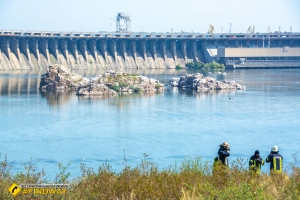
The Dnipro Hydroelectric Power Station dam is the defining industrial monument of Zaporizhzhia. Built in 1927–1932 to a design by American engineer Hugh Cooper, it flooded the Dnipro Rapids that had made navigation on the river dangerous for millennia. In 1941 it was blown up; after the war it was rebuilt. Today the DniproHES is once again under threat — this time as a target of Russian missiles.
The Mennonite heritage of Zaporizhzhia
In 1789, German Mennonites — a religious community from the Netherlands — settled on the territory of present-day Zaporizhzhia. Until the 1930s they remained a separate community, with their own language, schools and architecture. The Mennonite School in Zaporizhzhia itself is one of the few surviving buildings of this community. Nearby is the Regional Museum of Local History with an exhibition on the Mennonite colonisation.
The Ukrainian Pysanka and the Horse Theatre
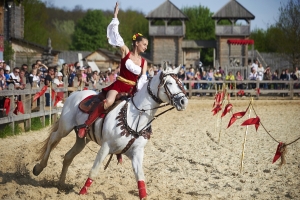
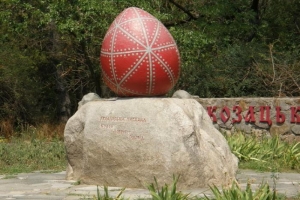
In 2007, a Ukrainian Pysanka monument was erected on Khortytsia — a brightly painted Easter egg one and a half metres tall that has become one of the symbols of modern Khortytsia. Nearby, the Horse Theatre "Zaporizhzhian Cossacks" puts on a show with Cossack cavalry, sabres, muskets and nagaykas (whips). A spectacle that will definitely delight children.
Obytichna Spit — a quiet corner of the Azov region
Obytichna Spit is a sandy spit between Obytichna Bay and Berdiansk Bay on the Sea of Azov. A natural area with beaches, estuaries and fishing villages. Before 2022 it was a little-known alternative to the crowded resorts of Berdiansk. Obytichna is currently partly under Ukrainian control, but proximity to the front limits access.
Oleksiivska Fortress of the Dnipro Line
The Oleksiivska Fortress in the village of Lantseve is one of several fortifications of the Dnipro Defence Line of the 1770s, built by the Russian Empire as a shield against Crimean Tatar raids. Earthen ramparts, moats, foundations. One of the least-known sites in the region, yet highly atmospheric.
Urbex and the unexpected
Zaporizhzhia Region is rich in abandoned Soviet-era facilities. The Abandoned Institute of Livestock Mechanisation in Zaporizhzhia itself is a classic of urban exploration tourism. The monument to Prince Sviatoslav and the abandoned Pavlik Morozov Pioneer Camp in Mykilske-on-the-Dnipro — a rare combination of medieval history and Soviet legacy. The Buddhist Stupa "Dharma Chakra" — a surprising location on the outskirts of Zaporizhzhia.
Day trips and weekend itineraries
Route 1. Khortytsia in one day
The classic itinerary of the region. Morning — the Historical and Cultural Complex "Zaporizhzhian Sich" with the reconstructed Cossack settlement. Then — the Museum of Cossack History. Lunch. Afternoon — the Observatory-Sanctuary and the Lapidary. Evening — the Horse Theatre show. A full day on the island.
Route 2. Industrial Zaporizhzhia in one day
An alternative itinerary for those interested in the 20th century. The DniproHES dam — view and photos. Then — the Mennonite School and the Regional Museum of Local History. Lunch. Afternoon — the 700-year-old oak in Verkhniya Khortytsia.
Route 3. Urbex and the unexpected
A route for lovers of abandoned places. Abandoned Institute of Livestock Mechanisation → Buddhist Stupa → monument to Sviatoslav and the abandoned Pioneer Camp. A compact, off-beat itinerary.
Route 4. Steppe and the Dnipro Line
Out of the city. Oleksiivska Fortress in Lantseve → Pansky Lake in Hryhorivka. A steppe day with a picnic, no hurry, and views across the Wild Field.
Route 5. Post-deoccupation itinerary — when it becomes possible
This route is currently impossible, but is preserved in the guide as a future prospect. Melitopol with the Kamyana Mohyla Reserve → Berdiansk with the spit → Kyrylivka with the Sea of Azov beaches. The direction to which Zaporizhzhia Region will return tourists after deoccupation.
Must-do in Zaporizhzhia Region
- Stand inside the reconstructed Zaporizhzhian Sich on Khortytsia and picture how Cossacks lived here 400 years ago.
- Touch the 700-year-old oak in Verkhniya Khortytsia — the tree that remembers Khmelnytsky.
- Walk across the DniproHES dam and reflect on how much it has lived through: two wars, two reconstructions.
- Watch the Horse Theatre "Zaporizhzhian Cossacks" show — a spectacle that conveys the energy of the Sich better than any textbook.
- Find a Cuman stone idol (baba) at the Lapidary on Khortytsia — an ancient stone stele that breathes millennia.
- Try Zaporizhzhian borscht with pampushky at one of the restaurants in the Khortytsia tourist complex.
- Buy an embroidered Cossack shirt with Zaporizhzhian ornamental motifs — the local school of embroidery has its own distinctive patterns.
- Stand on Dumska Rock on Khortytsia, from which you can see almost the entire island and the "great Dnipro".
- Bring back a jar of Melitopol cherries — once deoccupation becomes reality. These cherries were the finest in the country.
- Visit the Khortytsia museum and see the mummified hand of Sirko — a legendary relic still kept there to this day.
Khortytsia was voted into the Seven Wonders of Ukraine in 2009 in a nationwide poll. Its companions in the seven are St Sophia's Cathedral in Kyiv, Kamianets-Podilskyi, the Kyiv Pechersk Lavra, Khotyn Fortress, Chersonesus Taurica and the Sofiyivka park. The only island location in the seven.
Frequently asked questions
Is it safe to travel to Zaporizhzhia Region right now?
The controlled part (Zaporizhzhia city, Khortytsia, northern and western districts) is a frontline zone with a risk of shelling. Museums and tourist sites on Khortytsia are operating, but visitors must be prepared for air alerts. The southern and central parts of the oblast (Melitopol, Berdiansk, Enerhodar, Kyrylivka, Tokmak) are under occupation. Travel there without official authorisation is impossible.
How do I get to Khortytsia?
The island is connected to Zaporizhzhia by a bridge. Khortytsia itself is quite large (12 km long), so it is best to navigate by specific sites — the Zaporizhzhian Sich, the Museum of Cossack History, Dumska Rock. Most monuments are on the northern part of the island.
What was the Zaporizhzhian Sich?
A self-governing military republic of Ukrainian Cossacks that existed from 1556 to 1775. The Sich moved location several times across what is now southern Ukraine, but the Khortytsia Sich was the first. The most famous ataman was Ivan Sirko. The famous letter to the Turkish sultan, painted by Repin, was written at the Sich.
What happened to the Zaporizhzhia Nuclear Power Plant in 2022?
Russian forces seized the ZNPP — the largest nuclear power station in Europe — in the first week of the war (28 February–4 March 2022). Ukrainian staff continue to work at the plant under military control; the situation is being monitored by the IAEA. This is an unprecedented nuclear threat: no nuclear power plant anywhere in the world had previously been in an active combat zone.
Can Kamyana Mohyla be visited now?
No. The Kamyana Mohyla Reserve in the village of Myrne near Melitopol has been under occupation since 2022. The museum is currently closed to Ukrainian visitors. Reports indicate that the occupiers are attempting to use the site for propaganda purposes, which has drawn international concern.
Where to take children in Zaporizhzhia Region?
A must is the Horse Theatre "Zaporizhzhian Cossacks" on Khortytsia (one of the most spectacular children's shows in the country). Also recommended are the Children's Railway in Zaporizhzhia and the Zaporizhzhia Circus.
What are the most famous dishes of Zaporizhzhia?
Zaporizhzhian borscht with pampushky and garlic, Cossack kulish (millet stew), homemade sausage, steppe pancakes with sour cream. On the Azov coast (currently occupied) — traditions of Azov fish cuisine: goby, taran, Black Sea sprat. The Mennonite heritage left German dishes in Zaporizhzhia's culinary tradition: strudel and klopse (meatballs).
What souvenirs to bring from Zaporizhzhia Region?
An embroidered Cossack shirt, a miniature bulava (the symbol of the Cossack ataman), ceramics with Cossack motifs, postcards of Khortytsia, Cossack honey from steppe apiaries. A children's edition of "Taras Bulba" with illustrations — a classic that really should be bought here, of all places.
Zaporizhzhia Region is a region being divided in two right now. The part Ukraine holds — Khortytsia, the DniproHES, the Cossack reconstructions, the 700-year-old oak — is still accessible, still working, still alive. The part that has been taken from us for now — Berdiansk, Melitopol, Enerhodar, Kyrylivka, Kamyana Mohyla — is waiting to come back.
For now — Khortytsia. Everything began here. This is where to come to understand who Ukrainians truly are.
JoomShopping Download & Support
Attention! Part of Ukraine was occupied during Russia's unfounded military aggression against us and other democratic countries!
russia is a terrorist country, russians are murderers, thieves and rapists.
Russia's unhuman aggression against Ukraine since 2014 has led to the loss of homes and lives not only of many Ukrainians, but also of citizens of other countries and nationalities.
We consider any military actions against any state in the 21st century unacceptable and stupid, but unfortunately the Russians do not think so, and therefore many democratic countries, including Moldova, Georgia and our homeland, suffer from barbaric aggression.
Therefore, until the occupied parts of Ukraine are demilitarized and returned to our state, we remind users about the real danger of visiting the territories occupied by russia.