


- You are here:
-
Sights by Regions

-
Chernivtsi region
- Chernivtsi
Chernivtsi

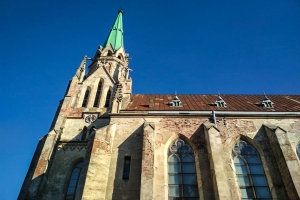

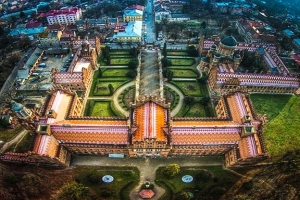



Picture a city where a single street holds an Orthodox cathedral, a Neo-Gothic Jesuit church, an Armenian church with a domed roof, a synagogue-turned-cinema and a «Drunken Church» with spiralling corkscrew domes. Picture a city that had the first university on the territory of modern Ukraine — with three languages of instruction — where Ukrainians, Romanians, Jews, Poles, Germans and Armenians lived side by side for over 140 years, peacefully competing for the best coffee in town. Picture a university campus that is a UNESCO World Heritage Site.
That city is Chernivtsi. «Little Vienna», «Jerusalem on the Prut», the capital of Bukovyna (the historic borderland region between Central and Eastern Europe). World War II left not a single historic building in ruins here, so the Austrian-era centre survives almost entirely intact. This is the city of writers Olha Kobylianska and Yurii Fedkovych, of German-language poet Paul Celan, of Rose Ausländer. And quite simply — one of the most beautiful regional cities in Ukraine, with cafes on cobblestone and poets’ statues around every corner.
City at a Glance
| Founded | First recorded mention — 1408 (charter of Moldavian voivode Alexander the Good) |
| Administrative status | Regional capital of Chernivtsi Oblast |
| Historic region | Northern Bukovyna; capital of the Duchy of Bukovina (1849–1918) and Cernăuți County in Romania (1918–1940) |
| Population | ~265,000 |
| Area | ~153 km2 |
| Main river | Prut |
| Nicknames | Little Vienna, Jerusalem on the Prut, Capital of Bukovyna |
| Best time to visit | Year-round. Especially magical — late summer, golden autumn and Christmas |
In This Article
- What kind of city is this and why people visit
- Location and character
- History in brief
- Legends and mysteries
- Top sights in Chernivtsi
- City itineraries
- Things you must do in Chernivtsi
- FAQ
What Kind of City Is This and Why People Visit
Chernivtsi is the cultural capital of Bukovyna and one of the most beautiful cities in Ukraine. Three things make it truly singular. First: a fully intact Austrian-era centre. Unlike Lviv, Kyiv or Kharkiv, Chernivtsi was never bombed during World War II — which means the 19th- and early-20th-century architecture stands essentially untouched. Second: extraordinary multiculturalism. Before 1941, the city was home to Ukrainians, Romanians, Jews, Germans, Poles and Armenians — each with their own institutions, languages, newspapers and schools. Third: a UNESCO World Heritage Site right at its heart — the Residence of the Metropolitans of Bukovyna and Dalmatia, built between 1864 and 1882 by Czech architect Josef Hlavka.
Visitors come for three reasons. First: to see the Metropolitan Residence — a fairy-tale ensemble in Neo-Moorish and Byzantine styles, with mosaic-tile roofs, internal courtyards and the Seminary Church. It now houses the main building of Yurii Fedkovych Chernivtsi National University. Second: to stroll through the Austrian centre — the pedestrian Kobylianska Street, the Central Square with its City Hall, the Jesuit Church, the Armenian Church, the «Drunken Church» — all within a single walkable kilometre. Third: to soak up the rhythm of Ukraine’s richest cultural city: cafes, bookshops, concerts, poetry, university life.
This is a European-quality city where the density of history and architecture per square metre rivals — and often exceeds — both Lviv and Kyiv. You can sit over a coffee on Kobylianska Street gazing at a City Hall built in 1843 to the same design as the Sorbonne in Paris.
Location and Character
Chernivtsi sits in the foothills of the Ukrainian Carpathians, on the right bank of the Prut river, in the far south-west corner of Ukraine. It is a border city: Romania is 40 km away, Moldova 60 km. Kyiv is 540 km, Lviv 270 km, Ivano-Frankivsk 140 km. The city functions as an international contact hub: it hosts one of Romania’s largest consulates in Ukraine alongside a lively Polish and Jewish diaspora scene.
Chernivtsi is built on seven hills — like Rome (locals enjoy making the comparison). The highest point of the centre is Cathedral Square (Soborna Ploshcha) with the Holy Spirit Cathedral. From here you get a panoramic view of the whole city and the Carpathians on the horizon. The Prut loops around the historic centre, which sits neatly inside the bend.
The historic core is compact and entirely walkable: you can cover everything on foot in a single day. The classic route runs from the Metropolitan Residence through Central Square to Cathedral Square, with detours along Kobylianska Street, to the Armenian Church and to the Turkish Bridge. A car in the centre is more hindrance than help: streets are narrow, parking is scarce, and the cobblestones are old.
When to visit. Chernivtsi is beautiful year-round. The sweet spot is late summer and early autumn (September through mid-October): unhurried crowds, golden foliage, warm without winter damp. Winter brings a Christmas-market atmosphere, with concerts in the Jesuit Church. Spring means chestnut blossom on Kobylianska Street. Summer is fairly humid with occasional thunderstorms — but nothing critical. The war that began in 2022 did not directly touch the oblast: Chernivtsi is one of Ukraine’s safest regional capitals, a city that sheltered hundreds of thousands of displaced people.
History in Brief
Moldavian Era (14th–18th centuries)
The earliest written record of Chernivtsi dates to 1408, in a charter from Moldavian voivode Alexander the Good: a modest trading settlement on the right bank of the Prut, along the Lviv–Suceava trade route. From the 14th to the 18th century the city was part of the Principality of Moldavia (a vassal of the Ottoman Empire from 1538). It changed hands many times — Moldavians, Poles, Cossacks, Tatars, Turks — and grew slowly. By the 1770s it had roughly 2,000 inhabitants.
The Austrian Golden Age (1774–1918)
In 1774, following the Russo-Turkish War, the Austrian Empire annexed Bukovyna. By 1849 Chernivtsi had become the capital of the Duchy of Bukovina, complete with a full set of imperial institutions: a governor, a parliament, a university (1875), a theatre, an opera house, a conservatoire. By 1918 the population had grown from 2,000 to 87,000 — among the fastest rates of urban growth in Europe for the period.
The Austrian era made Chernivtsi what it is today. The Austrians built the Metropolitan Residence (1864–1882), the City Hall (1843–1847), the opera house (1905), the University (1875), and hundreds of residential buildings in Classicist, Historicist and Secessionist styles. The city became a cultural hub rooted in German civilisation, with Ukrainian, Romanian, Jewish and Polish layers woven through it. On its main street you could hear five languages at once: German, Ukrainian, Romanian, Polish and Yiddish.
Romanian Period (1918–1940) and Soviet Era (1940–1991)
From 1918, Chernivtsi — known as Cernăuți — became part of Romania, with a new administration and Romanian replacing German as the official language. By 1940 the city’s population was roughly Ukrainians (~30%), Jews (~30%), Romanians (~20%) and Germans (~10%) — its multiculturalism largely intact. In 1940 Bukovyna was annexed to the Ukrainian SSR; from 1941 to 1944 it was again under Romanian control, this time under German tutelage. The Holocaust in Chernivtsi: more than 25,000 of the city’s Jews were deported to camps in Transnistria; most did not survive. After the war, Chernivtsi became a Soviet oblast capital; the Polish and German intelligentsia were expelled, and the city was remade in a Soviet mould.
The 21st Century and the War of 2022
Since 1991 Chernivtsi has been one of independent Ukraine’s most important cultural centres. The city is re-engaging with its multicultural heritage: the Austrian centre is being restored, new museums have opened (devoted to Paul Celan, Yurii Fedkovych and Olha Kobylianska), and the synagogue community has been revived. In 2011 the Metropolitan Residence was inscribed on the UNESCO World Heritage List.
In 2022 Chernivtsi Oblast was not directly affected by combat operations. The city became Ukraine’s principal rear sanctuary, absorbing thousands of internally displaced people from Mariupol, Kharkiv and Kyiv. The population grew by roughly 50,000. City life continues at its normal pace; sporadic missile strikes on military facilities at the outskirts have had no impact on the tourist infrastructure.
Until 1941, the official languages of administration in Chernivtsi were German, Ukrainian, Romanian and Polish. On a single street stood an Orthodox cathedral, a Greek-Catholic church, a Roman-Catholic church, an Armenian church and a synagogue. The city could claim 4 Nobel laureates: Joseph Schumpeter (economics), Erwin Schrödinger (physics), Isaac Bashevis Singer (literature, who grew up in Chernivtsi) and Josef Breuer. Within two city blocks — enough intellectual history to fill Paris or Vienna.
Legends and Mysteries
1. The Architect Who Lost His Sight
Czech architect Josef Hlavka (1831–1908) designed and supervised construction of the Metropolitan Residence from 1864 to 1882. Legend has it that he poured so much of himself into the project — particularly the intricate mosaic roofs and the interior of the Seminary Church — that he went blind before construction was complete. His blindness proved temporary; a few years later he recovered, returned to practice and founded the Academy of Sciences in Prague. Yet the fairy-tale ensemble he had created he saw completed only much later. It lends the Residence an almost mystical quality — a building its author “felt” rather than saw.
2. The «Drunken Church» with Corkscrew Domes
On Ruska Street stands St Nicholas Orthodox Cathedral (1939–1949), better known by its folk nickname: the «Drunken Church». The reason is instantly obvious — its five domes are twisted in a corkscrew spiral, creating the uncanny impression that you’re looking at the cathedral through inebriated eyes. The technique is borrowed from the Romanian Curtea de Argeş style. There is nothing else quite like it in Ukraine. Locals joke that you had better pray sober here, otherwise the sky and your head spin together.
3. The Turkish Bridge and the «Stone Giant»
On the outskirts of Chernivtsi stands the Turkish Bridge, a stone arch over the Prut river. Legend insists it was built by Turkish soldiers during the Khotyn War of 1621 — in a single night, by magic. The prosaic truth: the bridge is a 19th-century Austrian construction with decorative «Turkish» flourishes. But the name stuck. Locals say that beneath the arch lives a stone giant who emerges at night to fish the Prut and catches only the biggest carp.
Top Sights in Chernivtsi
Residence of the Metropolitans of Bukovyna and Dalmatia
The Residence of the Metropolitans of Bukovyna and Dalmatia is the city’s defining landmark and a UNESCO World Heritage Site (inscribed 2011). Built between 1864 and 1882 in Neo-Moorish and Byzantine styles to a design by Josef Hlavka, the complex comprises three wings, internal courtyards with mosaic-tile roofs and wrought-iron lanterns, the Seminary Church and the Synodal Hall with its carved wooden panelling. Today it houses the main building of Yurii Fedkovych Chernivtsi National University. Access is by guided tour only (book ahead). Not yet covered as a standalone page on the site, but this is an absolute must-see of Ukraine.
Kobylianska Street
Kobylianska Street is Chernivtsi’s main pedestrian artery and the heart of the Austrian centre. Cobblestones, ornate 19th- and early-20th-century facades, cafes, bookshops and small boutiques line the street. It is named after Ukrainian writer Olha Kobylianska (1863–1942), who lived and worked here. The best spot for an evening stroll and coffee. Look out for the Taras Shevchenko monument and the abundance of architectural detail — angels, lions, coats of arms of Austrian noble families.
Jesuit Church of the Sacred Heart of Jesus
The Jesuit Church of the Sacred Heart of Jesus (1893–1894) is one of the finest Neo-Gothic churches in Ukraine. Slender towers, lace-like facades, a stained-glass interior and a pipe organ. Built for the Jesuit order, which returned to Chernivtsi in the 19th century. During the Soviet period it served as a state archive and warehouse; since the 1990s it has been an active church again. Classical and organ concerts are held regularly.
City Hall and Central Square
Chernivtsi City Hall (1843–1847) is a Classicist building with a tower at the centre of the historic core, on Central Square. This is the traditional starting point for any tour of the city. Every day at noon a trumpeter plays the melody «Marichka» (a classic Bukovynian folk tune) from the tower — a tradition revived in 1992. Next to it stands the Chernivtsi Regional State Administration building in Classicist style. Central Square is the city’s liveliest spot, buzzing with street musicians and families out for a stroll.
Armenian Church
The Armenian Church of Saints Peter and Paul (1869–1875) is a rare surviving Armenian place of worship in Ukraine, built by none other than Josef Hlavka (the architect of the Metropolitan Residence). Single-domed, in an Armenian-Byzantine style with Gothic accents. Today it functions as an organ concert hall — one of the finest acoustic spaces in the city. Classical and organ recitals take place regularly. Not yet covered as a standalone page on the site.
The «Drunken Church» — St Nicholas Orthodox Cathedral
St Nicholas Orthodox Cathedral (1939–1949), universally known as the «Drunken Church». Five domes twisted in a spiral — a technique borrowed from the Romanian Curtea de Argeş style. Unique in all of Ukraine: nowhere else will you find corkscrew domes like these. Stands on Ruska Street; it is one of Chernivtsi’s most photographed buildings. Not yet covered as a standalone page on the site.
Holy Spirit Cathedral
The Holy Spirit Cathedral (1844–1864) on Cathedral Square is Bukovyna’s principal Orthodox church. A Classicist facade with twin towers, a 19th-century fresco interior, and the seat of the Chernivtsi eparchy’s metropolitan. Cathedral Square is the highest point of the historic centre and offers a panorama of the entire city. Not yet covered as a standalone page on the site.
The Turkish Bridge and Turkish Well
The Turkish Bridge on the city’s outskirts — a 19th-century stone arch with decorative «Turkish» motifs, wrapped in legends from the Khotyn War era. The Turkish Well in the centre (Shkilna Street) is said to have been sunk by the Turks in the 17th century. Small in scale but big in atmosphere, these are ideal for travellers hunting Chernivtsi’s off-the-beaten-track side. Not yet covered as standalone pages on the site.
The Former Synagogue — the Tempel
Where the Jewish quarter once stood, the Tempel (the Great Synagogue, 1873–1878) still rises in Moorish Revival style. In the Soviet period it was converted into the «October» cinema (now called «Chernivtsi»); the facade retains the lines of a synagogue while the interior was remodelled as a cinema hall. Nearby stands a Holocaust memorial on the site of the former ghetto. A quiet but essential place of memory: before 1941 a quarter of the city’s population was Jewish. Not yet covered as a standalone page on the site.
The Opera Theatre and Universytetska Street
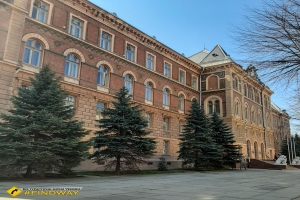
The Chernivtsi Academic Regional Ukrainian Music and Drama Theatre (1905) on Theatre Square is one of western Ukraine’s most beautiful opera houses, built in Viennese Secessionist style. Its architects — Fellner and Helmer — were the same duo who designed opera houses in Zurich, Salzburg and Graz. Alongside it runs Universytetska Street, lined with 19th-century faculty buildings of Chernivtsi National University. Not yet covered as a standalone page on the site.
City Itineraries
Itinerary 1. Chernivtsi in One Full Day
Morning (9:00–11:30) — Metropolitan Residence guided tour (book the day before). Walk to Central Square: City Hall (climb the tower by noon for the trumpeter), Regional Administration building. Lunch on Kobylianska Street. Afternoon: Jesuit Church, Armenian Church, «Drunken Church», Cathedral Square with the Holy Spirit Cathedral. Evening — coffee on Kobylianska or a concert in the Armenian Church.
Itinerary 2. Chernivtsi + Khotyn in Two Days
Day 1 — as in Itinerary 1. Day 2: drive to Khotyn (70 km). Khotyn Fortress — one of the Seven Wonders of Ukraine. Town walk and lunch. The route pairs well with Kamianets-Podilskyi (30 km from Khotyn).
Itinerary 3. Multicultural Chernivtsi
A thematic walk through faiths and cultures. Orthodox: Holy Spirit Cathedral, «Drunken Church». Catholic: Jesuit Church, Roman-Catholic Church of the Exaltation. Armenian: Armenian Church on Ukrainska Street. Jewish: the Tempel, Holocaust memorial. Greek: Greek church (Ukrainska Street). Five religions in one neighbourhood — a rarity for Europe.
Itinerary 4. Literary Chernivtsi
For lovers of literature. Olha Kobylianska House Museum on Dymytrova Street. Yurii Fedkovych Museum in a historic building. Paul Celan monument on Cathedral Square (Celan, the great German-language Jewish poet, was born in Chernivtsi in 1920). Rose Ausländer Museum. Unmissable for anyone who reads or writes.
Itinerary 5. Chernivtsi and Bukovyna for a Long Weekend
A three-day trip using Chernivtsi as a base. Day 1 — city, following Itinerary 1. Day 2 — Khotyn Fortress or the Storozhynets Arboretum. Day 3 — drive into the Hutsul Carpathians: Vyzhnytsia, Putyla, the waterfall on the Putylivka river. Chernivtsi is the ideal base for a Bukovyna tour.
Things You Must Do in Chernivtsi
- Book a guided tour of the Metropolitan Residence — an absolute must-do. The mosaic roofs, Seminary Church and Synodal Hall are unlike anything else in Ukraine.
- Be at Central Square at noon — listen to the trumpeter play «Marichka» (a beloved Bukovynian folk tune) from the City Hall tower.
- Walk Kobylianska Street in the evening — the finest pedestrian street in western Ukraine outside Lviv.
- Catch a concert in the Armenian Church or the Jesuit Church — the city’s best acoustics, with regular organ and chamber music recitals.
- Find the «Drunken Church» and photograph its corkscrew domes — there is nothing else like it in Ukraine.
- Pause at the Paul Celan monument on Cathedral Square — one of the great poets of 20th-century German literature, a Chernivtsi Jew by birth.
- Drink coffee on Kobylianska Street in one of the historic cafes — it is a local rite of passage.
- Try Bukovynian mamalyha with brinza and cracklings (mamalyha is a thick cornmeal porridge similar to polenta; brinza is a local sheep’s cheese) — a classic dish available at restaurants across the centre.
- Eat a plachynda — a Bukovynian filled pastry with various fillings, a legacy of Romanian culinary tradition.
- Buy Bukovynian embroidery at the «Folk Art» shop on Kobylianska Street — Bukovynian patterns are distinct from Galician ones.
- Photograph the Turkish Well — a small but atmospheric landmark right in the centre.
Yurii Fedkovych Chernivtsi National University is the third-oldest university on the territory of modern Ukraine (after Lviv and Kyiv). Founded in 1875 by Austro-Hungary as the Franz Joseph University of Czernowitz, it was the first university in Ukraine with three official languages of instruction: German, Ukrainian and Romanian. Its main building today is the Metropolitan Residence itself — a UNESCO World Heritage Site used daily by students. Alumni and associates include Ivan Franko (rector, according to legend), Olha Kobylianska (auditor), Joseph Schumpeter and Erwin Schrödinger.
Frequently Asked Questions
What can you see in Chernivtsi in one day?
The classic route: Metropolitan Residence (guided tour, 1.5–2 hours) → Central Square with City Hall (trumpeter at noon) → Kobylianska Street → lunch → Jesuit Church → Armenian Church → «Drunken Church» → Cathedral Square. All within 7–8 hours.
What is the Metropolitan Residence?
An architectural ensemble built in Chernivtsi between 1864 and 1882, designed by Czech architect Josef Hlavka as the residence of the Orthodox metropolitans of Bukovyna and Dalmatia. It combines Neo-Moorish, Byzantine and Gothic styles. Since 2011 it has been a UNESCO World Heritage Site. Today it houses the main building of Yurii Fedkovych Chernivtsi National University. Visits are by guided tour only (book in advance).
Is Chernivtsi safe to visit right now?
Yes. Chernivtsi is one of Ukraine’s safest regional capitals, located in the far south-west of the country. The city itself has not been occupied or struck at its centre. In 2022 it sheltered hundreds of thousands of internally displaced people. Sporadic missile strikes have targeted military infrastructure on the outskirts, but tourist sites have not been affected. Before travelling, monitor the situation via the «Air Alarm» app.
Why is Chernivtsi called «Little Vienna»?
For over 140 years (1774–1918) Chernivtsi was part of the Austrian Empire — capital of the Duchy of Bukovina. During that time the city acquired Austrian architecture, a university (1875), an opera house, a coffee-house culture and a multilingual population. The historic centre emerged from World War II virtually unscathed, leaving the Austrian streetscape essentially intact. Hence the comparison with Vienna.
Why is Chernivtsi called «Jerusalem on the Prut»?
Before 1941, more than 50,000 Jews lived in Chernivtsi — one of the largest Jewish communities in Europe relative to the city’s total population (~30%). Dozens of synagogues, Jewish schools, newspapers, theatres and university chairs flourished here. Chernivtsi was the heart of Bukovynian Jewish culture, which produced poets Paul Celan and Rose Ausländer and Nobel laureate Isaac Bashevis Singer. The Holocaust of 1941–1944 destroyed the majority of the community.
What is there to do in Chernivtsi with children?
The Metropolitan Residence — children love the mosaic roofs and courtyards. Central Square with the noon trumpeter — a ritual that sticks in the memory. Shevchenko Park for a leisurely walk. The Storozhynets Arboretum (20 minutes by car) with rare trees. Concerts in the Jesuit Church or Armenian Church — suitable for older children.
Where to go in Chernivtsi in the evening?
The pedestrian Kobylianska Street with its cafes and bars. Central Square lit up after dark. Concerts at the Armenian Church or Jesuit Church — check the schedule in advance. Opera at the Drama Theatre (that gorgeous 1905 Secessionist building).
What are the most famous dishes of Chernivtsi?
Bukovynian cuisine is a crossroads of Ukrainian, Romanian, Jewish and Austrian traditions: mamalyha with brinza and cracklings (cornmeal porridge with sheep’s cheese), tokan (thick corn porridge), Bukovynian borscht, holubtsi (stuffed cabbage rolls) with corn grits, plachynda (Romanian filled pastry), sarmale, strudel (an Austrian inheritance). For dessert: classic Viennese pastries with local twists.
What to bring back from Chernivtsi as a souvenir?
Bukovynian vyshyvanka (embroidered shirt — patterns here differ from Galician ones), a carved plate or box from Vyzhnytsia, a miniature of the Metropolitan Residence, Bukovynian wine, honey from Carpathian beehives, books by Paul Celan or Olha Kobylianska from local publishers, Romanian pastries (at the market near the border).
Chernivtsi is something rare in the post-Soviet world: a city where history was not erased. What survives here is not just an architectural centre but the very idea of multicultural coexistence — five religions in one neighbourhood, four languages on one street, six architectural styles in one building. This is a city where the past is not a museum but a living context: people still drink coffee on Kobylianska Street the same way they did a hundred years ago.
If you are choosing one Ukrainian regional city for a weekend trip — choose Chernivtsi. The Residence is once-in-a-lifetime. Kobylianska Street is forever.
JoomShopping Download & Support