


- You are here:
-
Sights by Regions

-
Poltava region
- Church of All Saints, Gadyach
Poltava region








There are two ways to arrive in Poltava region. The first is to know that the battle of 1709 was fought here — the engagement that redrew the map of Eastern Europe and delayed Ukrainian independence by three centuries. The second is to know that Gogol was born and lived here, and that Dikanka, Myrhorod and Sorochyntsi are not invented place names but real towns a few hours’ drive from Kyiv.
Most people know one or both facts. And yet even those who know — rarely come. Which is a shame: Poltava region surprises precisely because it looks ordinary — until you start reading the plaques on the buildings and realise where you actually are standing.
📍 Region at a Glance
| Administrative centre | Poltava |
| Area | 28,748 km2 |
| Population | ~1.35 million |
| Historic land | Left-Bank Hetmanate (Poltava, Myrhorod and Lubny Cossack Regiments) |
| Main rivers | Vorskla, Psol, Sula, Khorol, Oril |
| Best time to visit | April–October; August — Sorochyntsi Fair; May–June — best for nature and outdoor routes |
In This Article
- What Kind of Place Is This
- Geography and Climate
- History
- Legends
- Top Places to Visit
- Routes
- What You Must Do
- FAQ
What Kind of Place Is This and Why People Come
Poltava region is the Left-Bank Hetmanate in its purest form. This is where the Poltava, Myrhorod and Lubny Cossack regiments were based — administrative units of the Hetmanate that held the region under Cossack self-governance for nearly a century (17th–18th centuries). Hetmans lived, fought and issued their commands here — and it was here that their fate was sealed in July 1709.
Running alongside this serious historical layer is a literary one: Gogol was born in Sorochyntsi, lived in Hoholeve, wandered around Dikanka and gathered material for “Evenings” and “Myrhorod” from local grandmothers and grandfathers. Poltava region without Gogol is like the Carpathians without trembitas: technically possible, but something feels wrong.
Poltava region is the homeland of halushky as an official culinary symbol. The city of Poltava has a monument to the halushka dumpling. This is not a joke and not a tourist gimmick — it is a serious bronze monument honouring boiled dough, erected by the city with full awareness of its priorities.
Geography, Landscapes, Climate
Poltava region is a flat, plains region in the heart of left-bank Ukraine. No mountains, no canyons — instead, wide river valleys, forests with giant oaks, steppe ravines and picturesque meadows along the Vorskla and Psol. It is quiet, unhurried nature: not stunning in a single frame, but quietly absorbing.
The climate is moderately continental with warm summers and relatively mild winters. The best time to travel is May–September. In August, the Sorochyntsi Fair in Velyki Sorochyntsi is unmissable — one of Ukraine’s oldest and most celebrated fairs, held here every year since time immemorial (and appearing in Gogol for very good reason). The balneological resort of Myrhorod draws visitors year-round: its “Myrhorodska” mineral water is drawn from local wells.
History in Brief
The Hetmanate and Mazepa
Poltava region became the heart of the Left-Bank Hetmanate in the second half of the 17th century, after the Cossack state was divided along the Dnipro. Hetman Ivan Mazepa — who ruled for twenty years and built more Orthodox churches than anyone before him — gambled on an alliance with Swedish King Charles XII against Peter I, seeking to preserve Ukrainian autonomy. The gamble failed.
The Battle of Poltava, 1709
On 8 July 1709, two armies met near Poltava: Charles XII’s Swedes and Peter I’s Muscovites. The Swedes were considered the finest army in Europe — and lost within a few hours. Charles had been wounded in the leg before the battle and was commanding from a stretcher; Mazepa was too ill to take the offensive. The Muscovite victory marked the end of the Hetmanate as a meaningful entity and the beginning of the systematic dismantling of Cossack self-rule. Mazepa died a few months later in exile.
The battlefield is preserved as a state reserve: several redoubts, mass graves, a museum and memorials from different eras — each reflecting how differently successive regimes, from tsarist Russia to independent Ukraine, have chosen to interpret this battle.
Legends and Local Lore
1. Motria and the Oaks of Dikanka
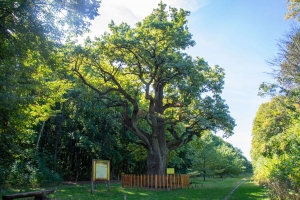
In Dikanka, four oak giants over 800 years old still grow in the park — the so-called Kochubei Oaks. According to local legend, it was beneath one of them that young Motria Kochubei secretly met Hetman Mazepa. Their romance ended in tragedy: Motria’s father, General Judge Vasyl Kochubei, denounced Mazepa to Peter I; Mazepa found out first and handed Kochubei over to the Muscovites for execution. Then he lost the battle. Then he died. The oaks remained — and still stand in the same Dikanka park today, like witnesses who have nothing left to fear.
2. Gogol and the Dark Side of Poltavshchyna
Gogol did not invent his witches, devils and water sprites — he recorded them. Childhood and youth in Poltava region gave him an entire archive of living folk legends, told by local grandmothers with complete seriousness. The witch in “The Sorochyntsi Fair,” the night before Christmas in Dikanka, the drowned maiden in “May Night” — all these plots have real-village originals. They say Gogol himself feared the dark until the end of his life and never slept in a room without a candle. He knew what he was writing about.
3. An Egyptian Pyramid in the Poltava Steppe
In the village of Berezova Rudka stands a genuine stone pyramid — the mausoleum of the Zakrevsky family, built in the early 19th century. Count Zakrevsky, a Freemason with singular aesthetic convictions, decided that his dynasty deserved Egyptian eternity and commissioned a pyramid in the middle of the Poltava steppe. Why the Egyptian form? The official answer is Masonic symbolism. The unofficial one is that nobody knows — but the pyramid stands and provokes thought.
Top Places to Visit in Poltava Region
The Battle of Poltava Battlefield, Poltava
The state reserve on the site of the 1709 battle is a mandatory stop for anyone touring Poltava region. The restored redoubts let you physically sense what the Swedish earthwork fortifications looked like. Alongside them: a museum with weapons, uniforms and battle maps of the period, mass graves and memorial columns from several different eras. The place is quiet and slightly melancholic — not pompous, but thoughtful.
Dikanka
The real town that Gogol made world-famous. Here you will find the 17th-century Church of St Nicholas, where the Cossacks of the Poltava Regiment prayed; the Kochubei Oaks, over 800 years old; and the 1820 triumphal arch built to mark the visit of Tsar Alexander I — the only monument in Ukraine linked to the victory over Napoleon. Dikanka is small, but every metre of it is either Gogol, the Cossack era, or both at once.
Myrhorod
Myrhorod is a balneological spa with mineral waters known since the 19th century. “Myrhorodska” water — a mild sodium-chloride mineral water — is extracted here and sold across the country. But culturally, Myrhorod means above all Gogol: he used the city’s name for his collection “Myrhorod,” in which “Taras Bulba” and “Viy” stand alongside “The Story of How Ivan Ivanovich Quarrelled with Ivan Nikiforovich.” The protagonists of that last tale, incidentally, were also based on real people.
National Museum-Reserve of Gogol, Hoholeve
The Gogol family estate in the village now officially named Hoholeve — a memorial house, park, ponds and the atmosphere of a quiet Poltava village that on its own explains where Gogol’s melancholy comes from. The writer returned here between his St Petersburg and Rome years and, by all accounts, wrote most easily in this place.
Zakrevsky Manor and Pyramid, Berezova Rudka. Two sites in one location: a Classicist manor house from the early 19th century and a pyramid-mausoleum in Egyptian style standing next to it. The manor park and architecture are in fine condition — a pleasant detour on the route north from Poltava.
Opishnia. The pottery capital of Ukraine: home to the National Museum-Reserve of Ukrainian Pottery with a collection of over 30,000 objects. Working craftspeople operate in local workshops — and you can do more than just buy a jug: you can sit at a potter’s wheel and make something yourself under a master’s guidance.
Velyki Sorochyntsi. Gogol’s birthplace and the site of the Sorochyntsi Fair — one of Ukraine’s oldest fairs, held here every August. Thousands of traders, folk celebrations, vyshyvanka embroidery, honey, ceramics and dumplings — all in the town that Gogol described with such affection that reading him feels like a personal invitation.
Day Trips and Weekend Routes
One Day: Poltava City
Morning — the Battle of Poltava battlefield and the restored redoubts (1.5 hrs). Then the city centre: Korpusnyi Garden, the Dormition Cathedral, Round Square with its Column of Glory. Lunch — halushky (at any restaurant with a “Poltava” menu). Afternoon — the local history museum in the Krychevsky building, and the Halushka Monument for good measure.
Weekend: The Gogol Route
Saturday: Poltava (battlefield, city centre) → Dikanka (30 km from Poltava: oaks, church, arch) → Opishnia (pottery museum, 50 km from Poltava). Sunday: Myrhorod (spa and Gogolian spirit, 100 km) → Velyki Sorochyntsi (Gogol museum, 15 km from Myrhorod) → Hoholeve (family estate, 20 km) → return.
Route: Manors and Mysteries
For those who love aristocratic architecture and the unusual: Zakrevsky Manor → pyramid-mausoleum (Berezova Rudka) → Dikanka → Poltava. A compact but rich three-point route through different worlds — aristocratic estate, mystery and Cossack glory.
What You Must Do in Poltava Region
- Eat authentic Poltava halushky. Not varenyky, not pelmeni — halushky specifically: soft, served in broth with pork cracklings and sour cream. Locals will tell you that a proper halushka melts in your mouth, and they are not exaggerating.
- Stand on the Battle of Poltava battlefield. Read something about the fight before you go — then the field starts speaking for itself. Without context it is just a meadow.
- Find the Kochubei Oaks in Dikanka. Eight hundred years old. Four trees with trunks more than 1.5 metres across. And you standing between them, very small.
- Attend the Sorochyntsi Fair in August. If you want to see what a 19th-century fair might have looked like — come here. Thousands of people, folk music, craftspeople, traders — all in the town where Gogol was born.
- Throw a pot in Opishnia. The pottery museum is not only a display. You can sit at a wheel and make something with your own hands. It will come out endearingly crooked — but yours.
- Drink the mineral water in Myrhorod. The same “Myrhorodska” sold in supermarkets — straight from the spring at the resort. The taste is different, and that is not just imagination.
- Buy a Poltava vyshyvanka or a piece of pottery. Opishnia ceramics — with their distinctive floral ornament and vivid colours — are one of the most recognisable styles of folk art in Ukraine.
Frequently Asked Questions
What can I see in Poltava in one day?
The Battle of Poltava battlefield and redoubts in the morning (1.5 hrs), then the city centre: Korpusnyi Garden, the Dormition Cathedral, Round Square. Lunch with halushky. Afternoon — the local history museum or a walk along Sobornist Street. Evening — the Halushka Monument for a photo.
Where can I go for a weekend from Poltava?
Dikanka (30 km) and Opishnia (50 km) make a perfect day. For two days — Myrhorod and Velyki Sorochyntsi. An alternative is Berezova Rudka, with the manor and pyramid.
Is it safe to visit Poltava region now?
Poltava region is not a front-line area, but it has been hit by missile strikes during the full-scale war. Check the current situation through official sources before travelling, and follow civil safety guidelines. Most tourist sites continue to operate.
What is the Sorochyntsi Fair and when does it take place?
The Sorochyntsi Fair is one of Ukraine’s oldest and largest folk markets, held every August in Velyki Sorochyntsi. Thousands of craftspeople and traders, folk performances, concerts, embroidered textiles, ceramics, honey — everything that Gogol’s “Evenings on a Farm Near Dikanka” evokes as the spirit of a Cossack celebration.
Where should I take children in Poltava region?
The Battle of Poltava site with its museum and redoubts appeals to children fascinated by real weapons and fortifications. Opishnia with a pottery masterclass is hands-on. Dikanka with the giant oak trees is awe-inspiring. Myrhorod with its resort park and mineral springs is relaxed and easy-going.
What are the most famous dishes of Poltava region?
Halushky — the symbol and pride of the region (dumplings made from plain dough, served in broth with cracklings). Poltava borscht — thick, with halushky instead of potato. Pampushky bread rolls with garlic and honey. Varenyky with various fillings. All of this is prepared in local restaurants and guesthouses — and looks exactly as Gogol described it.
What should I bring back as a souvenir from Poltava region?
Opishnia ceramics — jugs, plates and decorative figurines with bright folk painting. Vyshyvanka embroidered shirts and towels with Poltava’s characteristic ornament. Honey-based tinctures and wildflower honey. A miniature halushka — already available as a souvenir — for the person who has seen everything.
Poltava region is the kind of place you can drive straight through and notice nothing. Plains, fields, small towns — nothing shouts “stop here.” But once you know where to stop, you suddenly find yourself standing beneath an 800-year-old oak tree under which a girl once arranged to meet the hetman she had fallen in love with. And twenty kilometres away is the field where the fate of the country was decided.
Places like this don’t exist by accident. Poltava region rewards those who arrive prepared — and when you do, it gives back more than you came looking for.
JoomShopping Download & Support