


- You are here:
-
Sights by Regions

- Vinnytsia region
Vinnytsia region









There is a region of Ukraine where a woman blew up an entire fortress rather than surrender, where alchemist monks smelted gold for noblemen in castle dungeons, and where Hitler spent 156 days in a bunker beneath a pine forest — and left it visibly aged. If that sounds like three separate tall tales, a first visit to Vinnytsia Region sets the record straight: here the tales have addresses and postcodes.
Vinnytsia Region is the heart of Podolia, which most tourists still underestimate. The Roshen Fountain and Pirogov Estate are merely the surface. Beneath lies a world of thousand-year-old cliff monasteries, blood-soaked Cossack legends, Europe's oldest meteorite crater, aristocratic residences on a Versailles scale, and a Dnister canyon that no brochure has ever done justice.
Region at a glance
| Administrative centre | Vinnytsia |
| Area | 26 513 km2 |
| Population | ~1.5 million |
| Historical lands | Podolia (partly Bratslav land) |
| Main rivers | Southern Buh (317 km through the region), Dnister |
| When to go | April–October; winter for architecture and solitude |
In this article
- What makes this region tick
- Geography, landscapes, climate
- History in brief
- Legends and mystique
- Top sights of the region
- Day trips and weekend routes
- Must-do experiences
- FAQ
What makes this region tick
Vinnytsia Region is Podolia in its purest form: gently rolling forest-steppe, deep river ravines, white chalk cliffs, and dozens of noble estates that changed hands so often they have lost count of who fought for whom. Polish magnates, Cossack hetmans, Russian counts, Soviet collective-farm directors — each left something behind, and all of it now lies in layers in the same soil.
People come here for the natural quiet of the Dnister Canyon, for the Cossack mystique of Busha, for the palaces of the Potocki dynasty, for Vinnytsia with Europe's largest floating fountain, and simply for the feeling of a place where tourist crowds have not yet erased the atmosphere. Quieter than Galicia. Far more dramatic than the central steppe.
Geography, landscapes, climate
The region sits on the Podolian Upland — not a plain but a system of soft plateaux cut by deep valleys. The Southern Buh bisects it almost exactly, running 317 km through the oblast. The Dnister in the south is another world entirely: there it carves through rock, forming a canyon with steep walls, cliff-side monasteries, and views you photograph and cannot bring yourself to delete.
The climate is moderately continental: mild winters (−4 to −6 °C) and warm, fairly wet summers (+18.6 °C average). The region is covered in forest-steppe — open sunflower fields, hazel groves along the ravines, proper forests on the floodplains. Best season: May–October, when nature and all monuments are fully accessible. May is exceptional: the orchards around Nemyriv and Tulchyn burst into blossom and make you forget you ever had a route planned.
History in brief
Podolia is one of Ukraine's most frequently “rewritten” lands. The Trypillian culture left its traces here thousands of years ago. Scythians, Sarmatians, then Kyivan Rus. In the 14th century the Grand Duchy of Lithuania took control, followed by Poland and the Polish-Lithuanian Commonwealth, which turned Podolia into a noble paradise of estates, gardens, and extravagant people with vast fortunes and even vaster ambitions.
The clans of Potocki, Lubomirski, and Shcherbatov built residences here that rivalled anything in Europe, maintained private orchestras and private armies, and generally behaved as though Vienna and Paris were merely suburbs of their estates. Meanwhile — constant Cossack uprisings, the Khmelnytsky era, the Haidamaka rebellion of Koliivshchyna, which burned down those same estates with impressive regularity.
In the 20th century the region became the arena of both world wars, the Holodomor, and occupation. Near Vinnytsia in 1941–1942 the Nazis built Hitler's headquarters «Werewolf» — and it was here that the Fuhrer spent some of the most dramatic months of his Eastern campaign.
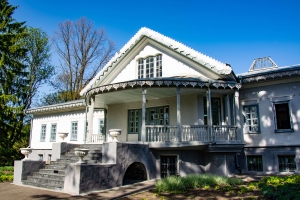
In Brailiv, Vinnytsia Region, Pyotr Tchaikovsky wrote the opera The Maid of Orleans and his First Orchestral Suite. The estate's owner, Nadezhda von Meck, later invited a young student from the Paris Conservatoire to stay there — Claude Debussy. Two genius composers, one estate, one Podolia.
Legends and mystique
1. Marusya of Busha, who blew up the fortress
1654. A Polish army, after a long siege, broke into the Busha fortress. The defenders fell. The wife of one of the Cossack commanders refused to be taken prisoner. She descended to the powder magazine — and lit the fuse. The fortress exploded, taking her and the enemy troops already in the courtyard with it. Her name in the tradition is Marusya. A bas-relief in Busha still depicts the scene. That is what happens when you anger a Podolian woman.
2. The Tulchyn alchemists and the tunnel wide enough for four horses
Stanislaw Szczesny Potocki — count, magnate, and a man whose imagination equalled his debts — built a palace in Tulchyn that had no rival anywhere on the Right Bank of Ukraine. According to legend, monk-alchemists in the palace dungeons smelted gold for the Potockis, while the underground passage between two family palaces was wide enough for four horses to ride abreast. The gold was never found. Neither was the passage. But people are still looking.
3. Werewolf and the Hitler who aged visibly
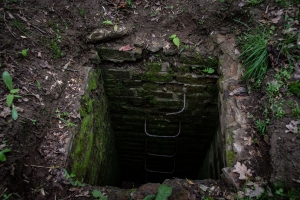
From September 1941 to October 1942, near Vinnytsia, in a pine forest outside Stryzhavka, stood Hitler's personal headquarters «Werewolf». The Fuhrer spent 156 days there. The German biographer Joachim Fest wrote that after Werewolf, Hitler had aged fifteen years: he could not tolerate bright light, complained of balance problems, took sedatives. What exactly happened beneath those pines has no official explanation. The underground halls were destroyed during the German retreat. The legends remain.
Top sights of the region
Busha — fortress, legend, and place of power
Busha Historical and Cultural Reserve is rock relief, a unique 12th–14th-century bas-relief, the remains of a Cossack fortress, and the sensation of standing in a place where the earth remembers everything. Nearby: Haidamak Ravine with caves where people hid from conquerors, and where, according to legend, a giant once lived. And Cossack Spring — with water that acquires a peculiar taste here.
Lyadova Cliff Monastery — a thousand years above the Dnister
On a sheer 90-metre cliff terrace above the Dnister, in Mohyliv-Podilskyi district, stands a monastery said to have been founded by Anthony of the Caves in 1013. Monks have served here for more than a thousand years without interruption — that is not hyperbole, it is fact. The cave churches are hewn directly into the rock; below flows the Dnister; all around is a silence broken only by bells and a flock of swallows. One of the seven official wonders of Vinnytsia Region.
Vinnytsia — city of fountains and surgeons
Vinnytsia deserves a day to itself. Here floats the Roshen Fountain — Europe's largest floating fountain: 97 metres long, jets reaching 63 metres high, not anchored to the riverbed but literally drifting on the Southern Buh. Here is the Pirogov Estate Museum, commemorating the great surgeon who settled near Vinnytsia in 1861 and built a hospital, a pharmacy, and a park. And for something entirely unexpected: the red-brick water tower from the early 20th century, now one of the city's emblems.
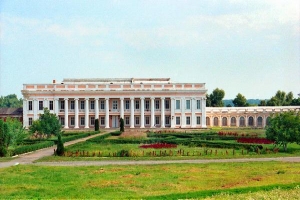
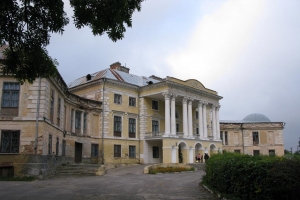
Potocki Palace in Tulchyn — the Podolian Versailles
The Tulchyn Palace, a neoclassical structure designed by a French architect in the late 18th century, was called “the Podolian Versailles” by contemporaries — without irony. The Potockis kept a private theatre, a private orchestra, and a constant stream of guests from across Europe. Alexander Suvorov lived here in 1796 between campaigns, developing the tactics that would later make him famous at Izmail. The palace now houses a school, but the exterior and the park are worth seeing.
Mohyliv-Podilskyi and the Dnister Canyon
Mohyliv-Podilskyi is a small city on the Dnister with a Genoese fortress and a superb view across to the Moldovan bank. From here the Dnister Canyon opens up: hairpin roads, limestone cliffs, vineyards, and secluded beaches on the river bends. This is Podolia as the Danubian lands might look — without the crowds.
Illintsi Crater (astrobleme). Some 60 km from Vinnytsia, near the town of Illintsi, a meteorite struck the earth 400 million years ago. The resulting crater is approximately 7 km in diameter — the oldest confirmed astrobleme in Europe, partly exposed at the surface. Today it is known mainly to geologists and those who read between the lines.
Werewolf Headquarters — bunker in a pine forest
Near Stryzhavka, 8 km from Vinnytsia, lie the remains of Hitler's wartime headquarters. On the surface almost nothing: a few concrete fragments, a memorial, pine trees. But it was here in 1941–1942 that decisions were made that altered the course of the Second World War. A sombre place, necessary for understanding the 20th century, and surprisingly popular with visitors.
Day trips and weekend routes
Route 1. Vinnytsia in a packed day
Morning — Vinnytsia's old town and the water tower museum on European Square. Afternoon — Pirogov Estate (20 min from the centre). Evening — Roshen Fountain on the embankment (shows every hour after sunset). For more: Sabarivska Rock with its ancient settlement, just 15 min from the city.
Route 2. Dnister Canyon and places of power (2 days)
Day 1: drive south from Vinnytsia — Tulchyn (Potocki Palace and park, ~90 min). Overnight in Mohyliv or Yampil. Day 2: Mohyliv-Podilskyi → Lyadova Monastery → Busha with Haidamak Ravine and Cossack Spring. Return via Yampil. This route delivers canyon gorges, cliff monasteries, Cossack memory, and deep quiet.
Route 3. Vinnytsia — Werewolf — Illintsi (1 day)
For those who want to pair the city with the secrets of the 20th century. Vinnytsia in the morning → Stryzhavka (Werewolf headquarters, ~20 min) → Illintsi (astrobleme, ~60 km from Vinnytsia) → return. Short but dense; afterwards you will want to re-read a history textbook.
Must-do experiences
- Watch the Roshen Fountain after sunset. Europe's largest floating fountain at night is a multimedia water show. Free entry, unexpectedly spectacular.
- Stand before the bas-relief in Busha and remember Marusya. One of the true Cossack legends with a precise location on the map. Worth the journey at least once.
- Enter the cave church of Lyadova Monastery. A thousand years of monastic life in a chapel hewn from rock above the Dnister — a feeling that no photograph transmits.
- Try Podolian borscht and kidney Podolia-style in one of Vinnytsia's old-town restaurants. Podolia is a region of generous tables and hearty cuisine.
- Buy Roshen chocolate in Vinnytsia itself — the brand's flagship shop is here, and the chocolate is as it should be: fresh and needing no explanation.
- Walk through Nemyriv Park in spring. The Shcherbatov park — the “Pearl of Vinnytsia Region” — turns into continuous pink and white blossom. Officially one of the most beautiful parks in the region.
- Find the meteorite crater in Illintsi. From the outside it looks like ordinary Podolia. But beneath your feet lie 400 million years of cosmic mystery. Europe's oldest astrobleme.
The Roshen Fountain sinks beneath the ice each winter and overwinters on the bed of the Southern Buh. In spring it is raised again. Perhaps Vinnytsia itself winters in the same way — and returns to the season each year.
Frequently asked questions
What to see in Vinnytsia in a single day?
The Roshen Fountain (evening), the water tower museum, the Pirogov Estate, and Sabarivska Rock — enough for a full day without rushing.
Where to go for a weekend from Kyiv in Vinnytsia Region?
The standard formula: Saturday — Vinnytsia and the Roshen Fountain; Sunday — drive to Busha or to Mohyliv-Podilskyi with Lyadova Monastery. Kyiv to Vinnytsia ~250 km, to Busha ~370 km. Feasible by private car or with a tour group.
Is it safe to travel to Vinnytsia Region now?
Vinnytsia Region is not a frontline zone, but the oblast has suffered missile strikes on infrastructure. Tourist sites have not been targeted. Before travelling, monitor air alerts via the Povitriana tryvoga app and check the current situation through official channels.
When is the best season to visit Vinnytsia Region?
May–October is ideal for nature, parks, and routes. May is particularly special: orchards in bloom, no summer heat yet. Vinnytsia and its architectural monuments are accessible year-round. Winter is quiet and uncrowded, though some monasteries and reserves run reduced hours.
What are the seven wonders of Vinnytsia Region?
The official regional list of outstanding sites includes Lyadova Cliff Monastery, the Busha complex, the Potocki Palace in Tulchyn, and other monuments. Most are in Mohyliv-Podilskyi district and in the Dnister valley.
Where to go with children in Vinnytsia Region?
The Roshen Fountain — essential; children love the evening show. Busha with its caves and rock formations is a natural adventure playground. The Pirogov Estate suits those who enjoy an open-air museum with a genuine period atmosphere.
What are the signature dishes of Vinnytsia Region?
Podolian borscht with beans, meat jelly, kidney Podolia-style, potato dumplings with crackling, apple uzvar from local orchards. The region is agricultural — produce is fresh and homestyle generous. Roshen chocolate is the unofficial souvenir of choice.
Vinnytsia Region is Podolia without boasting. It does not shout “look how beautiful” — it simply places you before a cliff above the Dnister, or before a Cossack bas-relief in Busha, or before a floating fountain on an evening river — and says nothing. You work out the rest yourself.
If you are still hesitating — scroll back up to the location cards. There is one there that will make up your mind.
JoomShopping Download & Support