


- You are here:
-
Sights by Regions

- Kherson region
Kherson region


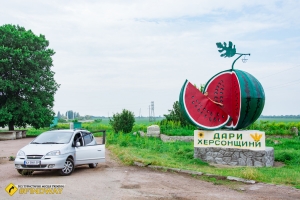

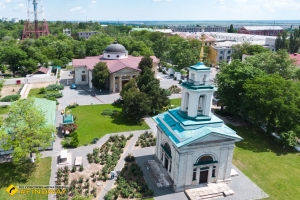






Khersonshchyna is the only region of Ukraine with a real desert. The only one where zebras and antelopes graze unfenced on open steppe. The only one where a pink lake turns so intensely coloured that unfiltered photos look photoshopped. And — since February 2022 — the only one whose larger half is under Russian occupation, where fighting continues to this day.
This guide covers both what is accessible now on the Ukrainian-controlled part of the region, and what awaits travellers after victory. Because Khersonshchyna is worth it — and it will come back.
⚠️ Current situation: The right bank of the Dnipro (including the city of Kherson) is under Ukrainian control, but faces constant shelling. The left bank — the Oleshky Sands, Askaniia-Nova, Heniches'k, the Arabat Spit — is occupied. Always check the current situation through official sources before any visit.
📍 Region at a Glance
| Administrative centre | Kherson |
| Area | 28 461 km2 |
| Population | ~1.0 million (pre-2022) |
| Historical territory | Tavriia (Black Sea region, former Zaporozhian Liberties) |
| Major rivers | Dnipro, Inhul |
| Best time to visit | April–June, September–October; summer heat reaches +40°C. Currently: right bank accessible but dangerous; left bank occupied |
In This Guide
What This Region Is and Why People Come
Before 2022, Kherson region welcomed over 3 million visitors a year. They came for the sea and the estuaries on the Arabat Spit and at Heniches'k, for the pink lakes that shift colour with the seasons and mineral content, for the “African” exoticism of Askaniia-Nova, and for the feeling of primeval steppe — the kind that exists nowhere else in Ukraine.
Khersonshchyna is not just the south of Ukraine. It is a different nature, a different horizon, a different sense of space. You understand here why the Cossacks sought freedom in these steppes — and why they were so impossible to displace.
Geography, Landscapes, Climate
The Dnipro divides Khersonshchyna into two banks with very different characters. The right bank is greener, home to Kherson and the Inhul river valley with its small canyons. The left bank is drier and sandier, with access to the Black Sea and the Syvash lagoon. That is where you find the Oleshky Sands, Askaniia-Nova, and the resort strip at Heniches'k.
The climate is arid and hot: in summer, the sand in the Oleshky Desert heats to +70°C, and rain falls only a few times a year. But spring and autumn are ideal — warm, wildflowers in the steppe, almost no crowds. The Kakhovka Reservoir, which once stretched along the Dnipro to the north, was destroyed in June 2023 when the occupying forces blew up the Kakhovka Hydroelectric Dam. The ecological consequences for the region are still unfolding.
History in Brief
The Cossack Heart of Tavriia
The lower Dnipro basin is the heartland of the Zaporozhian liberties. It was here, at the Dnipro rapids and in the steppes between the Buh River and the sea, that the Cossacks built and relocated their Sich fortresses across three centuries. After Catherine II destroyed the New Sich in 1775 and disbanded the Zaporozhian Host, some Cossacks passed under Ottoman suzerainty and temporarily settled at Oleshky (today the city of Oleshky) — where the Oleshky Sich had already existed earlier. This episode was long suppressed in official history: Cossacks under the Ottoman flag fit no convenient narrative.
Potemkin, Kherson, and the Black Sea Fleet
Kherson was founded by Hryhorii Potemkin (Grigory Potyomkin) in 1778 — as a fortress and shipyard for the new Black Sea Fleet. The city was built at breakneck speed and in chaos: workers died en masse from malaria and heat, the first stone buildings collapsed before completion. Nine years later Catherine II visited during her famous triumphal tour — the very journey that gave birth to the myth of “Potemkin villages.” Kherson spent two and a half centuries as a quiet port city — until February 2022.
Legends and Mysteries of the Region
1. Potemkin Villages: A 237-Year-Old Myth
During Catherine II’s journey to Kherson in 1787, the Austrian diplomat Georg von Helbig spread a rumour: Potemkin had reportedly built decorative fake villages along the Dnipro bank to impress the empress. In reality, Potemkin had genuinely built new cities and fortresses in the south — Kherson, Mykolaiv, Sevastopol — from nothing in just a few years. The problem was that his actual achievements looked just as implausible as invented stage-sets. The phrase “Potemkin village” outlived Helbig’s scandal, Catherine, and Potemkin himself — and today means any impressive facade concealing nothing behind it.
2. Falz-Fein and His Steppe Paradise
Baron Friedrich Falz-Fein inherited an estate on the Tavriian steppe in 1874 — and decided not to plough it up for farmland, but to protect it. He fenced off a patch of untouched steppe, imported African animals and birds, and named the whole thing “Askaniia-Nova” after a place in Germany where his family originated. People thought he was mad: why zebras on the steppe? But thanks to Falz-Fein, Askaniia-Nova became the world’s first steppe nature reserve — and the only place in Ukraine where you can still see what the Black Sea steppe looked like before it was ploughed up.
3. How Cossack Sheep Made a Desert
The Oleshky Sands — the largest sand massif in Europe — were not always a desert. In the 18th century these lands were moderate steppe. But after the Sich was abolished and the land passed to private owners, the new landlords drove millions of sheep onto it. The sheep stripped every blade of grass — and the sand, previously held by roots, began to drift on the wind. Within a century, 160,000 hectares of steppe had become a desert where summer sand temperatures reach +70°C. Nature exacted its revenge without any supernatural involvement.
Top Sights of Kherson Region
Below are the most significant places in the region. Current accessibility status is noted alongside each.
Askaniia-Nova ⚠️ occupied territory
The world’s oldest steppe nature reserve and one of Ukraine’s “Seven Natural Wonders.” On 33,000 hectares of pristine Black Sea steppe, zebras, antelopes, bison, deer, and hundreds of bird species roam freely. A botanical garden and zoo are also on site. Askaniia-Nova is currently under occupation; parts of the reserve have been damaged or destroyed. When liberated, it will be the first stop for every nature lover.
Oleshky Sands ⚠️ occupied territory
160,000 hectares of sand dunes in the middle of steppe — the largest sand massif in Europe. Summer sand temperature: +70°C; sandstorms; almost zero rainfall. The Oleshky Sands on the left bank of the Dnipro were used by the occupiers as a military testing ground. After liberation, the area will require demining and ecological rehabilitation.
Pink Lake, Heniches'k ⚠️ occupied territory
A salt lake near Heniches'k that turns a vivid pink from overheating and the microalgae Dunaliella salina — the same shade as in famous photos of Australian lakes. Surface area: 9.2 km2. Heniches'k and the entire Arabat Spit are currently under occupation.
Kherson and Kherson Fortress ✅ right bank
Kherson — a city on the right bank of the Dnipro, founded by Potemkin in 1778. Liberated in November 2022, it has since been under daily shelling from the opposite bank. Kherson Fortress Park — the remnants of 18th-century earthen defensive ramparts in the city centre — is visitable, but with real risk attached. Monitor the danger level and follow civilian safety rules.
Stanislav Canyon ✅ right bank
Stanislav Canyon — scenic granite ravines on the right bank, one of the few natural attractions in the region currently accessible. Low granite cliffs, steppe vegetation, silence, and a complete absence of crowds. Check accessibility directly before your visit.
Beryslav. Beryslav — an ancient Cossack town on the right bank where the Turkish fortress of Kyzikermen once stood. Currently in the front-line zone; visiting requires exceptional caution.
Arabat Spit and Syvash. A 112-km sand bar between the Syvash salt lagoon and the Sea of Azov — a unique natural phenomenon. Lemuriianske Lake (part of the Syvash) changes colour from pink to crimson depending on the season. The entire territory is currently occupied and inaccessible.
Routes
Right Bank: Accessible Now (with caution)
From Mykolaiv (50 km to the east) — Stanislav Canyon: a nature walk through granite ravines. Then — Beryslav with its Cossack heritage. Kherson — only if fully safe and status confirmed on the day. The route is possible but requires advance security checks.
Post-Victory Route: Classic Khersonshchyna
Kherson (fortress, port, embankment) → Oleshky and the Oleshky Sands (desert, dunes, sunset) → Heniches'k and the Pink Lake (Arabat Spit) → Askaniia-Nova (zebras, steppe, reserve). Four days — four fundamentally different landscapes and experiences.
Must-Do Experiences in Khersonshchyna
- Watch zebras on the Ukrainian steppe. Askaniia-Nova is the only place in Ukraine where this is possible. Standing in open steppe while a herd of zebras and wildebeest walk past you is a genuinely surreal experience.
- Walk across the Oleshky Sands. 160,000 hectares of dunes where sand rings underfoot and the horizon starts just beyond the next crest. The only desert in Europe — and it’s in Ukraine.
- Photograph the Pink Lake. The right moment: late summer, a scorching day. The colour is not edited — it’s real.
- Swim in the Syvash. The water of the Syvash is so salty a person can’t sink even lying flat. Therapeutic mud: a bonus.
- Drive the Arabat Spit. 112 km between sea and lagoon on a narrow strip of sand — the Sea of Azov on one side, the Syvash on the other. A drive that explains exactly why Cossacks loved these places.
- Taste Kherson watermelons and tomatoes. The sandy soils of Khersonshchyna produce the sweetest watermelons in Ukraine. This is not regional pride — it is an agronomic fact.
- Visit Kherson after victory. The city that held out and survived occupation deserves a visit — with respect, and at a safe time.
Frequently Asked Questions
Can you visit Kherson region right now?
The right bank of the Dnipro, including the city of Kherson, is under Ukrainian control but faces constant artillery and missile fire. The left bank — the Oleshky Sands, Askaniia-Nova, Heniches'k, the Arabat Spit — is occupied. Tourist travel to the right bank is theoretically possible but carries real danger to life. Check the current status through official sources and emergency services.
What is Askaniia-Nova and does it still exist?
Askaniia-Nova is the world’s oldest steppe nature reserve, founded in 1874, where zebras, antelopes, bison, and hundreds of bird species live freely across 33,000 hectares. It is currently under occupation; parts of the reserve have been damaged by fires and combat operations. The reserve administration continues to document the damage from evacuation.
What happened to Kakhovka Dam and Kakhovka Reservoir?
On 6 June 2023, the occupying forces blew up the Kakhovka Hydroelectric Dam. A massive flood inundated dozens of settlements on both banks, people were killed, and the ecosystems of the Dnipro delta were destroyed. The reservoir has effectively disappeared. The consequences for the region’s nature and agriculture continue.
What is the Pink Lake in Kherson region and when does it turn pink?
Henicheske (Pink) Lake near the Arabat Spit turns pink due to the microalgae Dunaliella salina under high salinity and heat — most vividly at the end of summer. Surface area: 9.2 km2. Currently inaccessible (occupied territory).
Where are the best watermelons in Ukraine?
In Kherson region. Sandy soils and a hot climate maximise sugar content. “Kherson watermelon” is a well-established national brand. Before 2022, the region grew hundreds of thousands of tonnes of watermelons annually.
What is a “Potemkin village” and where does the phrase come from?
The phrase was born after Catherine II’s journey to Kherson in 1787 — when the Austrian diplomat Helbig spread a rumour about decorative facades built to impress her. Most historians consider this a slander on Potemkin’s genuine achievements, but “Potemkin village” has survived as a synonym for an impressive front concealing nothing of substance.
Khersonshchyna is one of Ukraine’s most extraordinary regions for natural wonders. A desert, a steppe reserve with zebras, pink lakes, a spit between two seas — all of it real, all of it in one region. Most of it is temporarily inaccessible right now.
But temporarily is not forever. Come back to this page when it is safe to travel south again. The list of places worth seeing has not gone anywhere.
JoomShopping Download & Support
Attention! Part of Ukraine was occupied during Russia's unfounded military aggression against us and other democratic countries!
russia is a terrorist country, russians are murderers, thieves and rapists.
Russia's unhuman aggression against Ukraine since 2014 has led to the loss of homes and lives not only of many Ukrainians, but also of citizens of other countries and nationalities.
We consider any military actions against any state in the 21st century unacceptable and stupid, but unfortunately the Russians do not think so, and therefore many democratic countries, including Moldova, Georgia and our homeland, suffer from barbaric aggression.
Therefore, until the occupied parts of Ukraine are demilitarized and returned to our state, we remind users about the real danger of visiting the territories occupied by russia.