


- You are here:
-
Sights by Regions

- Crimea
Crimea

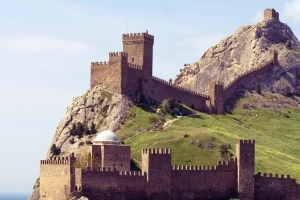








Crimea is Ukraine's most concentrated tourist region: a single peninsula of 27,000 square kilometres packs 2,500 years of ancient heritage, khans' palaces, Genoese fortresses, Crimean Tatar cave cities, a Black Sea coastline lined with palms, a mountain range with the highest peaks on Ukraine's left bank, pink lakes, and volcanic cliffs. Before 2014, Crimea was Ukraine's most popular travel destination — drawing over six million visitors a year.
Since February–March 2014 Crimea has been under occupation by the Russian Federation. Ukraine does not recognise the occupation; the peninsula remains part of Ukrainian territory under international law and the Constitution of Ukraine. This guide is about Crimean heritage awaiting de-occupation. It is not an active travel itinerary but a record preserved for the day the peninsula is Ukrainian once more.
Important. Tourist travel to Crimea is currently impossible. The peninsula has been occupied by the Russian Federation since 2014. Travel there is prohibited by Ukrainian law and dangerous due to the ongoing war. Crimea is part of Ukraine under a temporary occupation regime. This guide describes the peninsula's heritage — not as an active destination, but as a record to keep.
Region card
| Administrative centre | Simferopol (administrative centre of the Autonomous Republic of Crimea, occupied since 2014) |
| Area | 26 100 km2 (including Sevastopol as a city with special status) |
| Population | ~2.4 million before 2014; significantly altered since occupation through Russian settlement and the evacuation of Ukrainian residents |
| Historical land | Tavriia (since antiquity), Crimean Khanate (15th–18th c.), homeland of the Crimean Tatars |
| Seas and mountains | Black Sea and Sea of Azov; Crimean Mountains (highest point — Roman-Kosh, 1,545 m) |
| Indigenous people | Crimean Tatars (since the 13th century); the peninsula was also historically home to Greeks, Genoese, Karaim, Krymchaks, Armenians, and Bulgarians |
| Current status | Occupied by the Russian Federation since February–March 2014 |
| When to visit | Tourist travel is currently impossible; this guide is preserved until de-occupation |
In this article
- What kind of place this is and why people travel here
- Geography, landscapes, climate
- History in brief
- Legends and folklore
- Occupied since 2014
- Top sights of the peninsula
- Routes — for when it is safe again
- Things you must do
- FAQ
What kind of place this is and why people travel here
Crimea is a unique geopolitical and cultural crossroads at the southern tip of Ukraine. A single peninsula holds four climate zones, four bodies of water (the Black Sea, the Sea of Azov, the Syvash lagoon, and the Karkinit Bay), and eight complete historical layers: antiquity (Chersonesus, Panticapaeum), Byzantium, Genoese colonies, the Crimean Khanate, the Russian Empire, the Soviet Union, the Ukrainian SSR, and independent Ukraine.
Before 2014, Crimea was the premier beach resort of the former Soviet Union and the post-Soviet world. The Southern Coast (Yalta, Alupka, Alushta, Sudak), the Western Coast (Yevpatoriia, Saky), and the Eastern Coast (Feodosiia, Koktebel, Kerch) were home to dozens of sanatoria, hotels, and youth camps. The mountain range drew climbers, hikers, and cavers. An especially rich layer is Crimean Tatar cultural heritage: Bakhchysarai, Chufut-Kale, Stary Krym, khans' palaces and mosques.
This guide is being kept for the moment Crimea becomes accessible again. Until then, we honour the people who lived and still live here, and we remember that this is Ukrainian territory.
Geography, landscapes, climate
Crimea is Ukraine's most landscape-diverse peninsula. The north is the Crimean Steppe — a flat, arid expanse between the Syvash lagoon and the Black Sea. The centre holds the Crimean Mountains with three ridges: the Outer, the Inner, and the Main (the highest). The summit is Roman-Kosh (1,545 m). All peaks are limestone, riddled with karst cave systems: Marble Cave, Emine-Bair-Khosar, and Red Cave.
The south is the Southern Coast of Crimea (SCC) — a narrow strip of subtropics wedged between the mountains and the sea, where Yalta, Alupka, Hurzuf, Alushta, and Foros are located. The climate is Mediterranean: hot dry summers, mild rainy winters. To the east is Karadag, a volcanic massif 150 million years old with extraordinary rock arches. To the west is Tarkhankut — a steppe peninsula with white limestone cliffs above the sea, Ukraine's finest diving area.
Crimea's unique lakes deserve a category of their own. Koyashske Lake (Opuk Nature Reserve, Kerch Peninsula) is a pink lake that ranges from deep crimson to vivid rose because of the microalgae Dunaliella salina. Sasyk-Syvash is Crimea's largest salt lake, also pink in certain seasons. The Syvash is a major flyway for migratory birds.
When to visit. Tourist travel is currently impossible. Under normal circumstances: beach season runs from late May to early October; the mountains are best from April to October; winter Crimea (December–February) suits cultural tourism away from the crowds.
History in brief
The Crimean Peninsula is one of the oldest continuously inhabited territories in Europe. It was home to Cimmerians, Scythians, Taurians, Greeks, Romans, Goths, Huns, Khazars, and Cumans. In the 6th century BC, Greek colonists founded Chersonesus (present-day Sevastopol), Panticapaeum (present-day Kerch), and Theodosia. Chersonesus flourished for 2,000 years before declining in the 14th century.
In the 12th–13th centuries the Genoese arrived, building Kaffa (now Feodosiia), Soldaia (now Sudak), and Cembalo (now Balaklava). Their fortresses still stand — among the best-preserved on the Black Sea. In the 13th century the Tatars came from the Golden Horde; in 1441 Haci Giray founded the Crimean Khanate with its capital at Bakhchysarai. For over 300 years Crimea was an independent Tatar state (under Ottoman suzerainty from 1475).
In 1783 the Russian Empire annexed Crimea. Catherine II renamed it the "Tauride Governorate" and founded Sevastopol as the empire's main naval base. In the 19th century the southern coast became a resort for Russian aristocracy: the Romanovs built Livadia Palace, the Vorontsovs built their palace in Alupka. 1853–1856 brought the Crimean War and the Siege of Sevastopol. 1941–1944 brought Nazi occupation, the Holocaust of Crimean Jews and Karaim, and the defence and liberation of Sevastopol.
18 May 1944 — the deportation of the Crimean Tatars. Stalin ordered the entire Crimean Tatar people (roughly 200,000 people) to be deported within three days to the Urals, Siberia, and Central Asia, accused of collaborating with the Nazis — an accusation later declared groundless. About 46 per cent of deportees died within the first two years from hunger, cold, and disease. Crimean Tatars were only able to return to their homeland from the late 1980s. This is one of the cruelest acts of ethnocide of the 20th century.
In 1954 Nikita Khrushchev transferred Crimea from the Russian SFSR to the Ukrainian SSR. It was not a "gift," as Russian propaganda claims: the decision had economic logic, since Crimea had always been more tightly connected to Ukraine than to Russia by geography and infrastructure. In 1991 the Ukrainian independence referendum returned a "yes" vote on the peninsula (54 per cent in Crimea, 57 per cent in Sevastopol).
2014. The occupation. On 20 February 2014 Russian soldiers without insignia — the so-called "green men" — began seizing key sites across the peninsula. On 27 February the Verkhovna Rada of Crimea was seized. On 16 March a so-called "referendum" was held at gunpoint; its result has not been recognised by any democratic country. On 18 March Russia annexed Crimea. Ukraine, the EU, the US, Canada, Japan, and most UN members do not recognise the occupation.
In 2022 Crimea became the launch pad for Russia's full-scale invasion of Ukraine from the south. Russian forces advanced on Khersonska Oblast, Zaporizhzhia, and Mariupol. In 2022–2024 the Armed Forces of Ukraine carried out a series of successful strikes on Crimea's military infrastructure: attacks on the Crimean Bridge (8 October 2022; 17 July 2023), strikes on the airfields at Saky, Belbek, and Dzhankoi, on the Black Sea Fleet headquarters in Sevastopol, and the sinking of multiple warships. Russia's Black Sea Fleet has effectively withdrawn from Sevastopol to Novorossiysk.
The deportation of the Crimean Tatars on 18 May 1944 stands as one of the bloodiest crimes of the Soviet regime. Within three days, around 200,000 people were loaded into freight cars and transported to Central Asia. By the end of 1946, roughly 46 per cent of the deportees had perished. In 2015 Ukraine officially recognised the deportation as genocide of the Crimean Tatar people. 18 May is a national day of remembrance, marked each year not only in Ukraine but by Crimean Tatars around the world.
Legends and folklore of the region
1. Bear Mountain (Ayu-Dag) — the bear that stopped to drink from the Black Sea
Rising above the sea near Partenit is Bear Mountain (Ayu-Dag), 577 metres high. The mountain's profile genuinely resembles a bear leaning down to drink. According to a Crimean Tatar legend, it is an enchanted giant bear that set out from the northern steppe to reach the sea. It fell asleep on the way and has been there ever since. Locals whisper that if you strike the rock near the "head" with your fist, you will hear a muffled roar. Ayu-Dag is a biosphere reserve; guided tours ran here until 2014.
2. Swallow's Nest and Baron Steingel
Perched on the 40-metre Aurora Cliff near Haspra stands Swallow's Nest — a neo-Gothic miniature castle built in 1911–1912 and Crimea's number-one symbol. It began as a wooden dacha belonging to a Russian general; in 1911 Baron Vladimir von Steingel bought it and replaced it with a stone castle in the style of a medieval Scottish tower-house. Local legend insists the baron "built it so finely that no swallow could ever nest nearby." Nobody has managed to verify the claim. The castle survived the 1927 earthquake (it shifted but did not fall) and stands to this day, even under occupation.
3. The Valley of Ghosts on Demerdzhi
On the eastern slope of Demerdzhi Mountain above Alushta lies the Valley of Ghosts: more than 100 stone figures up to 25 metres tall, sculpted by millions of years of weathering. They look like the silhouettes of people, animals, and angels. At certain hours of the day — early morning and evening — shadows create the illusion that the figures are moving. A Crimean Tatar legend holds that these are the petrified riders of the Mongol horde, who came to destroy Crimean auls and were punished by Allah. Scenes from the Soviet classic film "Kidnapping, Caucasian Style" (1967) were shot here.
4. The Fountain of Tears in Bakhchysarai Palace
In the khan's palace at Bakhchysarai stands the Fountain of Tears (Selsebil) — a small marble fountain from the 18th century that drips "tears" through tiny apertures. Legend says it was built by Khan Krim-Giray in memory of a Polish concubine named Maria Potocka, whom he loved and who died young. Pushkin made the fountain the subject of his poem "The Fountain of Bakhchisaray" (1823), one of the cornerstone works of Russian Romanticism. Fresh roses are laid beside it — a tradition that began in the wake of Pushkin's visit.
Occupied since 2014
Crimea has been fully occupied by the Russian Federation since February–March 2014. Not a single democratic country has recognised the occupation. UN Resolution 68/262, adopted on 27 March 2014, affirms Ukraine's territorial integrity including Crimea.
During the years of occupation, Russian authorities have conducted systematic repression on the peninsula: persecution of the Crimean Tatar Mejlis (the people's highest representative body), arrests of journalists, activists, and Muslims on fabricated charges of "extremism," and the imprisonment of hundreds of people in Russian jails. Many Ukrainian activists and Crimean Tatars have become political prisoners of the Kremlin. Separately, residents of Crimea have faced forced passportisation, bans on Ukrainian and Crimean Tatar in schools, and the conscription of Ukrainian citizens into the Russian army.
Alongside this are environmental disasters: drought in the north (caused by Ukraine's closure of the North Crimean Canal until 2022), pollution of the Black Sea linked to the Crimean Bridge and Russian naval activity, and militarisation of the peninsula with missile systems, airfields, and military bases.
Current military status: an active front-adjacent zone. Ukraine's Armed Forces carry out regular strikes on Crimea's military infrastructure; Russian air defences respond to Ukrainian missile and drone launches. Civilian travel to Crimea has no place in current circumstances.
Top sights of the peninsula
All locations below are on occupied territory. This guide preserves them as national heritage to be rediscovered after de-occupation. Most specific sites do not yet have individual pages on the website and are therefore listed without links.
Bakhchysarai — capital of the Crimean Khanate
Bakhchysarai was the capital of the Crimean Khanate (1532–1783) and remains the heart of Crimean Tatar history. The centrepiece is the Khan's Palace (Hansaray) — the world's only surviving Crimean Tatar palace in its original form: mosques, khans' chambers, a harem, mausoleums, and the Fountain of Tears. Nearby is Chufut-Kale, a "cave city" on a clifftop (founded in the 5th–6th century as a Byzantine fortress, later a Tatar capital, and later still a city of the Karaim people). The Assumption Cave Monastery cut into the rock face is one of the oldest Christian sacred sites in Crimea. All three are within the same area — a full day of classic sightseeing.
Sevastopol and Chersonesus Taurica
Sevastopol is a city of special status, Ukraine's main naval base, and the centre of Crimean history. Within its boundaries lies Chersonesus Taurica — Ukraine's largest ancient archaeological site, founded by Greek colonists in the 6th century BC and a UNESCO World Heritage Site. Nearby: Malakhov Kurgan with its 1854 defences, Sapun Ridge with its 1944 battles, the Count's Quay, and the Sevastopol Panorama. Separately, Balaklava harbour shelters the underground Soviet submarine factory (Object 825 GTS).
Yalta and Livadia Palace
Yalta is the capital of the Southern Coast of Crimea and the USSR's most celebrated resort. The main draw is Livadia Palace, the Romanov family's summer residence, where the Yalta Conference took place in 1945 (Stalin, Roosevelt, and Churchill divided the post-war world here). Nearby: Massandra with its wine cellars (one of the empire's oldest wineries), the Nikitsky Botanical Garden (established 1812), and the Chekhov House Museum at the White Dacha. Foros with its clifftop church is close by.
Alupka and Vorontsov Palace
Alupka is a small Southern Coast town with the Vorontsov Palace (1828–1848), built for Count Mikhail Vorontsov. The architecture is extraordinary: the north facade is a Scottish neo-Gothic castle; the south is a Moorish palace in the style of the Alhambra. The 40-hectare park descends through a rocky chaos to the sea. Winston Churchill stayed here during the 1945 Yalta Conference. It is one of the most beautiful aristocratic ensembles of the former Russian Empire.
Swallow's Nest
Swallow's Nest on the Aurora Cliff near Haspra is Crimea's defining symbol. This neo-Gothic miniature castle, built in 1911–1912, sits on the very tip of a 40-metre cliff above the sea. It is the most photographed point on the Southern Coast. Despite its compact size — just a few rooms — it is architecturally and visually one of Crimea's most atmospheric sites.
Sudak and the Genoese Fortress
Sudak is one of Crimea's oldest towns. Above it rises the Genoese Fortress (14th century) — the best-preserved of all Crimean fortresses: 12 towers, 800 metres of walls, and an upper Consular Castle. Nearby is Novyi Svit ("New World") with Prince Lev Golitsyn's 19th-century sparkling-wine estate, its pine forests, and the Blue Cove.
Feodosiia and the Aivazovsky Gallery
Feodosiia — the ancient Greek-Genoese Kaffa — was the Crimean Khanate's main port. It is the birthplace and lifelong home of Ivan Aivazovsky (1817–1900), the world's most celebrated marine painter. The Aivazovsky Art Gallery in his former studio is the world's largest collection of his works (over 400 paintings). Nearby are the remains of the Genoese Fortress of Kaffa and the Jewish quarter.
Karadag — Crimea's ancient volcano
Karadag (Turkic: "Black Mountain") is a volcanic massif east of Koktebel. Europe's oldest volcano, it erupted 150 million years ago. The rocky massif features extraordinary formations: the Golden Gate (a natural arch above the sea), "Dragon," "Ivan the Brigand," and "The King and Queen." In Koktebel stands the house-museum of poet Maksymilian Voloshin, who hosted Tsvetaeva, Gumilev, and Mandelstam as guests.
Ai-Petri — the plateau above the Southern Coast
Ai-Petri is the most famous mountain plateau in Crimea, rising to 1,234 metres. Before 2014 a cable car from Miskhir ran up to it (one of Europe's longest express cable cars, at 2,980 m). From the top, the entire Southern Coast stretches out from Alupka to Alushta. In winter it is a snow zone and the only ski area in Crimea. On the plateau were restaurants serving Crimean Tatar cuisine — shurpa (lamb broth) and chebureki (fried pastries) — until 2014.
Chatyr-Dag and the Crimean caves
The Chatyr-Dag massif is Crimea's premier caving destination. It contains Marble Cave (one of the most beautiful in Europe, with stalactites, stalagmites, and stone "waterfalls"), Emine-Bair-Khosar (the "Mammoth Cave," filled with bones of prehistoric animals), and Red Cave. All three had guided tours with lighting and walkways until 2014.
Yevpatoriia — a resort with an ancient past
Yevpatoriia is a beach resort on the western coast with sandy beaches and a warm, shallow sea — Crimea's "children's capital" with dozens of camps and sanatoria. A separate highlight is its historic centre with Karaim kenasas (synagogues), the Tekiyye of the Dervishes (15th century, the only surviving Muslim monastic lodge in Crimea), and the Juma-Jami Mosque. Saky nearby is a mud-therapy resort going back to antiquity.
Kerch and ancient Panticapaeum
Kerch is one of Ukraine's oldest cities, founded over 2,600 years ago. This was the site of Panticapaeum, capital of the Bosporan Kingdom — a Greek state that endured from the 5th century BC to the 4th century AD. Palace ruins crown Mount Mithridates; royal burial mounds (Kul-Oba, Melek-Chesmen) dot the area. The Adzhymushkai Catacombs commemorate the underground resistance of 1942 — 170 days of defiance. Nearby is the Crimean Bridge, built by Russia in 2018 and already struck twice by the Armed Forces of Ukraine.
Tarkhankut and the pink lakes
The Tarkhankut Peninsula is the westernmost point of Crimea, with white limestone cliffs above crystalline water and Ukraine's best dive sites. Here are the Great Atlesh and Little Atlesh with their natural arches, and the Bowl of Love — a hollow connected to the sea through an underwater tunnel. To the east is Koyashske Lake in the Opuk Nature Reserve, whose water turns vivid crimson in certain seasons owing to the microalgae Dunaliella salina.
Routes — for when it is safe again
The itineraries below describe how Crimea was experienced by travellers before 2014. They are entirely impossible now because of the occupation. This guide preserves them for the day the peninsula is open again.
Route 1. Crimean Tatar Bakhchysarai — a day trip
The classic. The Khan's Palace with its mosques and Fountain of Tears. The climb to Chufut-Kale, the cave city. The Assumption Cave Monastery along the way. A Crimean Tatar lunch of lagman (noodle soup) and chebureki (fried pastries). A day best spent with a Crimean Tatar guide for full context.
Route 2. The Southern Coast and palaces — 2–3 days
The classic "palace tour." Vorontsov Palace in Alupka → Swallow's Nest on the Aurora Cliff → Livadia Palace with its Yalta Conference rooms → Massandra winery → Nikitsky Botanical Garden. Beaches at Yalta, Alupka, and Hurzuf along the way.
Route 3. Mountain Crimea — Ai-Petri, Demerdzhi, Chatyr-Dag
For those who love mountain trekking. Ascent to Ai-Petri by cable car from Miskhir. Trekking to the Valley of Ghosts on Demerdzhi from Alushta. Descent into Marble Cave at Chatyr-Dag. One of Crimea's most physically active routes.
Route 4. Sevastopol and Chersonesus
A full day in Sevastopol. Chersonesus Taurica in the morning, with its ancient ruins. Malakhov Kurgan and the Panorama. Lunch at the Count's Quay. Afternoon — Balaklava with the underground submarine factory. A route for lovers of history spanning from antiquity to the Cold War.
Route 5. Eastern Crimea — Feodosiia, Koktebel, Sudak
A two-day itinerary. Day 1: Feodosiia — the Aivazovsky Gallery and the Genoese Fortress of Kaffa. Koktebel — the Voloshin House Museum and the foot of Karadag. Day 2: Sudak — the Genoese Fortress and Novyi Svit with its sparkling-wine estate.
Things you must do in Crimea (when it is safe again)
- Stand in the Khan's Palace in Bakhchysarai before the Fountain of Tears — place a rose, as visitors have done since Pushkin's time.
- Climb Chufut-Kale and walk through the cave city — from Byzantine fortress to Karaim town.
- Walk the ruins of Chersonesus Taurica in Sevastopol — a 2,500-year-old ancient city on the Black Sea shore.
- Stand on the terrace of Livadia Palace — the spot where, in 1945, Stalin, Roosevelt, and Churchill redrew the post-war world.
- Photograph Swallow's Nest from the viewing platform on the adjacent cliff.
- Eat a proper Crimean Tatar cheburek at a teahouse in Bakhchysarai — not a Soviet imitation but the original: lamb and cumin.
- Drink Massandra Madeira in a 19th-century wine cellar.
- Descend into Marble Cave at Chatyr-Dag — one of the most beautiful caves in Europe.
- Walk the Valley of Ghosts on Demerdzhi with a guide who knows every legend.
- Stand before "The Ninth Wave" by Aivazovsky in his gallery in Feodosiia.
- Swim at Tarkhankut in crystal-clear water among the limestone cliffs.
- Buy a Crimean Tatar embroidered cap and a hand-woven rug — from craftspeople whose families returned from deportation.
Chersonesus Taurica is Crimea's only UNESCO World Heritage Site (since 2013). Founded in 421 BC by Greek colonists from Heraclea Pontica, the city endured for 2,000 years. In 988 AD, Prince Volodymyr the Great was baptised here — and from Chersonesus, Christianity spread to Kyiv. This is the place where ancient Greece and Kyivan Rus met. The site is under threat from Russian construction activity within the reserve boundaries.
Frequently asked questions
Can I visit Crimea right now?
No. Crimea has been occupied by the Russian Federation since February–March 2014. Travel to the peninsula is dangerous and restricted by Ukrainian law for Ukrainian citizens. Crimea is part of Ukraine under a temporary occupation regime. This guide is preserved until de-occupation.
When will Crimea be de-occupied?
De-occupying Crimea is a strategic goal of Ukraine. President Zelensky has stated repeatedly that the war will end with the restoration of Ukraine's territorial integrity within its 1991 borders — including Crimea. The precise timeline depends on the course of the war and subsequent military and diplomatic decisions.
Who are the Crimean Tatars?
The indigenous people of Crimea, who emerged in the 13th–15th centuries from Tatar, Cuman, Greek, Gothic, and other roots. The Crimean Tatars founded the Crimean Khanate (1441–1783), which endured for over 300 years. In 1944 Stalin's regime deported the entire Crimean Tatar people (roughly 200,000 people) to Central Asia on false charges. By the end of 1946, nearly half of the deportees had died. Crimean Tatars were able to return to their homeland only from the late 1980s. Ukraine has officially recognised the deportation as genocide. Today the Mejlis of the Crimean Tatar People is the community's highest representative body.
How did Ukraine come to have Crimea in 1954?
On 19 February 1954 the Presidium of the USSR Supreme Soviet transferred Crimea from the Russian SFSR to the Ukrainian SSR. The reasons were economic and geographical: Crimea had always been more tightly bound to Ukraine by infrastructure (water, electricity, railways) than to Russia, from which it is separated by the Kerch Strait. This was not a "gift," as Russian propaganda claims, but a rational administrative decision. In the 1991 Ukrainian independence referendum, 54 per cent of Crimea's residents voted in favour of independence.
What happened in Crimea in 2014?
Between 20 and 27 February 2014, while Kyiv's Revolution of Dignity held the world's attention, Russian soldiers without insignia — the so-called "green men" — seized key sites across Crimea. On 27 February the Verkhovna Rada of Crimea was occupied and a puppet premier, Aksyonov, was installed. On 16 March a so-called "referendum" was held at gunpoint. On 18 March Russia annexed Crimea. Not a single democratic country has recognised the occupation. UN Resolution 68/262 affirms Ukraine's territorial integrity.
What is Chersonesus Taurica?
Ukraine's largest ancient archaeological site, founded by Greek colonists from Heraclea Pontica in 421 BC on the site of present-day Sevastopol. The city endured for 2,000 years before declining in the 14th century. In 988 AD Prince Volodymyr the Great was baptised here — it is from Chersonesus that Christianity came to Kyiv. Crimea's only UNESCO World Heritage Site (since 2013).
What are the most famous dishes of Crimea?
Crimean Tatar cuisine: chebureki (deep-fried pastries filled with minced lamb), lagman (a thick noodle soup with meat and vegetables), shurpa (lamb broth), plov (pilaf), sarma (stuffed grape leaves), baklava. Karaim cuisine: kibiny (baked pastries with meat). Greco-Pontic cuisine: fish dishes and olives. A separate chapter is Crimean wine (Massandra, Novyi Svit, Inkerman).
What to bring back from Crimea?
Before 2014 the classic souvenirs were: Crimean wines (Massandra, Inkerman), Crimean Tatar embroidered caps and hand-woven rugs, Aivazovsky prints from Feodosiia, bay laurel wreaths from the Nikitsky Botanical Garden, dried fruits from Bakhchysarai, pickled scallops from Sevastopol, and natural rose oil from Crimea. Today much of this can be found in shops run by evacuated Crimean Tatars in Kyiv, Lviv, and Dnipro.
Crimea is not Russia, not a Soviet resort, not "disputed territory." It is Ukrainian land with 2,500 years of history written by Greeks, Genoese, Tatars, Karaim, Krymchaks, Pontic Greeks, Armenians, and Bulgarians. It is the homeland of the Crimean Tatar people, who survived deportation and returned. It is the place where Prince Volodymyr received Christianity. It is the Black Sea with palm trees — in Ukraine.
This guide is being kept for the day when you can travel to Bakhchysarai, hear the call to prayer from Kebir-Jami Mosque, eat a real cheburek, and hike up to Chufut-Kale on foot. Crimea is Ukraine. Always was, is, and will be.
JoomShopping Download & Support
Attention! Part of Ukraine was occupied during Russia's unfounded military aggression against us and other democratic countries!
russia is a terrorist country, russians are murderers, thieves and rapists.
Russia's unhuman aggression against Ukraine since 2014 has led to the loss of homes and lives not only of many Ukrainians, but also of citizens of other countries and nationalities.
We consider any military actions against any state in the 21st century unacceptable and stupid, but unfortunately the Russians do not think so, and therefore many democratic countries, including Moldova, Georgia and our homeland, suffer from barbaric aggression.
Therefore, until the occupied parts of Ukraine are demilitarized and returned to our state, we remind users about the real danger of visiting the territories occupied by russia.