


- You are here:
-
Sights by Regions

-
Volyn region
- Lutsk
Lutsk




In January 1429, the following gathered in Lutsk: the Roman King and future Emperor Sigismund, Polish King Władysław II Jagiełło, Lithuanian Grand Duke Vytautas, the Grand Master of the Teutonic Order, papal legates, the Crimean Khan, and envoys from Denmark, Hungary, Moscow and Byzantium. The largest royal congress of medieval Europe — lasting seven weeks — did not take place in Paris, Vienna or Krakow. It happened in Lutsk.
Today, roughly one in seven residents of Lutsk knows this fact. The rest walk past the very castle where it all unfolded without giving it much thought. A city with as dense a layer of history as Lutsk could easily sell itself — yet somehow it doesn’t. Which may be just as well. You arrive here and get the 14th century with no queues.
City at a Glance
| Founded | First mention — 1085 (Kyiv Chronicle) |
| Admin status | Regional capital of Volyn Oblast |
| Historic region | Volhynia (capital of the Volyn Principality, later Volyn Voivodeship) |
| Population | ~210,000 |
| Area | ~42 km2 |
| Main river | Styr (with tributary Hlushets) |
| Nicknames | City of Lyubart, Pearl of Volhynia, City of Three Faiths |
| Best time to visit | May–September for walking; year-round for the castle and museums |
In This Guide
- What kind of city is Lutsk and why visit
- Location and character
- History in brief
- Legends and lore
- Top sights in Lutsk
- Suggested itineraries
- Must-do in Lutsk
- FAQ
What Kind of City Is Lutsk and Why Visit
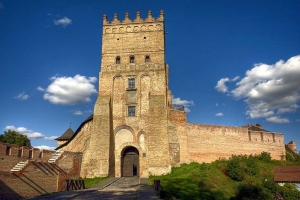
Lutsk is a castle city — and not just metaphorically. Lyubart’s Castle stands at the very heart of the old town like a granite horseshoe, with every other street curving around it. It is one of the best-preserved medieval castles in Ukraine: three towers, 14th-century defensive walls and a courtyard where knight festivals are held throughout the year. The castle graces the 20-hryvnia banknote.
People come here for three reasons. First — the castle and the medieval core: a cathedral, a synagogue, a Bridgettine convent, a Lutheran church, underground passages — all clustered on a single hill above the Styr River. Second — the atmosphere of a three-culture borderland: for centuries Lutsk was home to Ukrainians, Poles, Lithuanians, Jews, Karaites and Armenians, and the old town’s facades still carry those layers. Third — the quiet and the absence of tourist crowds: you can sit in a café without waiting in line, photograph the castle without strangers’ shoulders in the frame, and step out of an empty church into an empty lane. In 2026 that counts for a lot.
Location and Character
Lutsk sits on the Styr River in the southern part of Volyn Oblast, at the boundary between Volyn Polissia and the Volyn Upland. It is Ukraine’s northwestern corner: about 80 km from the Polish border, 160 km from Lviv and 410 km from Kyiv. The city is small and compact: the entire historic core fits within one square kilometre around the castle.
The Styr makes a sharp bend here, and it is on the peninsula formed by that bend that the old town stands. This is classic medieval geometry: natural water defences on three sides, walls and towers on the fourth. From the castle’s viewing platforms you can see Volhynia’s floodplains and pine forests — and instantly understand why the castle was placed exactly here.
When to go. The best season runs from late April to mid-October. May and September offer the ideal balance of warmth, greenery and manageable crowds. Summer brings the Knightly Arts Festival, «Night in Lutsk Castle» and medieval markets. In winter the city is quieter, but all the main museums are open, and the snow-covered castle looks as though someone has teleported you to the 14th century. Volyn is one of the safest regions in the country, far from the front line.
History in Brief
Early Rus Luchesk
The first written record dates to 1085, in the Kyiv Chronicle, under the name Luchesk (from «luk» — the bend of a river). Archaeological evidence points to a fortified settlement as early as the 9th–10th centuries. In the 12th century Lutsk became the capital of the Lutsk Principality — a domain of the Volyn Principality, ruled by princes of the Monomakhovychi dynasty. In 1259 the Mongol commander Kuremsa demanded that Danylo of Halych demolish the fortifications; the prince was forced to comply. But a century later everything was rebuilt.
Lyubart’s Castle and the Lithuanian Era
In 1340 Volhynia passed to the Grand Duchy of Lithuania. The new prince was Liubartas Gediminovich — a son of Grand Duke Gediminas. It was he who began building a stone castle (1340s) on the site of the older wooden one. Construction took half a century and was completed under his son. In 1429 this very castle hosted the Lutsk Congress of Monarchs — the largest diplomatic gathering of medieval Europe, at which Vytautas nearly received a royal crown (it was being brought from Nuremberg but was «lost en route» with the help of Polish agents).
The Polish Period
From 1569 Lutsk was part of the Polish–Lithuanian Commonwealth, the centre of Lutsk County within Volyn Voivodeship. In the 16th–17th centuries the city experienced a cultural golden age: Bernardine, Carmelite, Dominican and Bridgettine monasteries were built, along with the Cathedral of St Peter and Paul, a Lutheran church and a Karaite kenasa. It was a three-religion city: Orthodox (Ukrainians and Lithuanians), Catholic (Poles) and Jewish (Jews and Karaites). The Great Synagogue of 1628 is one of the best-preserved fortified synagogues in Europe.
20th–21st Centuries
In 1795 Lutsk was absorbed by the Russian Empire; after 1921 it returned to Poland (the Second Polish Republic); from 1939 it became part of the Ukrainian SSR. During 1941–1944 it was under German occupation: almost the entire Jewish community of the city (around 20,000 people) was murdered. After the war it became a Soviet industrial centre (the LuAZ off-road vehicles were famous). In independent Ukraine, Lutsk is the regional capital and the cultural and logistical hub of Volhynia. Since 2022 it has been one of the safest regional capitals in the country: thousands of displaced people from frontline regions have settled here and the city maintains a normal rhythm of life. Missile strikes are rare and generally target military facilities far from the centre.
The Lutsk Congress of 1429 was the largest royal summit of medieval Europe. For seven weeks inside Lyubart’s Castle the participants included: Roman King Sigismund, Polish King Jagiełło, Lithuanian Grand Duke Vytautas, the Grand Master of the Teutonic Order, papal legates, the Crimean Khan, and envoys from Denmark, Moscow and Byzantium. Two questions were on the table: the coronation of Vytautas (Lithuania wanted to become a kingdom) and an anti-Ottoman coalition. The Poles derailed the first; the second never materialised. But the event itself went down in history.
Legends and Lore
1. The White Monk of Lyubart’s Castle
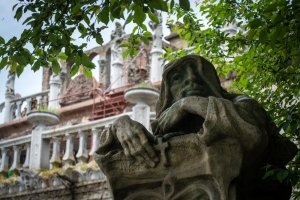
Lyubart’s Castle is said to be haunted — by a white monk. According to local legend, in the 17th century a monk who had seduced a nun from the neighbouring Bridgettine Monastery was walled up alive in the Styr Tower. His body was sealed away and his name struck from every record — but his spirit remained. On certain nights, especially before a thunderstorm, a pale figure in a white hood is said to appear in the tower windows. Tour guides recount this with relish; museum staff respond with a carefully neutral nod.
2. The Underground Passages of Lutsk and the 40-Kilometre Tunnel to Olyka
Beneath the old town lies a branching network of underground passages from the 16th–17th centuries. Some have been explored and opened to visitors (the cellars beneath the Cathedral of St Peter and Paul are a must-see). But the real legend is the underground tunnel to the Radziwill Castle in Olyka — reportedly 40 kilometres under Polissia, wide enough for a carriage. The tunnel has never been found. It has also never been conclusively disproved. The Radziwills kept their own army and had more money than some kingdoms — for them, 40 kilometres of tunnel would have been a modest indulgence.
3. The House of Thousand Faces
On Lesi Ukrainky Street stands a house whose facade is covered with hundreds of ceramic human faces. This is the life’s work of sculptor Mykola Holovan, who spent decades crafting and installing them. Every face is unique. Some are recognisable — Shevchenko, Lesia Ukrainka, local residents — while others remain unidentified, their subjects known only to the artist. Legend has it that certain faces «smile» at passers-by at night. Unconfirmed, but hard to dismiss once you’ve stood there in the dark.
Top Sights in Lutsk
Lyubart’s Castle — the city’s calling card
Lyubart’s Castle (14th c.) is one of the best-preserved medieval castles in Ukraine. Three towers (the Gate Tower, the Styr Tower and the Vladycha Tower), defensive walls and an inner courtyard. Inside: a Museum of Books with a printing press, a Museum of Bells in the Vladycha Tower and an artillery exhibition. The castle appears on the 20-hryvnia banknote. This is stop number one in any Lutsk itinerary.
Cathedral of Saints Peter and Paul
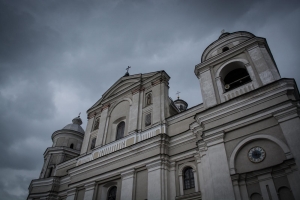
The Cathedral of Saints Peter and Paul (1606–1640) was a Jesuit church and is now the cathedral of the Lutsk Roman Catholic diocese. Baroque facade, pipe organ, 17th–18th-century icons and underground vaults with frescoes and sarcophagi. The subterranean section is particularly striking: you descend into a quiet chamber with a stone vault where ancient burials and a mysterious empty tomb were discovered.
The Big Synagogue of Lutsk
The Big Synagogue (1628) is one of the best-preserved fortified synagogues in Europe. The tall stone building with defensive towers reflects how synagogues were built in border towns that had to defend against Tatar raids. Today it serves as a cultural venue for exhibitions and concerts. Beside it stands a memorial to the Lutsk Jews murdered during the Holocaust.
The Monastery of Bridgettines
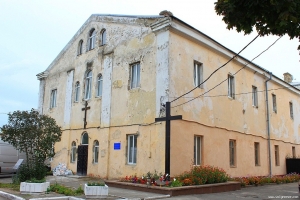
The Bridgettine Monastery (1624) was once the convent of the Catholic Order of St Birgitta of Sweden. Its stone church and residential buildings have, over the past four centuries, served as a monastery, a prison, a grammar school and a warehouse. Today it houses a museum and is one of the key buildings of the medieval core.
The House of Thousand Faces by Sculptor Holovan
The House of Thousand Faces on Lesi Ukrainky Street is sculptor Mykola Holovan’s personal project. The facade of this private house is covered with hundreds of ceramic faces crafted by the artist over decades. It is one of the most extraordinary examples of street art in Ukraine — you can study it for hours and every face will be different.
Museum of Technological Progress
The Museum of Technological Progress is an open-air collection of vintage machinery: LuAZ and Volyn automobiles (Lutsk was once the capital of the Ukrainian auto industry), motorcycles, bicycles and 20th-century household gadgets. Perfect for kids; nostalgic for adults. One of the most underrated museums in Lutsk.
Lutheran Church
Lutsk’s Lutheran Church is a small Neo-Gothic building from the early 20th century, erected for the city’s German-Czech community. Red brick, a pointed spire and an interior with a pipe organ. It now hosts classical and organ music concerts and has one of the most photogenic facades in old Lutsk. Not yet a separate page on the site.
Holy Trinity Cathedral
The Holy Trinity Cathedral (1755, rebuilt in the 19th century) is Lutsk’s main Orthodox church. Classicist facade, bell tower, quiet square. It is not as visually dramatic as the castle or the Latin cathedral, but it provides an essential sense of continuity: services have been held here since the 18th century and it was the seat of the Bishops of Volhynia. Not yet a separate page on the site.
Church of the Exaltation of the Holy Cross and the Brotherhood Monastery
The Church of the Exaltation of the Holy Cross (1619) is a small wooden-and-stone structure next to Lyubart’s Castle, once part of the Lutsk Orthodox Brotherhood Monastery — a centre of resistance to the Church Union in the 17th century. Books were copied here, and the monastery ran a school and a printing house. The church is active and open to visitors. Not yet a separate page on the site.
The Old Town and Lesi Ukrainky pedestrian street
Lutsk’s old town is itself a sight. The historic core around the castle is a maze of narrow streets with 18th–19th-century facades, courtyard cafés and small craft workshops. The main pedestrian artery is Lesi Ukrainky Street: chestnut trees, cobblestones, souvenir shops, open terraces. The best place for an evening stroll and coffee after seeing the main sights.
Suggested Itineraries
Itinerary 1. Lutsk in one packed day
Morning — Lyubart’s Castle with all towers and museums (allow at least 2.5 hours). Then — Cathedral of St Peter and Paul with its underground vaults and the Big Synagogue. Lunch in the centre. Afternoon — the House of Thousand Faces on Lesi Ukrainky Street and a stroll along the pedestrian zone. Sunset — on the Styr embankment with a view of the castle.
Itinerary 2. Lutsk in two days — full programme
Day 1 — as in Itinerary 1. Day 2 morning: the Bridgettine Monastery, the Lutheran church, the Holy Trinity Cathedral. Lunch. Afternoon — the Museum of Technological Progress with vintage LuAZ cars. Evening — a concert at the church or dinner at a Volhynian cuisine restaurant.
Itinerary 3. Lutsk of Three Faiths
A thematic walk through Lutsk’s confessions. Orthodox: Holy Trinity Cathedral and the Church of the Exaltation of the Holy Cross. Catholic: Cathedral of St Peter and Paul and the Bridgettine Monastery. Lutheran: the Lutheran church. Jewish: the Big Synagogue and the Holocaust memorial. Four religions in one city block — a rarity in Europe.
Itinerary 4. Underground Lutsk
A route for lovers of the mysterious. Start — the underground vaults of the Cathedral of St Peter and Paul with frescoes and tombs. Then — the cellars of the Bridgettine Monastery. Finish — the lower levels of Lyubart’s Castle with its dungeons and the legend of the white monk. A guided tour is advisable — local guides know which doors open.
Itinerary 5. Lutsk and the region for a weekend
A two-day trip. Day 1 — Lutsk following Itinerary 1. Day 2 — choose between Olyka (Radziwill Castle, 30 km away) or Volodymyr-Volynskyi (12th-century Dormition Cathedral, 80 km). If you’re visiting in summer and want lakes, head to the Shatsk Lakes with Svityaz (110 km) and return to Lutsk in the evening.
Must-Do in Lutsk
- Climb the Gate Tower of Lyubart’s Castle — from the top you can see the entire old town and the bend of the Styr.
- Visit the Museum of Bells in the Vladycha Tower — the only such museum in Ukraine, with bells spanning the 16th–20th centuries.
- Descend into the underground vaults of the Cathedral of St Peter and Paul with a torch — the most striking underground site in Lutsk.
- Find your favourite face on Holovan’s facade — within twenty minutes you will definitely have one.
- Spend a moment inside the Big Synagogue — one of the best-preserved fortified synagogues in Europe.
- Listen to organ music in the Lutheran church — concerts are held regularly; check the schedule in advance.
- Try Volhynian borscht with beans and pampushky at an authentic tavern.
- Eat hrechanyky with gravy — a simple, quintessentially Volhynian dish that is far better than it sounds.
- Buy Volhynian honey at the market — buckwheat, linden or forest nettle varieties.
- Have coffee on Lesi Ukrainky Street at any of the local cafés — this is a local ritual.
- Photograph the castle reflected in the Styr at dawn — a Lutsk photography classic.
Lyubart’s Castle was never taken by storm throughout its entire medieval history. Poles and Lithuanians fought over it for years; Tatars reached its walls three times; Swedish artillery bombarded it in the 17th century. The castle simply changed hands through treaties, marriages and the exhaustion of besieged garrisons. This says more about medieval diplomacy than about architecture — but also about the wisdom of placing a castle on a river bend.
Frequently Asked Questions
What to see in Lutsk in one day?
Classic route: Lyubart’s Castle (2–3 hours) → Cathedral of St Peter and Paul with underground vaults → the Big Synagogue → lunch → the House of Thousand Faces → Lesi Ukrainky pedestrian street. Everything fits comfortably into 7–8 hours.
What to see in Lutsk in two days?
Add to the first-day itinerary: the Bridgettine Monastery, the Lutheran church, the Holy Trinity Cathedral and the Museum of Technological Progress. On day three, head out to Olyka, Volodymyr-Volynskyi or the Shatsk Lakes.
Is Lutsk safe to visit now?
Yes, Lutsk is one of the safest regional capitals in Ukraine. Volyn Oblast is in the far west, well away from the front line. Thousands of displaced people from frontline regions have settled here; daily life continues normally. Missile strikes are rare. Check the latest situation before travelling via the official Air Alert app.
Where to go in the evening in Lutsk?
Stroll along Lesi Ukrainky Street with its cafés and bars. Sit on a terrace with a view of the castle. In summer, concerts and festivals are held in the courtyard of Lyubart’s Castle. Check the schedule for organ concerts at the Lutheran church — one of the most atmospheric evenings the city has to offer.
What to do with kids in Lutsk?
Lyubart’s Castle — medieval atmosphere, towers, cannons and room to run. The Museum of Technological Progress with vintage cars — kids love it all the way to the exit. The House of Thousand Faces — play «find the face that looks like dad». In summer — the Styr embankment with pedal boats.
What is the best season to visit Lutsk?
May and September offer the ideal balance: warm, green and uncrowded. June–August is also good, but summer brings festivals and fairs in the castle (decide in advance whether you want them or not). In winter Lutsk is quiet, but the snow-covered castle looks like a fairy tale.
What are the most famous dishes in Lutsk?
Volhynian borscht with beans and beetroot, hrechanyky (buckwheat patties) with gravy, potato pancakes with sour cream, homemade sausage, aspic, cabbage-and-mushroom pies. Mushrooms are gathered from the Polissia forests — porcini, chanterelles, slippery jacks. Wash it all down with Volhynian honey mead or a local craft beer.
What to bring back from Lutsk?
A magnet featuring Lyubart’s Castle, ceramics with traditional Volhynian patterns, Volhynian honey (buckwheat or linden), a souvenir bell from the Museum of Bells, a book about the Lutsk Congress of 1429, a knight figurine from the castle shop. And a local honey gingerbread with castle motifs.
Lutsk is a city that knows its own worth and feels no need to prove it. A 14th-century castle that was never stormed, a congress that drew half of Europe for seven weeks, a synagogue built like a fortress, a Lutheran church with an organ, a cathedral with underground tombs and a house that watches you with a thousand faces. All within one walkable kilometre, without queues or noise.
If you’re looking for a weekend destination in western Ukraine that doesn’t have Lviv’s tourist chaos, choose Lutsk. It’s the kind of place you come back to for one more day. People here will tell you that themselves.
JoomShopping Download & Support