


- You are here:
-
Sights by Regions

-
Kherson region
- Kherson
Kherson


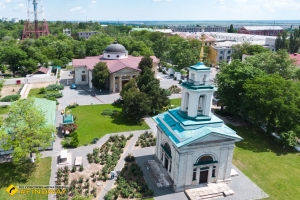

A city that Catherine II ordered named after the Greek Chersonesus — «so it would sound antique.» A city where Grigory Potemkin, the man who built it, is buried. A city in whose cemetery the English philanthropist John Howard died of typhus — the very man whose name is given to the British Howard League for Penal Reform. And — since 11 November 2022 — a city whose liberation Ukraine still celebrates as one of the most important victories of this war.
Kherson is not a tourist destination in the ordinary sense. It is not Lviv and not Odesa. It is a southern port city with an imperial past, a watermelon capital, a wide and unhurried river, and a very complicated present. Imagine: you stand on Potemkin Boulevard, looking at the Dnipro, and across the river is the occupied left bank. That is Kherson today.
⚠️ Current situation. The city has been under Ukrainian control since 11 November 2022, but is subject to daily artillery and drone strikes from the occupied left bank of the Dnipro. Tourist visits carry real risk to life. This article describes Kherson as it was and as it will be again. Before any visit, always check the situation through official sources and the Kherson Regional Military Administration.
City card
| Founded | 1778 (19 October — the fortress was laid) |
| Admin status | Regional capital of Kherson Oblast, Hero City of Ukraine |
| Historic land | Tavria (Northern Black Sea region, former Zaporizhian Freedoms) |
| Population | ~280 000 (pre-war estimate); significantly reduced now due to evacuation |
| Area | ~115 km2 |
| Main river | Dnipro (right bank) |
| Nickname | Watermelon capital, Hero City |
| Best time to visit | April–June, September–October; summers can reach +40 °C. Currently a front-line city — visit at your own risk |
In this article
- What kind of city is this, and why visit?
- Location and character
- History in brief
- Legends and mysteries
- Top sights of Kherson
- City itineraries
- Must-do in Kherson
- Frequently asked questions
What kind of city is this, and why visit?
Kherson was the first city the Russian Empire established on former Cossack lands in the second half of the 18th century. Not Mykolaiv, not Odesa, not Sevastopol — all of those came later. It was here that the «empire’s reach to the sea» began, and here that the first base of the Black Sea Fleet stood before it was moved to Sevastopol. The city was designed from the outset as a triangle: fortress — shipyard — admiralty. Everything else was built around it.
People came (and will come again) for three things. First — for «quiet imperial classicism»: wide straight streets, acacia-lined avenues, low-rise 19th-century architecture, the feeling of a southern city that hasn’t yet been spoiled by glass skyscrapers. Second — for the Dnipro: here the river is already calm and broad, preparing to flow into the estuary and the sea. Third — for watermelons and tomatoes, which became an all-Ukrainian brand in the 20th century and remain «the sweetest in the country.» And since 2022, there is a fourth reason: the sense of visiting a city that endured eight months of Russian occupation and came back. People come to see what courage looks like in daily life.
Location and character
Kherson stands on the right bank of the Dnipro, 25 km from the point where the river begins to branch into its delta, and 75 km from the estuary and the Black Sea. It is the last major urban point on the river’s route. Before 2022, it was where «lower Dnipro» tourist cruises began — with boat trips into the floodplains, to islands, and to the famous white herons and pelicans.
The city is flat (not hilly like Dnipro or terraced like Odesa), compact in the centre and spread wide on the outskirts. The main axis is Soborna Street, running from the Kherson Fortress Park through St Catherine’s Cathedral to Freedom Square. To the south: the Dnipro embankment and Glory Park. To the north: the industrial zone and river port.
When to visit. The best season is late April and September: acacia and steppe in bloom, not yet scorching. Summers here are long and very hot (+35–40 °C is not unusual); winters are mild with light snowfall. August watermelons are the peak of the city’s culinary calendar: hundreds of varieties at the markets, all sweet.
History in brief
Foundation in 1778 and the «Greek trace»
On 18 June 1778 Catherine II signed a decree establishing a fortress city at the mouth of the Dnipro. On 19 October of that year Prince Grigory Potemkin personally laid the foundations of the fortress on the right bank. The name was chosen deliberately: Potemkin insisted the city be called Kherson — after the ancient Greek colony of Chersonesus Taurica in Crimea. The logic was simple: an «antique» name would signal that this was not a new colony in wild steppe, but an heir to the Greek civilisation present here 2,000 years earlier. Potemkin was simultaneously constructing the toponymy of the South (Kherson, Sevastopol, Simferopol — all Greek names) and the political legitimacy of the new imperial territory.
First capital of the Black Sea Fleet
By 1784 Kherson already had a working shipyard, admiralty, and fortress with 220 cannon. The first large Russian warships for the new Black Sea Fleet were launched here. The city grew chaotically, with constant epidemics (mosquitoes from the Dnipro delta brought malaria — workers died in their thousands), but by the time of Catherine’s visit in 1787 Potemkin had managed to make it a respectable «parade» city. Nine years later, after Potemkin’s death and the conquest of Crimea, Sevastopol became the capital of the Black Sea Fleet, and Kherson gradually became a trading port.
19th–20th centuries: trade, watermelons, quiet
The 19th century turned Kherson into a quiet southern Ukrainian port. Grain and timber were loaded onto steamships heading down the Dnipro to the sea. In the early 20th century the Kherson region became the main supplier of watermelons and tomatoes for the whole empire — sandy soils and a hot climate produced unrivalled sweetness. In the Soviet era the city was industrial: shipbuilding, processing, light industry. Before 2022 Kherson was considered one of the most «quiet» regional centres in Ukraine — without particular tourist ambitions, with its own unhurried southern character.
2022: occupation and liberation
On 2 March 2022 Russian troops entered Kherson. The city became the first and only regional capital that Russia occupied in full during this war. Eight months of occupation meant six separate pro-Ukrainian underground groups, public rallies under the Ukrainian flag in the first weeks (despite armed occupiers), torture chambers in administrative buildings, attempts to stage a forced «referendum,» and the elimination of local activists. On 11 November 2022 Ukrainian forces entered Kherson. On Freedom Square the largest spontaneous outpouring of joy in Ukraine in decades erupted — with flags, embraces, and tears. President Zelensky arrived in the liberated city on 14 November.
The title «Hero City of Ukraine» was officially awarded to Kherson by Presidential Decree on 24 March 2022 — while it was still occupied. This was the first time in history that such a title had been awarded to an occupied city.
Legends and mysteries
1. Potemkin’s heart beneath the cathedral floor
Grigory Potemkin died on the steppe 40 versts from the city of Iasi on 5 October 1791 — of fever, in the middle of the road, having refused a carriage. A year later his body was brought to Kherson and buried in St Catherine’s Cathedral, which he had himself founded but had not lived to see completed. His heart, by his will, was placed separately — beneath the floor of the church, near the north wall. Over the following 70 years the grave was opened several times: first on orders from Paul I, who hated Potemkin and allegedly wanted to «scatter his remains,» then by descendants seeking relics. Today a symbolic tomb stands in the cathedral, and where the prince’s heart actually lies — no one knows precisely. Locals say: «In the city he founded.»
2. The English philanthropist who died in Kherson
In 1790 John Howard arrived in Kherson — the English philanthropist and prison reformer whose name today belongs to the celebrated British organisation the Howard League for Penal Reform. Howard was touring Europe and the Russian Empire, documenting the condition of prisons and hospitals. In Kherson he contracted typhus at the city hospital he was inspecting — and died there on 20 January 1790. His funeral was held with state honours on Catherine’s orders. Howard’s grave was preserved on the outskirts of Kherson until the 20th century. The British press of the time wrote: «The kindest man in England died saving prisoners in a city no one in London knows.»
3. The flags on the armoured vehicles of 11 November
A modern legend. On 11 November 2022, when Ukrainian forces entered liberated Kherson, a crowd gathered spontaneously on Freedom Square. The soldiers were no less astonished than the residents: a city that had been occupied for eight months, under Russian presence, might have been expected to fear even appearing on the square. But people brought out Ukrainian flags they had kept buried under floorboards, in jars of pickles, inside book covers, sewn into clothing belts. One woman produced a flag that had been sitting in her freezer inside a bag of dumplings. Blue-and-yellow ribbons were tied to Ukrainian armoured vehicles. Many wept. What is often called «the happiest day of modern Ukraine» lasted a few hours — until the first missile strikes from the left bank.
Top sights of Kherson
St Catherine’s Cathedral
St Catherine’s Cathedral is the oldest building in Kherson and the unofficial «soul» of the city. Founded in 1781 to a design by one of Catherine II’s court architects, consecrated in 1786. It is the burial place of Grigory Potemkin, interred here in autumn 1792, a year after his death. Inside: a Neoclassical interior, the prince’s tomb, 18th-century icons, and architectural solutions unusual for an Orthodox church — because Potemkin conceived it as an «imperial pantheon» of the South, not a parish church. Outside: white walls, a gilded cross, a single dome, a quiet square.
Kherson Fortress Park
Kherson Fortress Park is the central city park, laid out on the site of the 18th-century earthen defensive ramparts. This is where the very fortress with 220 cannon that Potemkin founded on 19 October 1778 once stood. Stone walls did not survive to the present day (the earthen fortifications gradually levelled with the terrain), but the Ochakiv and Moscow Gates have been preserved — the oldest surviving monuments in the city. Inside the park: alleys, benches, and a monument to Potemkin (whose head was repeatedly removed and replaced over recent years). A fine spot to imagine 18th-century Kherson.
Glory Park and the embankment
Glory Park and the Dnipro embankment form the southern edge of the centre, the city’s face towards the river. The park was laid out in the 1960s as a memorial to World War II soldiers: on the high bank stands a sculpture of a mother holding a wreath, looking out over the Dnipro. The embankment stretches for several kilometres and before 2022 was the main evening promenade for Kherson residents. Today it is one of the most dangerous spots in the city: the left bank across the river is occupied, and anyone on the embankment is within direct fire range.
Freedom Square. The central square of Kherson — the very one where crowds gathered to greet the Ukrainian Armed Forces on 11 November 2022. Before the war: the administrative centre with the City Council and Kherson Regional Military Administration, New Year trees, and official events. Now: a historic site of symbolic importance, a place of memory of liberation.
Kherson Regional Local History Museum. The largest museum in the oblast, with a collection spanning from Scythian times to the present. The archaeological exhibition features finds from Black Sea burial mounds and ancient colonies (Olvia is nearby, and Chersonesus finds are also held here). A separate hall covers the city’s founding and the Potemkin era. In 2022 the occupying administration attempted to transport part of the collections to the left bank and on to Russia — one of the most extensively documented wartime looting operations.
Shovkunenko Art Museum. Small in scale but high in quality, with a collection of Ukrainian 20th-century artists and Western European graphic art. Named after Kherson-born painter Oleksiy Shovkunenko (1884–1974), an academician who worked primarily in watercolour. In 2022 the occupiers also removed part of the collection.
Soborna Street. The city’s main historic street, lined with St Catherine’s Cathedral, the City Council, and a row of pre-revolutionary mansions. This is the Kherson where «nothing has changed since the 19th century»: acacias, low classical buildings, an unhurried southern pace.
Antonivka Bridge (destroyed). Before 2022: the only road bridge across the Dnipro in Kherson, connecting the right and left banks (the route to Oleshky, the Kinburn Spit, and Crimea). Russian forces destroyed the bridge in November 2022 as they retreated to the left bank. Now: a ruined structure jutting from the water, a symbol of the city’s severed connection with its left-bank suburb and the southern districts of the oblast.
Old Jewish Cemetery and John Howard’s Grave. On the outskirts of Kherson: the remains of the old 18th–19th-century city cemetery, with graves of the first residents, the Jewish community (before World War II Kherson was a large Jewish city), and the burial place of English philanthropist John Howard. Access is restricted due to proximity to a risk zone.
City itineraries
Kherson in one day (peacetime scenario)
Kherson Fortress Park with the Ochakiv and Moscow Gates → St Catherine’s Cathedral with Potemkin’s tomb → Soborna Street to Freedom Square → lunch (ideally with watermelons if in season) → Kherson Local History Museum → Glory Park and the Dnipro embankment. Core central programme in 6–7 hours.
Kherson and Kherson Oblast in two days (after victory)
Day 1 — city centre (itinerary above). Day 2 — right-bank Kherson Oblast: Stanyslavskyi Canyon (picturesque granite gorges), Holy Gregory Biziukiv Monastery in Chervonyi Maiak, ruins of the Turkish fortress Kyzikermen in Beryslav. Or: Kamianska Sich in the village of Respublikanets (one of the Cossack Siches).
«Imperial South» itinerary (3 days)
Kherson (fortress, cathedral, Potemkin’s tomb) → Mykolaiv (admiralty, observatory, naval history) → Odesa (port, opera house, Potemkin Steps). Three port cities that the Russian Empire established on former Cossack lands within 30 years (1778–1794). The chronology builds the imperial South by itself — and explains why this war eventually reached exactly here.
Post-liberation left-bank itinerary
Oleshky and the Oleshkivski Sands (160,000 ha of desert across the river) → Askania-Nova (zebras on the Ukrainian steppe, the world’s oldest steppe nature reserve) → Henichesk and the Pink Lake → Arabat Spit with Syvash Bay. The classic southern Ukraine tour — the kind millions of people made before 2022 and will make again after the territory is liberated.
Must-do in Kherson
- Stand at Potemkin’s tomb. In St Catherine’s Cathedral, in the very city he founded and never saw completed. One of the most important historical artefacts of southern Ukraine.
- Walk through the Ochakiv Gate. The earthen fortress is long gone, but the stone gates remain. The first Kherson residents passed through them in 1778. People still pass through them now.
- Visit Freedom Square. The same square where people greeted the Ukrainian Armed Forces on 11 November 2022. A place of memory without a memorial plaque — it doesn’t need one yet.
- Look at the destroyed Antonivka Bridge. It is powerful. It shows what the war has done to the physical geography of the city.
- Try a Kherson watermelon in season. August is peak time. At the Central Market (if open), from local vendors by the roadsides. This is not just «a fruit» — it is a different concept of sweetness.
- Eat Kherson tomatoes. The «Chumak,» «Bull’s Heart,» «Marusya» varieties — the kind you slice like bread and salt. None of that shop-bought rubbery taste.
- Buy a bottle of local wine from Prince Trubetskyi. A Nova Kakhovka winery with a tradition going back to the 19th century, famous across Ukraine (though Nova Kakhovka itself has been badly damaged by the war).
- Photograph the Watermelon Monument. Yes, this sculpture genuinely exists in Oleshky — the unofficial symbol of the watermelon capital.
- Walk Soborna Street in the evening. Pre-revolutionary mansions, acacias, silence. The Kherson that existed before 24 February 2022 — and will return.
- Listen to Kherson residents. The most important thing you can do here. The city carries a very deep and very restrained experience of occupation. Conversations with people who lived through eight months of it mean more than any museum.
Frequently asked questions
Is it safe to visit Kherson now?
The city has been under Ukrainian control since 11 November 2022, but is subject to daily artillery, mortar, and drone strikes from the occupied left bank of the Dnipro. Tourist visits are technically possible but carry real risk to life. Before any visit, check the situation through official sources, the Kherson Regional Military Administration, and State Emergency Service announcements. Most tour operators are not currently operating in Kherson.
What to see in Kherson in one day?
Kherson Fortress Park with the Ochakiv and Moscow Gates, St Catherine’s Cathedral with Potemkin’s tomb, Soborna Street, Freedom Square, Kherson Local History Museum, Glory Park and the Dnipro embankment. Core central programme: 6–7 hours.
Why is Kherson a Hero City?
The title was awarded by Presidential Decree on 24 March 2022 — for the resilience of residents during occupation, pro-Ukrainian rallies in the first weeks, and the organised underground resistance. The city was the only regional capital that Russia occupied in full during this war. It was liberated by Ukrainian forces on 11 November 2022.
Where is Grigory Potemkin buried?
In St Catherine’s Cathedral in Kherson. The prince died on 5 October 1791 on the steppe near Iasi (present-day Moldova); his body was brought to Kherson and buried in the cathedral he had himself founded but never seen completed. His heart, by his will, was placed separately beneath the floor of the church.
What happened to the Antonivka Bridge?
The Antonivka road bridge across the Dnipro — the only bridge connecting the right and left banks in Kherson — was destroyed by Russian forces in November 2022 as they retreated from the city. The ruined structure protrudes from the water and is a symbol of the city’s severed connection with its left-bank suburb and southern oblasts.
Why is Kherson called the watermelon capital?
The sandy soils and hot steppe climate of the Kherson region give watermelons maximum sugar content and intense flavour. Since the 19th century Kherson has been supplying watermelons across the empire and then across Ukraine. Before 2022 the oblast grew hundreds of thousands of tonnes a year. The «Kherson watermelon» brand is one of the most recognisable regional markers in the country.
What to bring back from Kherson as a souvenir?
In season: watermelons and tomatoes (if you can transport them). Local dried fruit, steppe honey, grape wine from Prince Trubetskyi of Nova Kakhovka (if available), printed souvenirs with the 11.11 liberation symbolism (currently popular). Books and periodicals from local publishers about the occupation and liberation.
Should you wait until Kherson is safe?
If the goal is tourism in the usual sense, then yes. The city is still a front-line city and that is not changing month to month. If the goal is solidarity, volunteering, documentation, or working with local initiatives, that is a different matter entirely — and Kherson is waiting for such people. In any case, a visit must be deliberate and coordinated with local authorities or volunteer organisations.
Kherson is the first city of the Russian Empire on former Cossack lands, the watermelon capital of Ukraine, and the city that became a symbol of liberation in this war. Potemkin is buried here; the English philanthropist died here; on 11 November 2022 people pulled flags out from under floorboards and out of freezers here.
Today it is dangerous to go to Kherson. But St Catherine’s Cathedral still stands. The Ochakiv Gate still stands. The Dnipro still flows. And when all this ends, the southern Ukrainian «imperial south» will be driven from Kherson to Odesa in three days, with watermelons on the roadside and the sea beyond the river.
JoomShopping Download & Support
Attention! Part of Ukraine was occupied during Russia's unfounded military aggression against us and other democratic countries!
russia is a terrorist country, russians are murderers, thieves and rapists.
Russia's unhuman aggression against Ukraine since 2014 has led to the loss of homes and lives not only of many Ukrainians, but also of citizens of other countries and nationalities.
We consider any military actions against any state in the 21st century unacceptable and stupid, but unfortunately the Russians do not think so, and therefore many democratic countries, including Moldova, Georgia and our homeland, suffer from barbaric aggression.
Therefore, until the occupied parts of Ukraine are demilitarized and returned to our state, we remind users about the real danger of visiting the territories occupied by russia.