


- You are here:
-
Sights by Regions

-
Vinnytsia region
- Vinnitsa
Vinnitsa





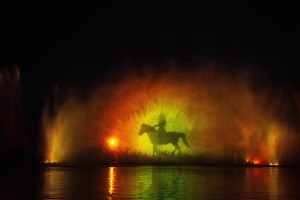


Imagine a city with Europe’s largest floating fountain — 97 metres on the water, with music, lasers and a jet that shoots 63 metres into the sky. Imagine that just outside this same city sits Hitler’s former personal headquarters, where he directed the Eastern Front for 156 days. And tucked away inside the city is the mummified body of the great surgeon Pirogov, open to visitors. All of this — in one regional capital on the Southern Buh river.
This is Vinnytsia. The capital of Podillia, the second-largest city on the Right Bank of Ukraine after Kyiv, and the unofficial capital of Ukrainian chocolate (this is the official home base of the Roshen brand). Over the past fifteen years, Vinnytsia has transformed from a quiet regional town into one of the country’s most dynamic destinations — with river lasers, multimedia wall projections, and a surprisingly bold culinary scene.
City at a glance
| Founded | First recorded — 1363 (as a Lithuanian fortress of Fedir Koriatovych) |
| Status | Regional capital of Vinnytsia Oblast |
| Historic region | Podillia (Bratslav land); historically the centre of the Bratslav Voivodeship of the Polish–Lithuanian Commonwealth |
| Population | ~370 000 |
| Area | ~113 km2 |
| Main river | Southern Buh |
| Nicknames | Capital of Podillia, city of Roshen, city of Pirogov |
| Best time to visit | May–September — for the fountain and parks; year-round — for museums and cathedrals |
In this article
- What kind of city is it and why people come
- Location and character
- History in brief
- Legends and mysteries
- Top attractions in Vinnytsia
- City itineraries
- Must-do in Vinnytsia
- FAQ
What kind of city is it and why people come
Vinnytsia is the second-largest city on the Right Bank after Kyiv — a regional capital of Podillia with an unusually high quality-of-life rating for a Ukrainian city. Over the past decade it has become a genuine tourist draw: the floating Roshen Fountain put it on Europe’s map, the restoration of the historic centre and riverfront made it worth lingering in, and the age-old combination of Podillian history and Podillian cooking made it one of the most «delicious» regional cities in the country.
People come for three reasons. First — to see the Roshen Fountain: Europe’s largest floating fountain, with a multimedia show, lasers and music. It runs every evening from May through October. Second — to walk Pirogov’s Vinnytsia: his estate, pharmacy, park and the church-mausoleum housing the mummified body of the great surgeon. Third — to peer into Podillia’s dark side: the ruins of Hitler’s «Werewolf» headquarters 8 km outside the city, the place where decisions that changed the course of World War II were made.
This is a city where the density of strange stories per square metre goes off the charts: a Lithuanian fortress from 1363, Polish churches, a Jewish quarter, Podillian Cossacks, Polish magnates, German occupation and a chocolate factory employing 26,000 workers. All of it contained in a compact walkable centre that is also excellent for coffee.
Location and character
Vinnytsia sits on the Southern Buh in the central part of the Podillian Upland. Kyiv is 250 km to the east, Lviv 360 km to the west, Odesa 430 km to the south. The city lies at the intersection of the E50 Kyiv–Chernivtsi highway and the E40 Chisinau–Kyiv road — making it one of the best-connected logistics points on the Right Bank.
Geologically the city sits on granite plateaus carved through by the Southern Buh. Along the river you find granite cliffs and escarpments, the most celebrated of which is Sabarivska Rock with its ancient settlement on the edge of the city, where people lived as far back as the 5th–7th centuries.
The historic core is compact and walkable: the Water Tower on European Square, a church, the wooden St. Nicholas Church, the riverfront — all within a single kilometre. You don’t need a car in the centre.
Best time to visit. The sweet spot is late April through mid-October. The Roshen Fountain runs from May to October — and for most visitors this is the anchor of the trip. May brings chestnut and apple blossom in the central parks. June–July offers full summer with river walks. August–September combines warm evenings with the fountain show at its best. In winter the city is quieter, but all museums and cathedrals are open.
History in brief
Lithuanian fortress and Polish period
The first mention of Vinnytsia dates to 1363, in Lithuanian sources. The city was founded by Prince Fedir Koriatovych, nephew of Grand Duke Gediminas of Lithuania, as a frontier fortress against the Tatars. Slavic settlements already existed on this territory (Sabarivka hillfort proves habitation in the 5th–7th centuries), but it was the Lithuanians who turned the site into a fortified town. During the 15th–16th centuries the fortress was burned by the Tatars several times; each time it was rebuilt.
In 1569 Vinnytsia joined the Polish–Lithuanian Commonwealth and became the centre of the Bratslav Voivodeship. Churches, monasteries and noble residences were built. In 1672, after the Treaty of Buchach, the city passed to the Ottoman Empire for 27 years — a brief but historically significant episode. It returned to Poland in 1699.
The Russian Empire and Pirogov
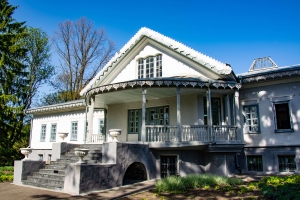
In 1793, after the Second Partition of Poland, Vinnytsia passed to the Russian Empire and became the centre of Podillia Governorate. During the 19th century the city developed as a typical imperial provincial capital. In 1861 Mykola Pirogov — the genius of Russian surgery, the founder of field surgery and anaesthesiology — moved here. He bought the «Vyshnia» estate 4 km from the centre, built a house, pharmacy and park, and lived and worked here for 20 years until his death in 1881. Pirogov’s body was mummified and remains in its church-mausoleum in Vinnytsia to this day.
The 20th century: tragedies and revival
In the 20th century Vinnytsia lived through all the major dramas of Ukrainian history. In 1932–1933 — the Holodomor: the villages of Podillia lost a significant share of their population. In 1937–1938 — mass NKVD executions, later known as the Vinnytsia Tragedy: when Soviet forces retreated in 1943, the Germans uncovered mass graves with the remains of at least 9,000 victims on the city’s outskirts. In 1941–1944 — German occupation; in a pine forest in Stryzhavka, 8 km from the city, they built Hitler’s personal «Werewolf» headquarters, where the Führer spent 156 days in 1941–1942. Almost the entire Jewish population of the city (over 15,000 people) was murdered in the Holocaust.
After the war: an industrial Soviet centre, machine-building, leather and confectionery industries. In 1996 Petro Poroshenko — later Ukraine’s president (2014–2019) — founded Roshen on the basis of the Vinnytsia confectionery factory. It went on to become Ukraine’s largest confectionery brand.
The 21st century and the 2022 war
Through the 2000s Vinnytsia became one of the country’s most dynamic regional centres. In 2011 the Roshen Fountain opened on the Southern Buh — and immediately became the city’s main tourist magnet. The historic centre, riverfront and parks were restored. The city consistently ranked in the top five for quality of life in Ukraine.
2022. Russian forces did not enter Vinnytsia Oblast directly. But the city suffered a devastating missile strike on 14 July 2022: three Kalibr cruise missiles hit the city centre in broad daylight, destroying the Yuniist office building, a medical centre and a car park. Twenty-seven people were killed, among them four-year-old Liza, whose image went around the world. The strike site is now a memorial «Liza’s Square» on Kosmonavtiv Avenue. A year later the historic centre had been fully restored.
Mykola Pirogov’s body is one of only three publicly displayed mummies in the world (alongside Lenin in Moscow and Ho Chi Minh in Hanoi). The mummification was carried out within five days of his death in 1881; since then the body has undergone three major re-embalming procedures (1945, 1995, 2024). The body lies in the Church-Mausoleum of St. Nicholas the Wonderworker in Vinnytsia, open to visitors. It is one of the most surreal «tourist sites» in Ukraine.
Legends and mysteries
1. The underground tunnels of Lityn and Vinnytsia
The old cellars of Vinnytsia are connected by a branching network of underground passages dating from the 16th–18th centuries. The most famous is said to run from the Church of the Holy Virgin of the Angels to the former Jesuit collegium, now part of the old town complex. In the 19th century parts of the tunnels were used by smugglers; in Soviet times they were sealed. Today only isolated fragments survive; the full network has never been opened. Sceptics say: underground tunnels are standard in every Polish-era city — nothing special. Romantics insist the Vinnytsia passages stretch all the way to Lityn, 45 km away.
2. The Yushchenko Psychiatric Hospital and its ghosts
The Vinnytsia Psychiatric Hospital named after O. I. Yushchenko is one of the oldest and largest in Ukraine (founded 1897), set in a picturesque park of century-old oaks. Among urban explorers and local romantics it has spawned legends of «a secret NKVD laboratory», «a floor where voices are heard», and «a nurse in white who walks at night». All typical urban folklore; the real history of the institution is connected with the distinguished Ukrainian psychiatrist Oleksandr Yushchenko (not to be confused with the president). The park is open to the public.
3. Sabarivka hillfort and the bell of the Slavs
On Sabarivska Rock above the Southern Buh stood a Slavic hillfort from the 5th–7th centuries — one of the oldest in Podillia. Archaeological evidence suggests the settlement perished in a fire, probably during a nomadic raid. Local legend holds that before the attack the inhabitants buried a large bronze bell, guarded for millennia. On certain nights of the year, so the story goes, the bell can be heard from the cliff — muffled, from underground. Archaeologists have dug; the bell was never found. Other artefacts were.
Top attractions in Vinnytsia
Roshen Fountain — Europe’s largest floating fountain
The Vinnytsia Roshen Fountain is the city’s top tourist attraction and one of the largest in Ukraine. Dimensions: 97 metres long, jet up to 63 metres. It doesn’t sit on the riverbed — it floats on a special platform (sunk under the ice each winter, raised each spring). A multimedia show with music, lasers and video projections onto the water jets runs every evening from May through October, every hour after sunset. Free entry.
The mausoleum with Pirogov’s mummy
The Church-Mausoleum of Mykola Pirogov in the Pyrohovo settlement (3 km from the centre) is a truly unique place: the mummified body of the great surgeon, on display in a glass sarcophagus. The mummification was carried out within five days of his death in 1881, and the body has survived 145 years. Alongside it: the «Vyshnia» estate with the Pirogov Museum, pharmacy and park. One of the most surreal spots in Podillia.
The Water Tower — memorial museum of fallen soldiers
The Water Tower on European Square (1912) is the symbol of Vinnytsia — a red-brick neo-Gothic tower in the city centre. Today it houses a memorial museum dedicated to soldiers killed in the war in eastern Ukraine and the 2022–2025 war. Inside: an exhibition of photographs of the fallen, personal effects and letters from the front. One of the most powerful memorials in modern Vinnytsia.
Hitler’s «Werewolf» headquarters
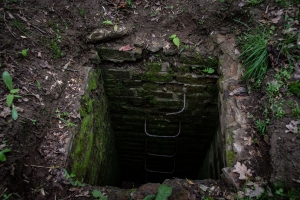
The ruins of Hitler’s «Werewolf» headquarters in the pine forest of Stryzhavka (8 km from Vinnytsia) are the remains of Hitler’s personal Eastern Front HQ, where he spent 156 days in 1941–1942. Today: a few fragments of concrete structures (the Germans blew up most of it when they retreated in 1944), a memorial and information panels. A sombre place, but essential for understanding World War II. The drive from Vinnytsia takes 15–20 minutes.
The Church of the Holy Virgin of the Angels
The Church of the Holy Virgin of the Angels is Vinnytsia’s oldest Catholic church, founded in the 17th century by the Dominicans. Baroque-classical facade, a pipe organ, icons including survivals from the Jesuit period. In the 19th–20th centuries it went through successive phases — church, warehouse, Soviet sports hall, church again from the 1990s. One of the key landmarks of the old town.
The wooden Church of St. Nicholas
The wooden Church of St. Nicholas (1746) is a rare surviving example of Ukrainian wooden religious architecture in Podillia. Three-nave construction, built without metal nails, with distinctive Podillian tent roofs. It stands in the heart of the historic old town. One of the few places in Vinnytsia where you can physically feel the 18th century.
Sabarivska Rock and ancient settlement
Sabarivska Rock with its ancient settlement on the right bank of the Southern Buh is one of the oldest Slavic settlements in Podillia (5th–7th centuries). A 20-metre granite cliff with a viewpoint; the base of the cliff is a good spot for a picnic. Archaeological digs have uncovered ceramic fragments, jewellery and bone implements. The destination for those who want to see prehistoric Ukraine.
The «Happy Hour Parlour» café-museum
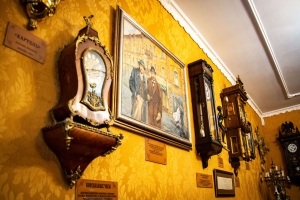
The «Happy Hour Parlour» café-museum (Pan Zavarkin and Son shop-museum) is one of the most original places in Vinnytsia. The interior evokes a pre-revolutionary pharmacy and tea room, with genuine 19th–20th-century exhibits: crockery, clocks, advertising, furniture. You can drink your coffee surrounded by a real museum. A unique Vinnytsia gem with few equivalents anywhere in Ukraine.
The park of the Yushchenko Psychiatric Hospital
The park of the Yushchenko Psychiatric Hospital (founded 1897) is not just a hospital garden — it is one of the most beautiful parkland ensembles in Vinnytsia: century-old oaks, lime-tree avenues, ponds. The hospital buildings are a fine example of late-19th-century medical architecture. The park is open for visits, walks and photography. The atmosphere is peaceful, with a pleasantly old-world feel.
The old town and the Southern Buh embankment
The old town of Vinnytsia is a compact historic core around the Water Tower, with 19th–early 20th-century facades, small shops, craft workshops and open terraces. The main pedestrian axis is Soborna Street. The Southern Buh embankment is the city’s best spot for evening strolls, especially with the Roshen Fountain as a backdrop. Along it you’ll find cafes, bars, the Pan Zavarkin café-museum and the drama theatre.
City itineraries
Itinerary 1. Vinnytsia in one day — the classics
Morning — the Water Tower memorial museum, the Church of the Holy Virgin of the Angels, the wooden St. Nicholas Church. Lunch in the centre. Afternoon — head out to Pyrohovo: Pirogov’s church-mausoleum with the mummy and the «Vyshnia» estate museum. Sunset and evening — on the embankment for the Roshen Fountain.
Itinerary 2. Vinnytsia in two days — with Werewolf
Day 1 — as itinerary 1. Day 2 morning: drive out to Werewolf (8 km). Return to centre for lunch. Afternoon — Sabarivska Rock and a walk along the Southern Buh embankment. Evening — the Pan Zavarkin café-museum for a historically atmospheric coffee.
Itinerary 3. Dark Vinnytsia — for lovers of 20th-century history
A thematic route through the tragedies of the 20th century. Werewolf in the morning. The memorial to victims of the Vinnytsia Tragedy (NKVD mass shootings, 1937–1938) in the city park. The «Liza’s Square» memorial on Kosmonavtiv Avenue — site of the missile strike on 14 July 2022. The memorial museum in the Water Tower — remembering those killed in the 2014–2025 war.
Itinerary 4. Podillian gardens and parks
A route for those visiting in May–June. The Yushchenko Hospital park with its century-old oaks → the Pirogov estate museum with its 100-hectare park → the central Gorky Park → the Southern Buh embankment. All in bloom with chestnuts and apple trees.
Itinerary 5. Vinnytsia and the region — a weekend
A two-day trip. Day 1 — Vinnytsia as per itinerary 1. Day 2 — choose: Tulchyn with the Potocki Palace (90 minutes’ drive), Mohyliv-Podilskyi with the Liadova cave monastery above the Dnister (2 hours), or Busha with its Cossack fortress (3 hours).
Must-do in Vinnytsia
- Watch the Roshen Fountain show at night — one of the finest public audio-visual installations in Europe. Free, every hour after sunset.
- Step inside Pirogov’s mausoleum — stand before the mummified body of the great surgeon, displayed for visitors. A singular experience.
- Climb the observation deck of the Water Tower — the classic view over central Vinnytsia.
- Stand at «Liza’s Square» on Kosmonavtiv Avenue — site of the missile strike on 14 July 2022. Part of the city’s living memory.
- See the ruins of Werewolf in the pine forest of Stryzhavka — history that is hard to read but important to witness.
- Have coffee at Pan Zavarkin’s in a 19th-century drawing room — one of the most atmospheric cafes in Ukraine.
- Buy Roshen chocolate at the factory shop in Vinnytsia — the freshest batch, around 30% cheaper than shops.
- Try Podillian borscht with beans at an authentic restaurant in the centre.
- Order «kidneys Podillian-style» — the local dish that will make you a defender of kidney cookery for at least one day.
- Stroll pedestrianised Soborna Street in the evening — the best way to feel the rhythm of modern Vinnytsia.
- Photograph the Roshen Fountain from the bridge over the Southern Buh — the classic Vinnytsia shot.
Mykola Pirogov was not just a surgeon. He was the founder of field surgery and anaesthesiology as a science. In 1847 he was the first person in the world to apply ether anaesthesia on the battlefield (Caucasian War); in 1855 he developed the plaster cast for fractures (Crimean War) and created the triage system still in use today. Without Pirogov, modern military medicine would look entirely different. And all of this was done by a Ukrainian doctor who spent the last 20 years of his life in Vinnytsia.
Frequently asked questions
What to see in Vinnytsia in one day?
Classic itinerary: morning — the Water Tower, the Church of the Holy Virgin of the Angels, St. Nicholas Church; lunch; afternoon — Pirogov’s mausoleum with the estate; evening — the Roshen Fountain. Everything fits in 8–9 hours.
What to see in Vinnytsia in two days?
Add to the first-day itinerary: the Werewolf ruins, Sabarivska Rock, the Pan Zavarkin café-museum and the Yushchenko Hospital park. On a third day: a trip to Tulchyn (Potocki Palace) or Mohyliv-Podilskyi with the Liadova cave monastery.
Is Vinnytsia safe to visit now?
Yes, with caveats. Vinnytsia is a rear-area city that has not been occupied. However, in summer 2022 it suffered a devastating missile strike on the city centre (14 July 2022, 27 killed). Periodic strikes on infrastructure still occur. Before travelling, check the current situation via the «Air Alert» app.
How does the Roshen Fountain work?
Season: May through October. Shows run every evening, starting at sunset, every hour until 23:00–midnight (check the exact schedule on site). Free admission. Best viewing spots: from the pedestrian bridge over the Southern Buh, from the embankment near the Mahirand shopping centre, from the parapet beside the fountain. In winter the fountain is submerged under ice (the platform is lowered).
What to do with kids in Vinnytsia?
The Roshen Fountain — essential, kids love it. Sabarivska Rock for outdoor adventure. The Yushchenko Hospital park with century-old oaks. Pirogov’s mausoleum with the mummy — for older children who are prepared. The central culture park with rides.
What to do in Vinnytsia in the evening?
The Southern Buh embankment with the Roshen Fountain — unquestionably #1. Pedestrianised Soborna Street with its cafes and bars. The Pan Zavarkin café-museum for a historically themed coffee. Concerts at the drama theatre or organ services at the Church of the Holy Virgin of the Angels.
What are the most famous dishes of Vinnytsia?
Podillian borscht with beans and beetroot, kidneys Podillian-style (the region’s signature dish), varenyky with potato and cracklings, kholodets (meat jelly), varenukha (spiced fruit drink), apple uzvar from local orchards. And, of course, Roshen chocolate from the factory shop — the freshest batch, straight from the factory, 30% cheaper than in shops.
What to bring back from Vinnytsia as a souvenir?
Roshen chocolate straight from the factory shop (the classic). Fridge magnets featuring the fountain and the Water Tower. Podillian honey from local apiaries. Varenukha and apple liqueurs. Books about Pirogov or photo albums of Vinnytsia. For World War II enthusiasts — a guidebook to the Werewolf site.
Vinnytsia is a city that bears no resemblance to «provincial Ukraine». A river laser, Pirogov’s mummy, a restored historic centre, cafes with stained glass and a drama theatre — all of it 250 kilometres from Kyiv, without tourist queues and without hotel mark-ups. This is a regional city that made a leap to European quality over the past fifteen years without losing its Podillian character.
If you’re choosing one Ukrainian regional city for a weekend trip — choose Vinnytsia. The Roshen Fountain runs every evening. Pirogov is waiting in his mausoleum. The Podillian borscht is already on the stove.
JoomShopping Download & Support