


- You are here:
-
Sights by Regions

-
Vinnytsia region
-
Vinnitsa
- Church-tomb of Pirogov, Vinnitsa

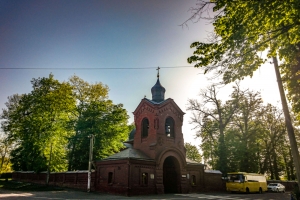


For nearly one hundred and forty years, in a glass sarcophagus beneath a church in Vinnytsia, lies the embalmed body of the man who changed surgery forever. This is no museum replica — these are the genuine remains of Mykola Pirogov.
The Pirogov Church-Mausoleum is the centrepiece of the National Museum-Estate «Vyshnia» and one of Vinnytsia’s most extraordinary sites: a church beneath which the body of a great surgeon has rested for over a century.
Location card
| Location | south-western Vinnytsia, Vyshnia Estate |
| What it is | church-necropolis containing Pirogov’s sarcophagus |
| Church built | 1885, consecrated to St Nicholas |
| Time needed | 1–2 hours (including the museum) |
| What to bring | camera, respect for the site, and time to enjoy the park |
What it is and why visit
Mykola Pirogov (Nikolai Pirogov) was a brilliant surgeon, anatomist and the founder of military field surgery, who spent the last twenty years of his life (1861–1881) here at the Vyshnia estate outside Vinnytsia.
This is a hidden gem where science meets the uncanny: a church beneath which the embalmed body of the scholar lies in a sarcophagus. It is one of the very few embalmed bodies of this age preserved anywhere in the world — and at the same time a place of remembrance for a man who saved thousands of lives. The estate is rightly called a jewel of Vinnytsia’s tourism and one of the «seven wonders» of the region.
Pirogov’s body was embalmed on the fourth day after his death — and has been preserved in the sarcophagus for over one hundred and thirty years.
History: the estate, the death and the embalming
Pirogov purchased the Vyshnia estate (then the village of Sheremetka near Vinnytsia) in 1859 at an auction in Kyiv, from the heirs of a Dr Hrykolevskyi. Here he spent his final two decades: receiving patients, operating and writing.
After the surgeon’s death in 1881, his body was embalmed on the fourth day by the St Petersburg physician D. I. Vyvodtsev. In 1885 a church designed by architect V. I. Sychuhov was built above the family mausoleum and consecrated to St Nicholas the Wonderworker. Church and mausoleum became a single whole.
A special chapter belongs to the Soviet era. On 27 October 1944, shortly after Ukraine’s liberation, a government decree was issued to perpetuate Pirogov’s memory: a museum was established at Vyshnia and the preservation of the surgeon’s body was placed under state care. Since then, specialist commissions have periodically renewed the embalming.
What to see on site
The Church-Mausoleum. The main attraction: the 1885 church whose lower level contains the sarcophagus with Pirogov’s embalmed body.
The memorial house-museum. The house where Pirogov lived and worked, with period-accurate interiors.
The pharmacy-museum. Period consulting room and operating theatre — an immersive glimpse of 19th-century medicine.
The memorial park. Historic estate greenery linking all parts of the complex into a single walk.
How to get there
By car. The museum-estate is in the south-western part of Vinnytsia. Follow signposts to the Pirogov Museum; parking is available nearby.
By public transport. City buses run from Vinnytsia centre to the museum — it is one of the city’s best-known attractions and easy to find.
Combine with Vinnytsia. A visit to the estate pairs naturally with a walk through the city — from the musical fountain to the historic quarters.
Traveller’s checklist
- Museum hours: check in advance, especially during the current wartime period.
- Respect for the site: the mausoleum is both a grave and a place of worship.
- Time for the full complex: museum, pharmacy, church and park together deserve several hours.
- Camera: the church and park are photogenic (ask about photography rules inside).
What NOT to do: treat the sarcophagus as a tourist attraction — this is a place of remembrance where quiet and respect are appropriate.
Frequently asked questions
Is Pirogov’s body really there?
Yes. The embalmed body of the surgeon is preserved in a sarcophagus beneath the church; specialist commissions renew the embalming periodically. The original embalming was performed in 1881.
What does the museum complex include?
The house where Pirogov lived, a pharmacy-museum with a period consulting room and operating theatre, the church-necropolis with the sarcophagus, and a memorial park.
Is it suitable for children?
Yes, but it helps to explain beforehand that this is both a museum and a burial site. The 19th-century medicine exhibits tend to fascinate school-age children.
The Pirogov Church-Mausoleum is a place where science and memory intersect in the most literal sense: beneath this church, for over a century, rests the man who taught the world to operate differently.
Visit the Vyshnia estate, walk through the house, the pharmacy and the park — then step into the mausoleum for a quiet moment with the person whose name medicine will never forget.
JoomShopping Download & Support