


- You are here:
-
Sights by Regions

-
Rivne region
- Rivne
Rivne




Imagine a city that was a capital three times in a single century — and never once by its own choosing. Rivne was «designated» a centre first by the Directorate of the Ukrainian People’s Republic, then by the Nazi Reichskommissariat, then by Soviet administration. The city survived each time, rebuilt, and returned to what it truly is — a calm regional centre of Volhynia that has no appetite for pomp.
People do not come here to tick a box. Rivne opens itself to those prepared to scratch the surface: behind restrained facades hide a Neo-Gothic church with an organ, underground passages from the 18th century running beneath the very heart of the city, and Ukraine’s only amber museum. This is a city you have to read between the lines.
City at a glance
| Founded | 1283 (first written mention in the Galician-Volhynian Chronicle and the Krakow Chronicle) |
| Admin status | Regional capital of Rivne Oblast |
| Historic land | Volhynia |
| Population | ~245,000 (noticeably higher since 2022 with internally displaced persons) |
| Area | ~63 km2 |
| Main river | Ustya; to the south — Basivkutske Lake |
| Nickname | Unofficial «amber capital» of Ukraine |
| When to visit | Year-round. May–September for parks and walks; cool season for organ evenings and museums |
In this article
- What kind of city this is and why people come
- Location and character
- History in brief
- Legends and mystique
- Top sights of Rivne
- City routes
- Things you must do in Rivne
- FAQ
What kind of city this is and why people come
Rivne is a crossroads city. It sits almost exactly halfway between Lviv and Kyiv, and for centuries it was more of a transit point than a destination in its own right. Tourist buses traditionally drive straight through it — onward to the Tunnel of Love, to Ostroh, to Dubno. More fool them.
Because Rivne has something louder neighbours lack: no queues and no tourist noise. Here you can listen to an organ in a half-empty hall, descend into dungeons without elbowing through crowds, and drink coffee on the pedestrian street without anyone hurrying you along. Rivne is a city for those who have seen enough of over-promoted locations and want an unvarnished, unfiltered regional centre.
People come for three things. First — organ music in a former Neo-Gothic church. Second — underground Rivne: passages and casemates beneath the centre, shrouded in legend since the days of Korolenko. Third — amber: Rivne Oblast sits atop one of the largest deposits of «sunstone» in Europe, and Ukraine’s only amber museum is right here.
Location and character
The city spreads along the banks of the Ustya river — small, quiet, in places almost imperceptible. To the south the Ustya widens into Basivkutske Lake, around which a whole recreational area called Basiv Kut has grown, with beaches and rowing boats. The terrain here is genuinely flat — which, by one theory, gave the city its very name (rivne means «level» in Ukrainian).
The centre of Rivne is compact and walkable. The main axis is Soborna Street, which runs from the railway station to the heart of the city past most of the key buildings. Everything important fits into an hour’s leisurely walk, making a car in the centre more hindrance than help.
When to visit. Rivne is comfortable year-round but has its seasons. May–September is the time for parks, Swan Lake and evenings on Soborna. Golden autumn settles beautifully on the old squares. But the cool season is paradoxically the best time for Rivne: when it is grey and wet outside, the city retreats into its concert hall for the organ and into its museums — of which there are surprisingly many for a regional centre of this size.
History in brief
Rivne is first mentioned in 1283 — as a settlement of the Galician-Volhynian state. According to tradition, the fortification on level ground above the Ustya was built by Volhynian prince Volodymyr Vasylkovych, nephew of Danylo Halytsky. What followed: the Grand Duchy of Lithuania, the Polish-Lithuanian Commonwealth, an endless succession of owners — the Nesvytski, the Ostrozki, the Zamoyski.
The turning point came in 1731, when the princes Lubomirski took possession of the town. They transformed provincial Rivne into a residence: they built a Baroque palace, laid out a park with fishponds, a pheasantry and even an artificial «Vesuvius volcano» for the entertainment of guests. The Lubomirskis owned Rivne for nearly two centuries and left the city its defining myth — of underground passages beneath the palace.
In the 19th century a student at Rivne’s Real Gymnasium was Volodymyr Korolenko — the very writer whose childhood memories of the city formed the basis of the story «In Bad Company» (also known as «Children of the Underground»). Underground Rivne entered Ukrainian literature from his pen.
The 20th century was brutal. World War I, the Polish period, World War II with the Nazi occupation and the destruction of the city’s large Jewish community. In 1941 the Nazis made Rivne the capital of the Reichskommissariat Ukraine — the administrative centre of all occupied territory. Soviet and Ukrainian underground networks operated here; the spy Mykola Kuznetsov ran his famous operation here. After the war — decades under the name «Rovno,» and only on 11 June 1991 was the historic Ukrainian name Rivne restored.
Rivne is one of the few cities in Ukraine to have served as an administrative «capital» three times: under the Directorate of the UNR, under the Nazi Reichskommissariat, and under Soviet rule. Every time — against its own will.
Legends and mystique
A city without a myth is just an address. Rivne has three myths, and all of them lead, one way or another, underground.
1. Where the name came from
The most popular legend goes: when the prince was choosing a site for a fortification, the guide pointed to the wide treeless valley above the Ustya and said — «the land here is level.» And the name stuck. Romantic, but historians lean toward the more prosaic: the name does indeed derive from the word for «flatland» — the surrounding terrain is remarkably flat. A lesser-known version derives the name from a «level» spot between two hills. Whatever the truth, Rivne is one of the few Ukrainian cities whose name honestly describes the landscape.
2. Korolenko’s underground Rivne
As far back as the late 19th century, Volodymyr Korolenko wrote of an entire network of passages running beneath Rivne. Researchers today still suppose that a tunnel 5–7 metres deep ran from the area near what is now the gymnasium, under the Ustya river, to the ruins of the Lubomirski Palace in the centre. By tradition these passages were used for escape routes during sieges, for hiding treasure, and — inevitably — for secret rituals. Part of the Lubomirski estate’s underground has now been excavated and opened to visitors. The rest is still beneath the feet of Rivne’s residents.
3. The swans of the last princess
Swan Lake in the city park is a remnant of the old Lubomirski pond. Local legend has it that the last princess of the family loved her swans so dearly that, when leaving the estate forever, she asked the birds to «watch over the city in her place.» Since then, people say, as long as swans live on the lake, nothing bad will befall the city. Feeding the swans here is therefore not just entertainment for children but a local ritual for good fortune.
Top sights of Rivne
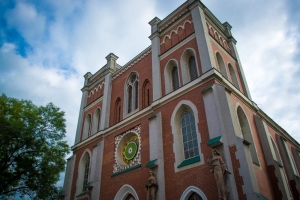
St Anthony’s Church and the Chamber and Organ Music Hall
The city’s chief architectural gem. The Neo-Gothic St Anthony’s Church was built at the turn of the 19th and 20th centuries — with towers, sharp spires and one of the finest organs in Europe at the time. Two world wars took both the spires and the original organ. What survived was the acoustics: in the 1980s the building was converted into a concert hall, a new organ installed — and now Bach and Baroque music sound here every week. Hearing the organ in Rivne costs less than in Lviv, with exactly the same impact. See the Chamber and Organ Music Hall.
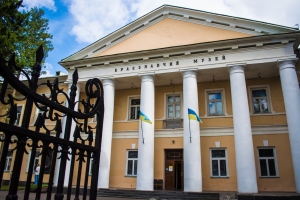
Rivne Regional Local History Museum
One of the oldest museums in Volhynia — founded in 1906, its modern collection built up thanks to Baron Shteinhel. Everything is here: from the archaeology of the Galician-Volhynian period to Polissia ethnography, weapons, icons and documents from occupied Rivne. The best place to understand Volhynia in an hour. See the Regional Local History Museum.
Amber Museum
Ukraine’s only museum devoted entirely to «sunstone.» Rivne Oblast sits atop one of the richest amber deposits in Europe, and here you can see pieces of resin over 40 million years old, the largest weighing nearly two kilograms. Among the exhibits: a unique amber crown and a «Kobzar» embroidered in amber. Small but absolutely unique. The Amber Museum does not yet have its own page on the site.
Lubomirski Palace excavations and dungeons
Of the once-splendid Baroque Lubomirski Palace, mainly foundations and the underground section have survived to the present day — a system of vaulted chambers archaeologists have excavated and conserved. This is the physical «entry point» to all the legends of underground Rivne: you can descend and see with your own eyes what Korolenko wrote about. See the Lubomirski Palace excavations.
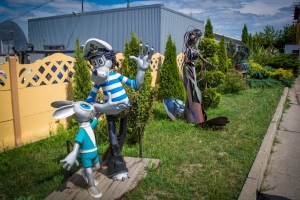
Art Gallery of Farriery and Museum of Steel Shapes
The city’s most unexpected location. Rivne blacksmiths have created an entire park of metal sculpture — from dragons and knights to wry scenes of everyday life. This is the rare case of a «museum» that works equally well for adults, children and people who do not normally like museums at all. See the Art Gallery of Farriery.
Resurrection Cathedral. The city’s main Orthodox church, built in 1895 in a Neo-Byzantine style on the site of an older wooden church founded by Princess Maria of Rivne. A landmark visible from almost everywhere in the centre. Not yet given its own page on the site.
Dormition Church. The oldest surviving building in Rivne — a wooden church of 1756 in the style of Volhynian vernacular architecture. The date is confirmed by an inscription preserved on the door. A quiet, almost village-like corner of the old city. No separate page on the site yet.
Shevchenko Park and Swan Lake. A large city park of over 30 hectares — a designated landscape heritage site. Its heart is Swan Lake, a remnant of the Lubomirski estate, with the swans that legend says protect the city. No separate page on the site yet.
Rivne Zoo. One of the largest zoos in western Ukraine, with genuinely spacious enclosures and a shaded grounds. A reliable programme stop when travelling with children. See the Rivne Zoo.
Basiv Kut and Basivkutske Lake. The southern edge of Rivne, where the Ustya river widens into a lake. In summer it is the city beach and rowing-boat hire; in any season a peaceful walking area with the remains of an old fortification. No separate page on the site yet.
City routes
Route 1. Rivne in one day (must-see essentials)
Start on Soborna Street and at the Resurrection Cathedral. Then — the Regional History Museum for context, then descend into the Lubomirski Palace dungeons. Lunch in the centre — and afternoon at an organ concert in St Anthony’s Church. If time allows — an evening walk through Shevchenko Park to Swan Lake.
Route 2. Rivne in two days (full)
Day 1 — as in Route 1: Soborna, Regional History Museum, Lubomirski dungeons, organ at St Anthony’s Church. Day 2 — Amber Museum, Dormition Church, Art Gallery of Farriery and Basiv Kut. Give the second half of the afternoon to a trip to Klevan for the Tunnel of Love — just 25 km from the city.
Route 3. Sacred and underground Rivne
A route for those who love churches and mysteries: Resurrection Cathedral → Dormition Church of 1756 → St Anthony’s Church with organ → Lubomirski Palace dungeons. Four eras and three confessions in a single walkable day.
Route 4. Rivne with kids
Rivne Zoo in the morning → Art Gallery of Farriery with the Museum of Steel Shapes → Shevchenko Park to feed the swans on the lake → in summer — beach and rowing boats at Basiv Kut. A day without queues, museum boredom or «don’t run.»
Things you must do in Rivne
- Hear the organ in St Anthony’s Church — Neo-Gothic architecture, Baroque music and a ticket cheaper than a coffee with dessert.
- Descend into the Lubomirski dungeons and see with your own eyes the «underground Rivne» that Korolenko wrote about.
- See the amber crown in the Amber Museum — a stone 40 million years old looks unexpectedly warm.
- Feed the swans on Swan Lake in Shevchenko Park — the local ritual for the city’s good fortune.
- Walk Soborna Street from the station to the centre — the quickest way to «read» the city.
- Photograph the iron dragon in the Art Gallery of Farriery — Rivne’s blacksmiths know how to put humour into metal.
- Try Volhynian potato pancakes and bean borshch — Polissia cooking is hearty, simple and honest.
- Step into the Dormition Church of 1756 — the oldest wooden building in the city, a quiet corner of old Rivne.
- Buy an amber souvenir — a necklace, pendant or simply a raw piece of resin from the local deposit.
- Take a half-hour trip out of town — to Klevan for the Tunnel of Love, if travelling in the warm season.
- Stroll Basiv Kut at sunset — water, silence and the remains of the old fortification.
Rivne is home to Ukraine’s only amber museum. The largest exhibit is a piece of resin weighing nearly two kilograms. For comparison: it is roughly like holding a brick in your hands — one that is 40 million years old.
FAQ
What to see in Rivne in one day?
The essential circuit: Soborna Street and the Resurrection Cathedral → Regional History Museum → Lubomirski dungeons → organ concert at St Anthony’s Church → Shevchenko Park.
What to see in Rivne in two days?
Day one — the city centre (Soborna, museums, dungeons, organ). Day two — Amber Museum, Dormition Church, Art Gallery of Farriery, Basiv Kut, and in the afternoon a trip to Klevan for the Tunnel of Love.
Where to go in the evening in Rivne?
To an organ concert at St Anthony’s Church or to the Rivne Music and Drama Theatre. For a walk — evening Soborna Street and Shevchenko Park with the illuminated Swan Lake.
Where to take kids in Rivne?
Rivne Zoo, Art Gallery of Farriery with the Museum of Steel Shapes, Shevchenko Park with the swans, and in summer the beach at Basiv Kut.
Is Rivne safe to visit now?
Rivne is a western rear-area city, far from the front line. Occasional missile strikes on infrastructure (energy facilities) occur; tourist locations have not been affected. Before your trip, monitor air-raid alerts via the official «Air Alarm» app.
What is the best season to visit Rivne?
May–September for parks, Swan Lake and Basiv Kut; golden autumn is lovely for walks. The cool season is surprisingly rewarding — that is precisely when the organ and the museums are at their best.
What are Rivne’s most famous dishes?
Volhynian-Polissia classics: potato pancakes (deruny) with sour cream, bean borshch, holubtsi with buckwheat, vereshchaka, dishes made with forest mushrooms and berries. Polissia bread is baked in a wood-fired oven to old recipes.
What to bring back from Rivne as a souvenir?
First of all — amber: a necklace, pendant or raw piece of «sunstone» from the local deposit. Also — pieces by Rivne blacksmiths and Polissia berry preserves (cranberry, bilberry).
Rivne does not try to win you over at first glance. It is reserved, a little closed off, and does not display its treasures in the window. But once you descend into its dungeons, hear the organ in a former church and hold a piece of amber in your hand — it becomes clear that between Lviv and Kyiv there was hiding another city that would have been a shame to merely drive through.
If Rivne was only ever «a dot on the road to the Tunnel of Love» in your plans — give it at least one full day. It is worth it.
JoomShopping Download & Support