


- You are here:
-
Sights by Regions

-
Ivano-Frankivsk region
- Ivano-Frankivsk
Ivano-Frankivsk

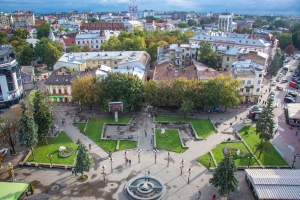




Imagine a city that was built from scratch according to a single plan in 1662. It didn’t grow from an ancient settlement or around a market by a castle — it was deliberately designed, like a blueprint. The plan took the shape of a six-pointed star — a model of Vauban-style European fortification. At the centre: a market square with a town hall; around it, quarters for the nobility, craftsmen, Armenians, and Jews. For its time — an ideal city model.
This is Stanyslaviv (known as Ivano-Frankivsk since 1962). The capital of the Carpathian foothills, the gateway to the Carpathians, and the city where in the 1990s the celebrated «Stanyslaviv Phenomenon» was born — a literary movement led by Yuriy Andrukhovych, Taras Prokhasko, and Yuriy Izdryk. Today it is one of the most pleasant regional cities in Ukraine, with a compact walkable centre, cobblestone cafes, and the Carpathians visible from its windows.
City card
| Founded | 1662 (as Stanyslaviv, by Hetman Andrii Pototskyi) |
| Admin status | Regional capital of Ivano-Frankivsk Oblast |
| Historic land | Galicia (Pokuttia); centre of the Stanyslaviv Voivodeship of Poland, then of the Austrian district |
| Population | ~230 000 |
| Area | ~84 km2 |
| Main river | Bystrytsya (formed by two branches — the Solotvynska and the Nadvirnanska) |
| Nicknames | Stanyslaviv, capital of the Carpathian foothills, gateway to the Carpathians |
| Best time to visit | May–October for city walks and Carpathian day trips; December–March as a base for skiing at Bukovel |
In this article
- What kind of city is this, and why visit?
- Location and character
- History in brief
- Legends and mysteries
- Top sights of Ivano-Frankivsk
- City itineraries
- Must-do in Ivano-Frankivsk
- FAQ
What kind of city is this, and why visit?
Ivano-Frankivsk is the capital of the Carpathian foothills, the regional centre, and the gateway to the Ukrainian Carpathians. It is often described as «a smaller Lviv»: the same Polish-Austrian facades, the same coffee culture, the same pedestrian street — but half the people, half the crowds, and twice as close to the mountains. Many Lvivians come here precisely to drink coffee in the calm that has long since vanished from Lviv itself.
People come for three reasons. The first is to stroll the market square of Stanyslaviv: a 17th–18th-century ensemble around the Town Hall, flanked by three cathedrals of three faiths — Roman Catholic, Greek Catholic, and Armenian. The second is to see the Bastion: a surviving fragment of the 17th-century star-shaped Stanyslaviv fortress, a rare example of Vauban fortification in Eastern Europe. The third is to use the city as a base for the Carpathians: Yaremche is 50 km away, Bukovel 100 km, and Hoverla 130 km. You can have morning coffee on the Market Square and be standing at a waterfall by lunchtime.
There is also a distinct literary Prykarpattia angle. In the 1990s the Stanyslaviv Phenomenon was born here: Yuriy Andrukhovych, Taras Prokhasko, and Yuriy Izdryk turned a provincial regional town into the leading literary capital of independent Ukraine. The cafes where they worked still operate. Some are must-visits for fans of contemporary Ukrainian literature.
Location and character
Ivano-Frankivsk sits in the Carpathian foothills, at roughly 280 metres above sea level, in the valley between the two branches of the Bystrytsya river — the Solotvynska and the Nadvirnanska. It is the zonal centre of Pokuttia, on the border between Hutsulshchyna to the south and Pokuttia to the north. Lviv is 130 km away, Kyiv 555 km, the Polish border 230 km, and the Carpathians a mere 30 km (the first peaks are visible right from the city streets).
What sets the city apart is its preserved 17th–18th-century ensemble. Unlike multi-layered Lviv, Ivano-Frankivsk is almost exclusively Polish-Austrian late-period: cobblestones, 19th-century paving slabs, stucco on facades, and cast-iron balcony railings. Modern «layers» (Soviet prefab blocks, shopping centres) have been pushed to the outskirts. The centre is a historic core within roughly 1 km2.
The historic core is walkable and compact: Town Hall on the Market Square → Collegial Church → Cathedral of the Resurrection → Armenian Church → pedestrian Nezalezhnosti Street → Bastion. All of it can be covered in a leisurely 2–3 hours.
When to visit. The best seasons are May–September for city walks and Carpathian day trips, and December–March if you are planning Bukovel or skiing. Summers are not as hot as in central Ukraine (the Carpathian microclimate rarely pushes above +28 °C). Autumn is superb: golden chestnut trees lining the streets, cool evenings, no ski-season crowds yet. In winter the city is quiet but enchanting: snow on the fir trees, the mountains visible from the Town Hall tower.
History in brief
Founded by the Potocki family (17th century)
In 1662, Polish hetman Andrii Pototskyi established a new city on the site of the village of Zabolottia — naming it after his father, Hetman Stanislaw Potocki. The city was built to a unified plan in the shape of a six-pointed star — a model of contemporary European fortification (Vauban system). At the centre: a market square with a town hall; around it, quarters for three communities — Catholics (Poles), Orthodox and Greek Catholics (Ukrainians), and Armenians. A Jewish quarter also took shape nearby. This was a classic magnate’s private city: entirely on Potocki land, with its own privileges and self-government.
17th–18th centuries: flourishing and fortification
In the 17th–18th centuries Stanyslaviv was one of the largest magnate cities in the Polish-Lithuanian Commonwealth. The Collegial Church (1672–1703), the Armenian Church, and the Cathedral (1672–1703, originally Jesuit) were all built during this period. The Vauban star fortress, with its bastions, moats, and scarps, was also constructed. In 1672, 1676, and 1742 the city withstood sieges by Turks and Tatars — and never surrendered. The Potockis maintained their own orchestra, printing house, and gymnasium here.
The Austrian period (1772–1918)
In 1772, after the first partition of Poland, Stanyslaviv passed to Austria and became the centre of the Stanyslaviv District of the Kingdom of Galicia. The Austrians modernised the city: they laid a railway (1866), built banks, hotels, and cafes, and opened new schools. Architecturally, the city acquired its present appearance — eclecticism and early Art Nouveau from the early 20th century. Three communities were active here: Poles, Ukrainians, and Jews — each with a full set of institutions.
The 20th century: tragedies and a new name
In 1918–1919 Stanyslaviv served as the temporary capital of the West Ukrainian People’s Republic. In the interwar period it was again part of Poland. During 1939–1941 it was under Soviet rule, and thousands of Poles and Ukrainian patriots were deported to Siberia. During 1941–1944 the city was under German occupation: virtually the entire Jewish population (~40% of prewar residents, over 30,000 people) was murdered in the Holocaust, primarily at the «Rudolfsmühle» concentration camp on the city’s outskirts. After the war Stanyslaviv became Soviet, and the Polish intelligentsia was expelled.
On 9 November 1962 the city was renamed Ivano-Frankivsk in honour of the writer Ivan Franko, on the centenary of his birth. Soviet urban planners built typical prefab-block districts around the historic centre, but the historic core itself survived. In the 1990s the Stanyslaviv Phenomenon was born here — the literary movement of Yuriy Andrukhovych, Taras Prokhasko, and Yuriy Izdryk, which made the city the cultural capital of independent Ukraine.
The 21st century and the war of 2022
Through the 2000s–2020s Ivano-Frankivsk evolved into one of Ukraine’s most liveable regional cities. The historic centre, riverfront, and parks were restored. The city regularly ranks among the top three for quality of life. In 2022 the Russian occupation did not reach the Prykarpattia region directly, but the city suffered several missile strikes on the military airfield at Kalyniv on its outskirts. In 2023–2025 Ivano-Frankivsk received thousands of displaced people from the east and south, which changed the city’s character somewhat but did not diminish its appeal.
The Stanyslaviv Phenomenon of the 1990s is what happens when a provincial regional town becomes the literary capital of a country. Yuriy Andrukhovych (Recreations, Twelve Rings, Perversion), Taras Prokhasko (The UnSimple), and Yuriy Izdryk (Wozzeck) wrote revolutionary texts here, in Stanyslaviv–Ivano-Frankivsk. It is one of those rare cases where a local school transforms an entire national literature.
Legends and mysteries
1. The underground passages of Stanyslaviv
Beneath the centre of Ivano-Frankivsk runs a branching network of underground passages dating from the 17th–18th centuries. They were built primarily as part of the fortification system: corridors linking the bastions to the central town hall, the churches, and the voivode’s residence. Some passages have been explored and are accessible (the Town Hall cellars, fragments in the Bastion); most are filled in or bricked up. The most famous legend: a secret passage from the Town Hall to the Collegial Church, used by the Potockis to escape during sieges. Parts of it have been found. The best place to investigate is the cellar of the Town Hall, which houses the local history museum.
2. The Potocki treasure
Legend has it that before the first partition of Poland in 1772, the Potocki family hid their treasury in the cellars of the Collegial Church — gold coins, silver tableware, and family documents. The Austrians who arrived in Stanyslaviv never found it. Treasure hunters have been searching ever since. In the 1980s, during restoration work on the church, a bricked-up cellar was discovered, from which a few minor items were removed — but this is not considered the «Potocki treasure.» Romantics believe the main hoard is still down there somewhere.
3. Ghosts of the Armenian Church
The Armenian Church in Stanyslaviv is one of the oldest buildings in the city (1762). In 1939 the Soviet authorities seized the church from the Armenians (most of whom were deported or emigrated) and later used it as a warehouse. Local legends speak of strange sounds heard from beneath the church floor on certain nights: said to be the chanting of Armenian priests who were executed in 1941–1944. Sceptics explain it as the acoustics of an old stone building full of cavities. Romantics say that the Armenian community never truly left the city — it simply moved underground.
Top sights of Ivano-Frankivsk
Town Hall on the Market Square
The Town Hall of Ivano-Frankivsk is the centrepiece of the city, standing on the main market square. Built in the 18th century and rebuilt in 1929 in the Constructivist style (a unique case for a western Ukrainian city), it houses a local history museum with exhibitions on Stanyslaviv, the Potockis, and the West Ukrainian People’s Republic. The tower has an observation deck offering a view over the entire historic centre and the Carpathians on the horizon. Climbing it is non-negotiable.
Bastion of the Stanyslaviv Fortress
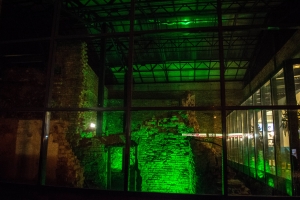
The Bastion — a remnant of the star-shaped Stanyslaviv Fortress of the 17th–18th centuries. One of six bastions that once surrounded the city. In the 19th century the Austrians filled in most of them; this one survived. Today it is the «Bastion» cultural and entertainment complex: contemporary art galleries, restaurants, cafes, and craft workshops in the historic vaulted cellars. One of the finest examples of adaptive reuse of fortification architecture in Ukraine.
Collegial Church of the Blessed Virgin Mary
The Collegial Church of the Blessed Virgin Mary (1672–1703) is the burial place of the Potocki family and one of the finest Baroque buildings in western Ukraine. Inside are the sarcophagi of Andrii Pototskyi (the city’s founder), his father, and their descendants. Today it houses the Museum of Arts of the Prykarpattia, with a collection of Galician paintings, icons, and sculpture from the 17th–20th centuries. One of the richest regional museums in the country.
Cathedral of the Holy Resurrection
The Cathedral of the Holy Resurrection (1672–1729, originally a Jesuit church) is the main Greek Catholic church of Ivano-Frankivsk and the cathedral of the Ivano-Frankivsk Archeparchy of the UGCC. It features a Baroque facade with two towers, a pipe organ, icons including the miracle-working icon of the Intercession of the Mother of God. Originally Jesuit, it passed to the Greek Catholics after the suppression of the order. One of the key landmarks of the old city.
Armenian Church of the Immaculate Conception
The Armenian Church (1762) is a rare surviving Armenian place of worship in Ukraine. It was built for the Armenian community of Stanyslaviv (present since the 17th century, primarily merchants and jewellers). Single-nave, with a characteristic facade in the late Baroque style. Today it serves as the Holy Protection Cathedral of the OCU. Inside is an icon of the Mother of God venerated as miraculous. Not yet described on the site as a separate page.
Pedestrian Nezalezhnosti Street
Nezalezhnosti Street is the main pedestrian artery of Ivano-Frankivsk, running from the Market Square to the railway station. Cobblestones, stucco facades from the 19th–early 20th centuries, cafes, bookshops, and craft boutiques. This is the city’s main evening axis: where people stroll, drink coffee, and meet. The best cafes here are those where Andrukhovych, Prokhasko, and Izdryk once wrote. Not yet described on the site as a separate page.
Potocki Palace
The Potocki Palace (17th century, rebuilt in the 19th) was the residence of the city’s founders. Built simultaneously with the city in the 1670s and later rebuilt in the Neoclassical style, it now houses a city hospital, but the facade and park have survived. The park surrounding it is one of the most beautiful in the city. Not yet described on the site as a separate page.
Shevchenko Park
Shevchenko Park is the central city park, laid out on the former ramparts of the Stanyslaviv Fortress. Ancient chestnuts, fir trees, ponds, and sculptures. City festivals, concerts, and fairs take place here. The best spot for a family walk — wide alleys, playgrounds, benches. Not yet described on the site as a separate page.
Holocaust Memorial at the site of the former Jewish ghetto
On the outskirts of the city stands a Holocaust memorial: a marker at the site of the former «Rudolfsmühle» concentration camp, where over 30,000 Jews of Stanyslaviv were murdered in 1941–1944. Before the war Jews made up around 40% of the city’s population; the community never recovered from the Holocaust. A quiet, sobering place of memory. Not yet described on the site as a separate page.
Cafes of the Stanyslaviv Phenomenon
In the 1990s–2000s, the cafes of Ivano-Frankivsk became centres of Ukrainian new literature. Yuriy Andrukhovych, Taras Prokhasko, Yuriy Izdryk, and the Bu-Ba-Bu and Plerus circles worked here for years. The most notable spots: «Manuskrypt» (Nezalezhnosti Street, with a vintage interior), «Lvivska kopalnia kavy» on the Market Square (a branch of the Lviv chain), and «Bublyky» (authentic Galician cuisine). Each is a story in itself, with its own bookshelves and art exhibitions. Not yet described on the site as a separate page.
City itineraries
Itinerary 1. Ivano-Frankivsk in one day
Morning: Town Hall with the local history museum and observation tower. Stroll around the Market Square. Collegial Church with the Potocki tombs. Cathedral of the Resurrection. Lunch on pedestrian Nezalezhnosti Street. Afternoon: Bastion with galleries and cafes. Sunset: coffee on the pedestrian street.
Itinerary 2. Ivano-Frankivsk + Halych over two days
Day 1 — as in Itinerary 1. Day 2: drive to Halych (30 km west). Halych Castle, Church of the Nativity of Christ, and the 12th-century Church of St Panteleimon in Shevchenkove — a rare example of Galician Romanesque architecture. A two-day itinerary for those who want both the city and a medieval capital.
Itinerary 3. Literary Stanyslaviv
A themed route for fans of contemporary Ukrainian literature. The Bu-Ba-Bu cafes on Nezalezhnosti Street where Andrukhovych and colleagues worked. Market Square with its coffee shops. The courtyards and galleries that became settings in Andrukhovych’s Twelve Rings. Bookshop «Ye» on Hrushevskoho Street. End with an evening reading in Shevchenko Park.
Itinerary 4. Ivano-Frankivsk — Yaremche (1 day)
The classic «city + Carpathians» route. Morning: Town Hall and Bastion in Ivano-Frankivsk (2–3 hours). Drive to Yaremche (50 km, 1 hour). Probii Waterfall, Dovbush Rocks, old railway bridge. Return in the evening.
Itinerary 5. A Carpathian week based in Ivano-Frankivsk
Five-day itinerary. Day 1: city (Itinerary 1). Day 2: Halych with its castle and churches. Day 3: Yaremche with Dovbush Rocks. Day 4: ascent of Hoverla (start from Zaroslyak). Day 5: Manyavskyi Skete or Kolomyia with the Pysanka Museum. Base: hotel in Ivano-Frankivsk (the largest selection of hotels and restaurants in the region).
Must-do in Ivano-Frankivsk
- Climb the Town Hall observation tower — from 49 metres up you can see the Carpathians on the horizon.
- Stand before the sarcophagus of Andrii Pototskyi in the Collegial Church — the man who built Stanyslaviv from nothing.
- Have coffee in one of the Bu-Ba-Bu cafes — specifically the one where Andrukhovych wrote Recreations. Ask locals for the recommendation.
- Stroll through the Bastion in the evening — contemporary art galleries, cafes, and craft shops in the fortress vaults.
- Buy a woven lizhnyak blanket or an embroidered vyshyvanka at one of the city’s craft fairs — the Prykarpattia is famous for Hutsul folk culture.
- Try banosh with brynza cheese — the classic Hutsul dish, at an authentic restaurant in the centre.
- Eat Galician varenyky — the traditional dumplings filled with potato, mushrooms, or meat.
- Walk pedestrian Nezalezhnosti Street in the evening — the best hour to feel the rhythm of the city.
- Buy a book by Yuriy Andrukhovych at bookshop «Ye» — one of the country’s finest, with an outstanding selection of contemporary Ukrainian literature.
- Visit the Museum of Arts of the Prykarpattia in the Collegial Church — Galician painting, icons, and sculpture from the 17th–20th centuries.
- Photograph the Town Hall with its Constructivist upper tier — a rare combination of Baroque and Modernism in a single building.
The star fortress of Stanyslaviv is a rare Ukrainian example of the fortification system devised by Sébastien Vauban (1633–1707), Europe’s most celebrated military engineer of the 17th century. Vauban’s principles were applied to fortresses across the continent, from the Atlantic to the Don. In Ukraine this style survives only in Stanyslaviv and partially in Lutsk. In Western Europe, very little of the original star fortresses remains. The Bastion of Ivano-Frankivsk is small, but it is the real thing.
Frequently asked questions
What to see in Ivano-Frankivsk in one day?
Classic route: Town Hall with museum and observation tower → Collegial Church → Cathedral of the Resurrection → pedestrian Nezalezhnosti Street → Bastion. All in 6–8 hours.
What to see in Ivano-Frankivsk over two days?
Add the Armenian Church, Shevchenko Park, and the Bu-Ba-Bu cafes to the first day’s route. On the second day, take a trip to Halych (30 km), Yaremche with Dovbush Rocks (50 km), or Manyavskyi Skete (60 km).
Is Ivano-Frankivsk safe to visit now?
Yes. Ivano-Frankivsk is one of Ukraine’s safest regional cities, located in the far west of the country. The city itself has not been occupied. There have been periodic missile strikes on military infrastructure (the airfield at Kalyniv on the outskirts), but tourist sites have not been targeted. Before travelling, monitor the current situation through the «Air Alert» app.
Why is the city called Ivano-Frankivsk?
The city’s original name was Stanyslaviv (from 1662, in honour of Stanislaw Potocki). On 9 November 1962 the Soviet authorities renamed it Ivano-Frankivsk to mark the centenary of the birth of Ivan Franko (1856–1916), Ukrainian writer and public figure. Many locals still call the city «Stanislaviv» or «Stas» in everyday speech.
What is the Stanyslaviv Phenomenon?
A literary movement that emerged in Ivano-Frankivsk in the 1990s. Its central figures were Yuriy Andrukhovych (Recreations, Twelve Rings, Perversion), Taras Prokhasko (The UnSimple), and Yuriy Izdryk (Wozzeck). In the 1990s–2000s it was in this regional city that contemporary Ukrainian prose was born — prose that would define the country’s literary identity for decades to come.
Where to go with children in Ivano-Frankivsk?
Shevchenko Park with playgrounds and century-old chestnut trees. The Town Hall observation tower (the climb excites even small children). Bastion with craft workshops for kids. On a day trip: Probii Waterfall in Yaremche and Dovbush Rocks (50 km).
Where to go in the evening in Ivano-Frankivsk?
Pedestrian Nezalezhnosti Street with its cafes and bars. The Bastion for concerts and gallery openings. The Philharmonia — classical music in a restored 19th-century hall. The Franko Drama Theatre — classic Ukrainian repertoire. Literary evenings at bookshop «Ye» — check the schedule in advance.
What are the signature dishes of Ivano-Frankivsk?
Classic Galician and Hutsul cuisine. Banosh — polenta cooked in sour cream, served with brynza cheese. Brynza — sheep’s milk cheese. Galician varenyky with potato and mushrooms. Ham smoked in spruce sawdust. Holubtsi (stuffed cabbage rolls) with sour cabbage. To drink: Hutsul mead or spruce-infused horilka.
What to bring back from Ivano-Frankivsk as a souvenir?
Hutsul lizhnyak blankets from Kosiv (sold in the city), carved wooden boxes, ceramics from the Kolomyia region, brynza from Hutsul mountain pastures (vacuum-packed), books by Yuriy Andrukhovych and other «Stanyslaviv» authors, Hutsul embroidered shirts, mead.
Ivano-Frankivsk is a city of scale and pace that have become rare commodities. Not as noisy as Lviv, not as tense as Kyiv, not as provincial as the rest of the regional centres. It has everything: Baroque architecture, a Vauban fortress, the Carpathians outside the window, cafes with a literary heritage — and still a compact regional quality where everything is in its proper place.
If you are looking for a base for exploring the Prykarpattia, choose Ivano-Frankivsk. From here everything is close: Halych is 30 minutes, Yaremche an hour, Hoverla two and a half. You have your morning coffee on the Market Square and by evening you are already in the Carpathians. No other regional city can offer you that.
JoomShopping Download & Support