


- You are here:
-
Sights by Regions

-
Ivano-Frankivsk region
-
Ivano-Frankivsk
- Ratusha (Town Hall), Museum of Local history and Observation Deck, Ivano-Frankivsk
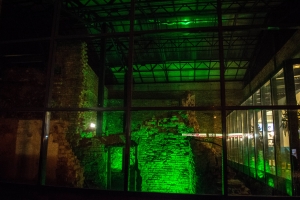
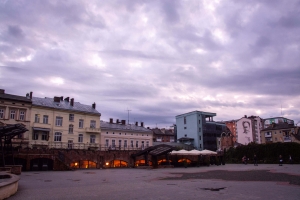
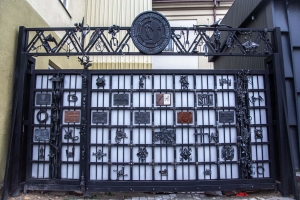
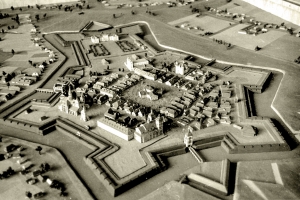
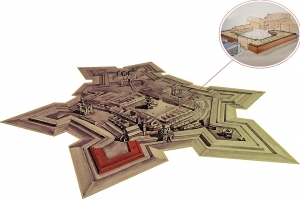
Stanyslaviv was once ringed by a hexagon of earthworks with six bastions. Today, essentially one fragment of wall survives from the entire fortress — and that fragment alone holds the memory of a whole fortified city.
This is the western bastion of Stanyslaviv Fortress in Ivano-Frankivsk — a surviving remnant of the defences laid down by magnate Potocki in the 17th century. Today the restored walls house the Bastion art gallery, where history sits comfortably alongside coffee and contemporary exhibitions.
Location card
| Location | historic centre of Ivano-Frankivsk (Fortetsnyi Lane / Liubomyr Huzar Street) |
| Fortress founded | 1661 (magnate Andrii Potocki) |
| Bastion restored | 2012 |
| What’s here now | Bastion art gallery, cafés, walkable zone |
| Time needed | 30–60 minutes |
What it is and why visit
Stanyslaviv Fortress is essentially a lost fortification complex whose outline once defined the boundaries of what is now Ivano-Frankivsk’s historic centre. Only fragments survive, and the western bastion is the most striking of them.
People come to touch the city’s origins: the fortress literally gave birth to Stanyslaviv. They also come for the atmosphere — the restored walls now contain a gallery where ancient stonework meets contemporary art, a combination that works surprisingly well.
History
The fortress was founded in 1661 by magnate Andrii Potocki. The town plan and fortification design were created by a military engineer from Avignon in Potocki’s service — Lieutenant-Colonel Francois Corassini.
The future city was given a regular hexagonal layout: a square market place, rectangular blocks, and surrounding it all a hexagonal earthwork with sides of about 400 m, a moat, and six corner pentagonal bastions. Between 1679 and 1682 the fortifications were improved under engineer Karol Benoit.
How the fortress disappeared
When Galicia passed to Habsburg rule, the fortress lost its defensive purpose. An imperial decree of 1804 ordered the walls demolished; the moats were filled in and the earthworks levelled right through to the 1870s. The fortified city became an ordinary city, and the defences were reduced to isolated fragments.
Six bastions, kilometres of earthworks, a moat encircling an entire city — all of it levelled within two generations. What you see today is almost everything that survived the 19th century.
The surviving fragments — the faces and flanks of the western bastion — are built from brick and alabaster blocks. They can be seen along Fortetsnyi Lane and set back within the Liubomyr Huzar Street building line; restoration was carried out in 2012.
What to see
The bastion walls. Authentic brick-and-alabaster masonry — the main historic draw of the site.
The Bastion gallery. A fortress art gallery in the restored walls: exhibitions, cafés, and space for a stroll.
The historic centre next door. The bastion is the perfect starting point for a walk through old Frankivsk — the Rynok square, the Town Hall and former churches are all within minutes.
How to get there
On foot. The bastion sits right in the historic centre, a few minutes’ walk from the Rynok square — easy to slot into any city walk.
Getting to the city. Ivano-Frankivsk is well connected by train and bus to Lviv, Kyiv and other cities; the station is a short ride from the centre.
Traveller’s checklist
- Comfortable shoes: the historic centre is cobblestoned.
- Camera: ancient walls plus contemporary exhibitions make for striking shots.
- Route: pair it with a walk through the Frankivsk city centre.
- What NOT to expect: a «full fortress» — this is a surviving fragment, not an intact castle.
Frequently asked questions
What survives of the fortress?
Mainly the faces and flanks of the western bastion, built from brick and alabaster. The rest of the defences were demolished in the 19th century.
Who built the fortress?
It was founded in 1661 by magnate Andrii Potocki; the design was by French engineer Francois Corassini.
What is there now?
The restored walls house the Bastion fortress art gallery, with exhibitions and cafés.
How long does a visit take?
Usually 30–60 minutes on its own; half a day if you combine it with a walk through the historic centre.
The bastion is one of those rare cases where a single surviving wall is worth more than many intact castles. Place your hand on the old alabaster masonry — and you reach back to the very 1661 that brought Ivano-Frankivsk into existence.
JoomShopping Download & Support