


- You are here:
-
Sights by Regions

-
Zhytomyr region
- Zhytomyr
Zhitomir








Imagine a city where the chief designer of the Soviet space programme was born — the man who launched Sputnik in 1957 and Gagarin in 1961. Without him, half of what we call the Space Age would not have happened. He was born in a regional capital on the Teteriv river, in an ordinary townsman’s house that you can visit today. His name was Serhii Korolov. This is Zhytomyr.
But Korolov is just one axis of the city. The second is granite cliffs above the Teteriv — a rare river-meets-stone canyon landscape for flat Ukraine, right within the city limits. The third is an 800-year-old centre with a cathedral, a synagogue, an Orthodox church and a wooden town hall on Castle Hill. All of this — in a regional city just 140 kilometres and two hours from Kyiv.
City at a glance
| Founded | First recorded — 1240; legendary founding — 884 (by a warrior of Princes Askold and Dir) |
| Status | Regional capital of Zhytomyr Oblast |
| Historic region | Drevlian land / Polissia (historically the centre of Kyiv Voivodeship, then Volhynia Governorate) |
| Population | ~265 000 |
| Area | ~65 km2 |
| Main river | Teteriv (with tributary Kamianka) |
| Nicknames | Korolov’s city, green city, capital of Polissia |
| Best time to visit | May–September — for parks and the Teteriv; year-round — for museums and cathedrals |
In this article
- What kind of city is it and why people come
- Location and character
- History in brief
- Legends and mysteries
- Top attractions in Zhytomyr
- City itineraries
- Must-do in Zhytomyr
- FAQ
What kind of city is it and why people come
Zhytomyr is a regional city with three distinct historical layers. The first: an ancient Polissian capital, centre of the Drevlian land and Volhynia, with 800 years of unbroken history. The second: a Polish–Volhynian city of the 16th–19th centuries, with churches, noble houses and a Jewish quarter that at its peak made up 40% of the population. The third: an atomic–space capital of the 20th century, the city where Korolov was born.
People come for three reasons. First — to see the house where Korolov was born: the Cosmonautics Museum with the family estate — the finest thematic space museum in Ukraine. Second — to walk Castle Hill and the centre: a compact historic core with a church, a cathedral, a town hall and the Teteriv embankment. Third — to step into the granite cliffs above the Teteriv: a rare river-canyon landscape right within the city limits.
This is a quiet, underrated regional city where tourist crowds never materialise even in summer. Cafes without queues, museums without tour groups, churches without guides at your elbow. The experience that Lviv and Kamianets-Podilskyi can no longer offer.
Location and character
Zhytomyr stands on the Teteriv river (a left tributary of the Dnipro), in the centre of Zhytomyr Oblast, at the junction of Polissia and the Podillian foothills. Kyiv is 140 km to the east, Berdychiv 45 km away, Vinnytsia 130 km. The E40 Kyiv–Uzhhorod highway passes through the city — one of the key western arteries of the country.
The distinctive feature of Zhytomyr is its granite geology. The city sits on the southern edge of the Ukrainian Crystalline Shield (one of the oldest massifs on the planet, ~3 billion years old). Along the Teteriv rise granite cliffs 20–40 metres high — a rare landscape for flat Ukraine. The most celebrated viewpoint is Chatsky’s Rock in the city park, with panoramic views over the river and the opposite bank.
The historic core is Castle Hill on the high right bank of the Teteriv. This was the site of the original wooden fortress, then a wooden town hall and cathedral. Today it is a hill with a viewpoint offering views over the Teteriv loop and the whole city centre. The entire walkable core fits within 1–1.5 kilometres.
Best time to visit. The sweet spot is late April through mid-October. May–June brings flowering chestnuts and bird cherry on the Teteriv embankment. July–August is for swimming in the granite quarries of Korostyshiv nearby. September–early October brings golden autumn in the city parks. In winter the city is quieter, but all museums and cathedrals are open. The 2022 war did not directly touch the oblast: Zhytomyr is a rear-area city, with occasional missile strikes on infrastructure.
History in brief
The Drevlians and Kyivan Rus
The lands of modern Zhytomyr were home to the Drevlians, one of the largest Slavic tribes. Legend dates the founding of the city to 884: supposedly it was established by a warrior of Kyiv princes Askold and Dir named Zhytomyr. The first written record dates to 1240, in a chronicle describing the Mongol invasion: the city is mentioned as one of the Drevlian centres burned by the horde. In the 13th–14th centuries Zhytomyr was part of the Kyiv Principality, then of the Grand Duchy of Lithuania (1362).
The Polish period and Jewish Zhytomyr
From 1569 Zhytomyr was in the Polish–Lithuanian Commonwealth, the centre of Kyiv Voivodeship. In the 16th–18th centuries the city enjoyed a cultural flowering: Catholic churches, monasteries and noble estates were built. In 1768 during the Koliivshchyna uprising, Zhytomyr was under strong Polish control, and trials of insurgents were held here. In 1793, after the Second Partition of Poland, the city passed to the Russian Empire and became the centre of Volhynia Governorate.
In the 19th century a powerful Jewish community formed in Zhytomyr — by 1897 Jews made up 30% of the population (~17,000 out of 65,000). The city became a centre of craft trades, commerce and Jewish education. A rabbinical college operated here — one of only two official ones in the Russian Empire. Among natives of the city was the writer Volodymyr Korolenko (born 1853), who considered himself more Ukrainian than Russian.
The 20th century: Korolov, war, revival
On 12 January 1907, at 5 Dmytrivska Street in Zhytomyr, Serhii Korolov was born — the future chief designer of the Soviet space programme. The family moved to Kyiv in 1914; Korolov himself later worked in Moscow. But he returned to Zhytomyr several times throughout his life and always emphasised: this was his homeland.
In 1941–1943 Zhytomyr was under German occupation. Almost the entire Jewish population was murdered at Zhytomyr’s Babyn Yar and other execution sites. The city was liberated in November 1943 (twice, as the Germans recaptured it and it was taken again in December). In the post-war period Zhytomyr became an industrial centre with light industry, machine-building and food processing. In 1991 the Korolov Cosmonautics Museum opened in his childhood home.
2022. On 24 February Russian forces entered the Malyn district of Zhytomyr Oblast from Belarus, heading towards Kyiv. Zhytomyr itself was not occupied, but suffered dozens of missile strikes — the military airfield, a residential school and a hospital were damaged. In March 2022 dozens of Zhytomyr residents died in the bombardment. In April 2022 the northern part of the oblast was de-occupied; since then Zhytomyr has been a rear-area city, hosting thousands of internally displaced people from frontline regions.
Serhii Korolov was not simply «one of the designers». He was the chief architect of the first years of the Space Age. Without him: no Sputnik-1 (4 October 1957), no Gagarin’s flight (12 April 1961), no first woman in space Tereshkova (1963), no first spacewalk by Leonov (1965). All of these were his projects. And all of it came from a man from Zhytomyr who as a child looked up at the sky above the Teteriv and built his first glider models.
Legends and mysteries
1. The warrior Zhytomyr and the founding of the city
The most popular legend holds that in 884 the city was founded by a warrior named Zhytomyr — a loyal soldier of Kyiv princes Askold and Dir. When Prince Oleh killed Askold in 882, Zhytomyr fled Kyiv westward with his retinue to the Drevlians and founded a fortified settlement on the high bank of the Teteriv. This is supposedly how the city was born and kept the name of its founder. Archaeology neither confirms nor disproves the legend: the cultural layer on Castle Hill dates to the 9th–10th centuries, consistent with this era. Either way, Zhytomyr bears the name of a person rather than an object or plant — a rarity among Ukrainian cities.
2. The underground passages of Zhytomyr
Beneath the centre of Zhytomyr lies a branching network of underground passages from the 17th–18th centuries. Mostly built in the Polish period: between the cathedral and the Jesuit collegium, between the town hall and the voivode’s residence. Some passages are known for certain, others only through legend. The most famous tale: a tunnel from the cathedral to an old Polish cemetery on the edge of the city, through which the nobility supposedly escaped during Cossack–Tatar raids. Sections have been found; the complete network has never been mapped.
3. Chatsky’s Rock and the suicide of love
In Gagarin Park above the Teteriv stands Chatsky’s Rock, with one of the finest views of the river. According to legend, in the 19th century the Polish poet and nobleman Tadeusz Czacki fell in love with a local Ukrainian girl from a simple family. Her parents forbade the marriage. The lovers leapt from the cliff together — or so the Romantic version goes. The story is literary and almost certainly never happened (Tadeusz Czacki was a real historical figure who died in Dubno in 1813). But the rock has kept the name, and every second person in Zhytomyr knows the legend.
Top attractions in Zhytomyr
Korolov Cosmonautics Museum
The Museum of Cosmonautics named after S. P. Korolov is the leading thematic space museum in Ukraine. Opened in 1991 in the house where the designer was born. The exhibition includes: Serhii Pavlovych’s childhood desk, early rocket models, rocket engines, spacesuits, a Lunokhod-1 (replica), a Vostok re-entry capsule and personal belongings. Two-storey, with the family estate. The unmissable #1 sight in the city.
Cathedral of St Sophia
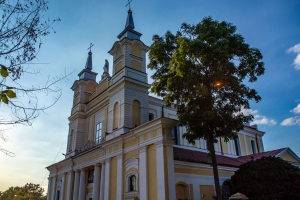
The Cathedral of St Sophia (1737, rebuilt in the 19th century) is the main Catholic church of the Zhytomyr Diocese. Baroque–classical facade with two towers, a 19th-century organ, icons including Jesuit-era survivals. Catholic masses and organ concerts take place here. One of the city’s finest architectural landmarks.
Regional Museum of Natural History
The Regional Museum of Natural History holds one of the largest natural history collections in Ukraine. A collection of granites and minerals from the Ukrainian Crystalline Shield, taxidermied Polissian animals (wolves, bears, lynx, elk), mammoth and woolly rhinoceros fossils found in Polissia 20,000 years ago. A dedicated hall covers the Polissian Nature Reserve.
Castle Hill and the Transfiguration Cathedral
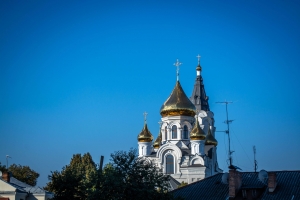
Castle Hill is the historic core of Zhytomyr on the high right bank of the Teteriv. This was the site of the first wooden fortress, then a wooden town hall, then a stone Transfiguration Cathedral (1874, Russo-Byzantine style). White, with five domes, visible from the opposite bank of the Teteriv. Alongside it: a viewpoint with panoramic views over the river loop. Not yet described on the site as a separate page.
The cliffs and park above the Teteriv
Along the Teteriv within Zhytomyr rise granite cliffs 20–40 metres high. A rare landscape for flat Ukraine. The most celebrated spots: Chatsky’s Rock (in Gagarin Park), Chatsky’s Head (resembling a face in profile), The Four Brothers (a cluster of cliffs with a distinctive shape). The city’s best viewpoints for sunset. Not yet described on the site as individual pages.
St Michael’s Cathedral
St Michael’s Cathedral (1856) is another significant Orthodox church in Zhytomyr, on the northern edge of the centre. Classical facade with lateral bell towers. Built in the Russo-Byzantine style as a garrison church of the Russian Imperial Army; later became a parish church. Not yet described on the site as a separate page.
Monument of Eternal Glory and Park of Glory
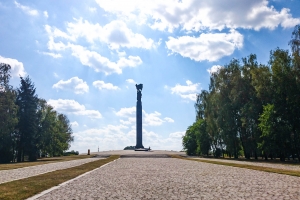
The Monument of Eternal Glory in the Park of Glory is a memorial to victims of World War II, opened in 1969. A tall bronze figure of Mother Ukraine on a plinth, an eternal flame, an alley of remembrance. Today it also serves as a memorial to heroes of the 2014–2025 Russo-Ukrainian war, with a dedicated alley of photographs of fallen Zhytomyr residents.
The old synagogue and Jewish Zhytomyr
On Kafedralna Street survives the building of the old Great Synagogue of Zhytomyr (19th century) — a landmark of the pre-revolutionary Jewish era, when Jews made up a third of the city’s population. Nearby are the former streets where Hasidim, merchants and craftsmen lived. After the Holocaust the Jewish community effectively ceased to exist, but the architecture survives in places. Not yet described on the site as a separate page.
Mykhailvska Street and the city centre
Mykhailvska Street is the pedestrian artery of Zhytomyr, with 19th-century facades, cafes, small shops and open-air terraces in summer. The former centre of Polish–Jewish trade. The best spot for an evening stroll and coffee after seeing the main sights. Also here: the drama theatre in a Classical 19th-century building.
City itineraries
Itinerary 1. Zhytomyr in one day — space and the centre
From Kyiv ~140 km. Morning — the Korolov Cosmonautics Museum (2.5 hours). Walk to the centre: the Cathedral of St Sophia, Mykhailvska Street, lunch. Afternoon — the Regional Museum and Castle Hill with the Transfiguration Cathedral. Sunset — from Chatsky’s Rock above the Teteriv.
Itinerary 2. Zhytomyr in two days — with a trip to Berdychiv
Day 1 — as itinerary 1. Day 2: drive to Berdychiv (~45 km) for the Carmelite church where Balzac married Evelina Hanska in 1850. Nearby — the historic centre with its Jewish heritage. Alternative for day 2 — the Korostyshiv granite quarries with turquoise water (especially beautiful in summer).
Itinerary 3. Granite Zhytomyr
A thematic route for geology and photography enthusiasts. Chatsky’s Rock → Chatsky’s Head → The Four Brothers — all along the right bank of the Teteriv within the city. A walk along the embankment. Finale — Korostyshiv Canyon (30 km away) and the flooded granite quarry of Korostyshiv.
Itinerary 4. Literary Zhytomyr
A thematic route for those in search of writers’ traces. The house where Volodymyr Korolenko was born (1853), with its memorial plaque. The drama theatre on Mykhailvska. A stroll through the streets walked by Korolenko and his contemporaries. Can be combined with a trip to Novograd-Volynsky (Zvyahel), birthplace of Lesia Ukrainka (80 km away).
Itinerary 5. A Drevlian week
A four-day tour of the whole Drevlian land, based in Zhytomyr. Day 1: Zhytomyr as per itinerary 1. Day 2: Korosten with Drevlian Park and the memory of Princess Olha. Day 3: Olevsk and the Stone Village in Rudnia-Zamyslovychi. Day 4: Berdychiv with Balzac.
Must-do in Zhytomyr
- Stand at Korolov’s childhood desk in his family home — the one where he drew his first glider models at age six.
- See the Vostok capsule in the Cosmonautics Museum — a replica of the capsule in which Gagarin returned from orbit.
- Attend an organ service at the Cathedral of St Sophia — check the concert schedule in advance.
- Photograph the Transfiguration Cathedral from the Castle Hill escarpment in golden autumn — the classic Zhytomyr postcard shot.
- Climb Chatsky’s Rock at sunset — the city’s finest view over the Teteriv loop.
- Try Polissian borscht with porcini mushrooms at an authentic restaurant in the centre.
- Stroll pedestrianised Mykhailvska with a coffee from a local Zhytomyr roastery.
- Buy cranberry jam at the market — the classic Polissian souvenir from wild berries.
- Try Zhytomyr «Kashovka» sausage — a local meat brand.
- Visit the Regional Museum of Natural History and see mammoth bones found near the city.
- Buy a granite miniature from Korostyshiv at the market — from some of the oldest minerals on the planet, which you can hold in your hands.
On 4 October 1957 the first artificial satellite — Sputnik-1 — entered Earth’s orbit. The designer was Zhytomyr native Serhii Korolov, then 50 years old. On 12 April 1961 Yuri Gagarin flew into space on Vostok-1. The designer was the same Korolov, now 54. Ukraine, as a country, donated to the Soviet Union — and through it to the world — the chief engineer of the Space Age. Without the man from Dmytrivska Street, 5, space would have looked very different.
Frequently asked questions
What to see in Zhytomyr in one day?
Classic itinerary: the Korolov Cosmonautics Museum (2.5 hours) → the Cathedral of St Sophia → Mykhailvska Street → lunch → the Regional Museum and Castle Hill → sunset from Chatsky’s Rock. Everything fits in 7–8 hours.
What to see in Zhytomyr in two days?
Add to the first-day itinerary St Michael’s Cathedral, a walk along the granite cliffs above the Teteriv, the Jewish quarter with the old synagogue. On a third day: a trip to Berdychiv (Balzac), Korostyshiv (granite quarries) or Korosten (the Drevlian capital).
Is Zhytomyr safe to visit now?
Yes, with caveats. Zhytomyr is a rear-area city, far from the front line. The territory itself was not occupied in 2022. Occasional missile strikes on infrastructure (the military airfield, energy facilities, in some cases residential areas) still occur. Before travelling, check the current situation via the «Air Alert» app.
Why is Serhii Korolov Ukrainian?
Serhii Korolov was born on 12 January 1907 in Zhytomyr, into the family of a Ukrainian gymnasium teacher, Pavlo Korolov. He lived in the city until 1914, then the family moved to Kyiv, where he studied at school and the Kyiv Polytechnic Institute. He later became the chief designer of the Soviet space programme. The Cosmonautics Museum is in his family home in Zhytomyr.
What to do in Zhytomyr in the evening?
Stroll pedestrianised Mykhailvska Street with its cafes and bars. Sit on a terrace with a view of the Teteriv. In summer, outdoor concerts are often held in Gagarin Park. The cathedral holds regular organ concerts — check the schedule in advance.
What to do with kids in Zhytomyr?
The Cosmonautics Museum — rockets, spacesuits, a moon rover — ideal for children of all ages. The Regional Museum of Natural History with mammoth bones and taxidermied Polissian animals. Gagarin Park for walks with views above the Teteriv. In summer — swimming in the Korostyshiv granite quarry 30 km away.
What is the best season to visit Zhytomyr?
May–June — flowering chestnuts and bird cherry on the Teteriv embankment. August–September — swimming in granite quarries and the start of golden autumn. In winter the city is quiet, but all museums and cathedrals are open, and the Transfiguration Cathedral looks particularly beautiful under snow.
What are the most famous dishes of Zhytomyr?
Polissian borscht with porcini mushrooms, Drevlian kulish with millet, Zhytomyr «Kashovka» sausage (a local brand), potato cakes with cracklings, cranberry and bilberry liqueurs, open sandwiches with home-cured lard. On the outskirts — classic Polissian cooking with mushrooms, berries and fish from the Teteriv.
What to bring back from Zhytomyr as a souvenir?
Granite miniatures from Korostyshiv (from the oldest minerals on the planet), cranberry jam, honey from Polissian apiaries, postcards from the Korolov Museum, ceramic miniatures with Transfiguration Cathedral motifs, a bottle of local Zhytomyr vodka or flower-berry liqueur.
Zhytomyr is a city that operates on three levels simultaneously: ancient Rus (Castle Hill), Polish–Volhynian (the cathedral, synagogue, Jewish quarter) and space–Soviet (Korolov, rockets, ideology). All three layers are readable within one walkable square kilometre. That is a rare density of history per square metre.
If you’re choosing one city in the Kyiv region or central Ukraine for a quiet day trip with a genuine discovery — choose Zhytomyr. Korolov is waiting. Chatsky’s Rock too.
JoomShopping Download & Support