


- You are here:
-
Sights by Regions

-
Poltava region
- Poltava
Poltava







Imagine a city where the monument stands not to a tsar or a general but — to a dumpling. Poltava can afford that, because it knows its own worth. Modern Ukrainian language was born here (from Kotlyarevsky’s Eneida), the fate of the Hetmanate was decided here at the battle of 1709, and Gogol, Korolenko and Panas Myrnyi all lived here. For a single regional capital, it holds a suspiciously large amount of history.
And yet Poltava remains surprisingly unhurried. Tourist buses do not besiege it; its centre — a Classicist ensemble worthy of a European capital — stands quiet, without queues. This is a city you read slowly, like a good book. Here is where to start.
City at a glance
| Founded | First recorded mention — 1174 (as Ltava) |
| Admin status | Regional capital of Poltava Oblast |
| Historic land | Left-Bank Hetmanate (centre of the Poltava Cossack regiment) |
| Population | ~280,000 |
| Area | ~110 km2 |
| Main river | Vorskla |
| Nicknames | City of halushky, spiritual capital, pearl on the Vorskla |
| When to visit | Year-round, subject to the security situation. May–September for parks and walks |
In this article
- What kind of city this is and why people come
- Location and character
- History in brief
- Legends and mystique
- Top sights of Poltava
- City routes
- Things you must do in Poltava
- FAQ
What kind of city this is and why people come
Poltava is the spiritual capital of the Ukrainian language. In 1798 a local civil servant named Ivan Kotlyarevsky published his Eneida here — the first printed work in modern Ukrainian. From that moment the city became to Ukrainian culture what Weimar was to German: small, almost provincial, yet the axis of everything that followed ran through it.
People come here for the Classicist centre. Round Square with its Monument of Glory, built in the early 19th century to a single unified design, is one of the finest Classicist ensembles in Ukraine. Nearby are Korpusny Garden, Cathedral Square and unhurried tree-lined alleys. The city is easily walkable in a day.
They also come for the Battle of Poltava Field: in 1709 the fate of the Hetmanate was decided here, and on the outskirts the battlefield landscape survives, with redoubts, a museum and monuments of different eras. And of course for halushky — in Poltava these Ukrainian dumplings are not just a dish but an official cultural position, complete with a monument and all due honours.
Location and character
Poltava stands on the right, elevated bank of the Vorskla — a small, picturesque river that flows toward the Dnipro. The city sits on hills from which broad views open over the river valley and its floodplain forests. The most famous viewpoint is Ivan’s Hill with a white gazebo on the slope.
The historic core is compact and walkable. Everything that matters — Round Square, Korpusny Garden, Cathedral Square, the main museums — fits comfortably into an hour’s leisurely stroll. This is one of those cities where a car is more hindrance than help: the centre is simply too small.
When to visit. Poltava is comfortable year-round, but plan any trip with the security situation in mind. The best seasons are May and September: warm but without July heat, parks at their finest. Winter is quieter, but theatres and museums are open. August is Sorochyntsi Fair season in a nearby village, so many oblast visitors stop in Poltava along the way.
History in brief
From Ltava to the Cossack regiment
First mentioned in 1174, in a chronicle as Ltava. In the medieval period it lay on the border of Kyivan Rus and the Wild Steppe. In the 17th century Poltava became the centre of one of the largest Cossack regiments of the Hetmanate, with its own self-government, markets and churches.
The Battle of 1709
On 8 July 1709 near Poltava, the armies of Swedish King Charles XII (accompanied by Hetman Ivan Mazepa) and Muscovite Tsar Peter I clashed. The battle lasted several hours and ended in the total defeat of the Swedes. For the Hetmanate it meant the end of any real autonomy: self-governance was gradually curtailed and the Cossack order dismantled. The battlefield on the city’s outskirts is today a state nature reserve.
19th–21st centuries
In the early 19th century Poltava was developed to a unified Classicist plan — that is when Round Square and the Monument of Glory appeared. Ivan Kotlyarevsky — the founder of modern Ukrainian literature — lived and worked here. In the 19th and 20th centuries Panas Myrnyi and Volodymyr Korolenko also called Poltava home. In independent Ukraine the city is one of the country’s cultural centres. Since 2022 Poltava has been a rear-area city that periodically suffers infrastructure missile strikes but continues to function normally.
In 1798 the Eneida of Poltava civil servant Ivan Kotlyarevsky was published in St Petersburg — the first literary work in modern Ukrainian. The comic poem about Cossack Trojans launched an entire century of Ukrainian literature. Poltava has never quite recovered from that fact — and rightly so.
Legends and mystique
Poltava is a city of quiet legends, without overblown effects. Each one has left its mark on Ukrainian culture.
1. Marusia Churai and songs that outlasted everything
According to tradition, in the 17th century a woman called Marusia Churai lived in Poltava — a singer and composer of folk songs, including «Oi ne khody, Hrytsiu» (Don’t go, Hryts). Her story is a full-blown folk drama: her lover was unfaithful, she poisoned him with a herb potion, she was condemned to death, and the Cossacks intervened «on behalf of her songs» and snatched her from the executioner. Historians still argue about whether Marusia was a real person. But the songs exist, and they are still sung today — which is an argument stronger than any document.
2. Kotlyarevsky, who started a language with a joke
When modest Poltava civil servant Ivan Kotlyarevsky began writing his Eneida, he can hardly have imagined he was founding an entire literary tradition. It was a parody of Virgil in which Roman heroes spoke «in our language.» The joke spread, the poem circulated in handwritten copies, and when it was printed in 1798 it turned out that the language in which people had been «just joking» was perfectly fit for serious literature. So Poltava quietly gave Ukraine what it needed most: a written standard.
3. The White Gazebo over the Vorskla
On the slope of Ivan’s Hill stands the White Gazebo — a small rotunda with columns offering one of the finest views in the city. Local legend says that from this vantage point one could once see three districts at once. Every generation of Poltava residents has loved the gazebo: couples meet here, newlyweds pose for photographs, and people shelter from the heat. If there is one point in Poltava where the city «looks at itself», this is it.
Top sights of Poltava
Round Square and Korpusny Garden
The heart of the city and one of the finest Classicist ensembles in Eastern Europe. An octagonal — effectively circular — square with the Monument of Glory (1811) at its centre and eight former government buildings arranged around its perimeter. Beside it: the leafy Korpusny Garden. Best visited in the morning when it is quiet. Round Square does not yet have its own page on the site.
Poltava Museum of Local History after Krychevsky
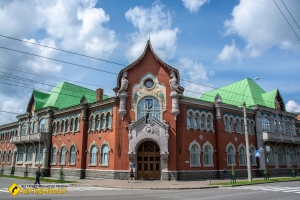
One of the most beautiful museum buildings in the country — a masterpiece of Ukrainian Art Nouveau by Vasyl Krychevsky (1908). The building alone is worth the journey; the collection spans from Trypillian ceramics to the region’s modern history. The best place to understand Poltava Oblast in a couple of hours. See the Poltava Museum of Local History.
Battle of Poltava Field
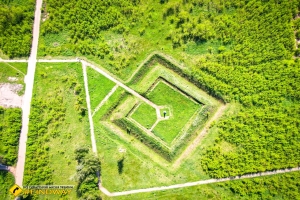
A state nature reserve on the city’s outskirts: preserved landscape of the 1709 battle, reconstructed redoubts, a museum with weapons and uniforms, monuments of different eras. The place is more contemplative than pompous — and that is precisely why it is worth your time. See the restored redoubt.
Monument to the Poltava halushka (dumpling)
A bronze halushka resting in a spoon, beside the Kotlyarevsky Estate Museum. Cheerful to look at, even more cheerful to photograph, but placed here in complete seriousness: the halushka is to Poltava what the chestnut is to Kyiv. A mandatory photo stop on any itinerary. See the Dumplings Monument.
Kotlyarevsky Estate Museum. A reconstructed cottage on Ivan’s Hill where the author of the Eneida lived. Memorial interiors, manuscripts, editions of the poem from different years. A small museum with an outsized significance for Ukrainian culture. Not yet given its own page on the site.
White Gazebo on Ivan’s Hill. That same columned rotunda above the Vorskla from which the city contemplates itself. The best sunset stop on the route. Not yet given its own page on the site.
Assumption Cathedral. The city’s main church on Cathedral Square — a Classicist cathedral restored in independent Ukraine, with a tall bell tower. Not yet given its own page on the site.
Exaltation of the Holy Cross Monastery. A Baroque ensemble from the 17th century on one of Poltava’s hills, featuring a distinctive seven-domed cathedral — one of the finest examples of Cossack Baroque in Ukraine. Not yet given its own page on the site.
Panas Myrnyi Museum and Volodymyr Korolenko Museum. Two memorial estates of two writers who lived in Poltava in different decades. Small, quiet, with the same atmosphere of tranquil provincial life in which great texts are written. Not yet given their own pages on the site.
City routes
Route 1. Poltava in one day (must-see essentials)
Start at Round Square with the Monument of Glory and Korpusny Garden. Then the Krychevsky Museum of Local History. Lunch — halushky. Afternoon — Cathedral Square and the Assumption Cathedral, the Kotlyarevsky Estate Museum, mandatory photo beside the Dumplings Monument. At sunset — the White Gazebo above the Vorskla.
Route 2. Poltava in two days (full)
Day 1 — as in Route 1: centre, Krychevsky Museum, halushka, White Gazebo. Day 2 — history beyond the centre: the Battle of Poltava Field with the redoubt, the Exaltation of the Holy Cross Monastery, the Korolenko or Panas Myrnyi Museum.
Route 3. Literary Poltava
For those who came for Kotlyarevsky and company: Kotlyarevsky Estate Museum → Panas Myrnyi Museum → Volodymyr Korolenko Museum → Krychevsky Museum with its literary section. A quiet but rich programme for a full day.
Route 4. Poltava with kids
Korpusny Garden with its Classicist facades → Dumplings Monument for a fun photo → White Gazebo with views over the Vorskla → the redoubt on the Battle of Poltava Field with real fortifications. Plenty of space and minimal museum boredom.
Things you must do in Poltava
- Stand on Round Square — a Classicist ensemble of this quality exists nowhere else in Ukraine.
- Eat real Poltava halushky — not varenyky, not pelmeni, but halushky in broth with pork cracklings and sour cream.
- Photograph the Dumplings Monument — without this shot the visit is officially incomplete.
- Step into the Krychevsky Museum of Local History — look at the building first, then the collection.
- Walk the Battle of Poltava Field — and read something about the battle in advance, otherwise it is just a field.
- Stand on Ivan’s Hill beside the White Gazebo at sunset — one of the finest viewpoints in Left-Bank Ukraine.
- Visit the Exaltation of the Holy Cross Monastery — the seven-domed Cossack Baroque cathedral makes you want to linger.
- Visit the Kotlyarevsky Estate Museum — this is precisely where modern Ukrainian language began.
- Buy an embroidered Poltava rushnyk — white on white, with the delicate drawn-thread pattern typical of the region.
- Stroll the centre slowly — Poltava does not like to be hurried through.
The Monument of Glory on Round Square was erected in 1811 on the centenary of the Battle of Poltava. It is one of the first large urban monuments on the territory of modern Ukraine — and one of the most recognisable symbols of the city.
FAQ
What to see in Poltava in one day?
The essential circuit: Round Square with the Monument of Glory → Krychevsky Museum of Local History → Cathedral Square → Kotlyarevsky Estate Museum and the Dumplings Monument → White Gazebo on Ivan’s Hill.
What to see in Poltava in two days?
Day one — the centre (Round Square, Krychevsky Museum, Kotlyarevsky, halushka, White Gazebo). Day two — the Battle of Poltava Field, the Exaltation of the Holy Cross Monastery, the Korolenko or Panas Myrnyi Museum.
Is Poltava safe to visit now?
Poltava is a rear-area city, far from the front line. Periodic missile strikes on infrastructure occur, but the city functions normally. Before travelling, check the standard official channels and the «Air Alarm» app.
Where to take kids in Poltava?
Korpusny Garden and Round Square, the Dumplings Monument for a fun photo, the White Gazebo with views over the Vorskla, and the redoubt on the Battle of Poltava Field with its real fortifications.
Why is Poltava called the city of halushky?
Because the halushka here is not just food but a cultural symbol: Kotlyarevsky joked about it, every local restaurant serves it, and a bronze monument to the dish stands in the city centre. Culinary pride, officially enshrined.
Who was Ivan Kotlyarevsky?
A Poltava civil servant and writer (1769–1838), author of the poem Eneida (1798) — the first printed work in modern Ukrainian. He also wrote the play Natalka Poltavka. Regarded as the founder of modern Ukrainian literature; his estate museum is one of the key cultural sites in the city.
What are Poltava’s most famous dishes?
Poltava halushky in broth with pork cracklings and sour cream, Poltava borshch with halushky, cherry varenyky, pampushky with garlic. Classic Left-Bank cuisine — hearty, simple, without unnecessary fuss.
What to bring back from Poltava as a souvenir?
A miniature halushka (yes, those exist), a rushnyk with Poltava’s white-on-white embroidery, Opishnia ceramics from the region, an edition of Kotlyarevsky’s Eneida, local honey and tinctures.
Poltava is a city that rewards slow reading. It does not overwhelm with a single frame, does not push itself forward, does not market itself. But once you know that Round Square here matches a European capital, that modern Ukrainian language was born in this city and that there is a monument to a dumpling in the centre — the city opens up in a completely different way.
If you are still wondering where to start — start at Round Square. From there you can see both the city and the reason why Poltava was worth coming to.
JoomShopping Download & Support