


- You are here:
-
Sights by Regions

-
Poltava region
-
Poltava
- Ancient temple, Poltava

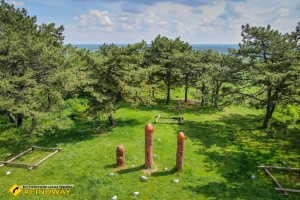


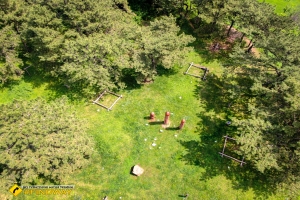
On a hilltop near Poltava stand three carved wooden deities, guarded on four sides by winged wolves — Semarhly, who according to the faith protect the spirit of the ancestors. From here a wide panorama opens over the surrounding land, and it feels as though you’ve stepped into pre-Christian Ukraine.
The ridnoviry kapyshche (pagan shrine) near the village of Patlaiivka is a modern Slavic sanctuary not far from Poltava. An off the beaten path destination for those drawn to Slavic mythology, symbolism, and the quiet power of nature. (Ridnoviry — literally «native faith believers» — are followers of a contemporary movement reviving pre-Christian Slavic beliefs.)
Location Card
| Location | near Patlaiivka village, close to Poltava |
| What it is | pagan ridnoviry shrine (kapyshche) |
| Highlights | carved deity idols, symbolism, panoramic views |
| Time needed | 30–60 minutes |
| What to bring | camera, comfortable shoes, respect for the place |
What It Is and Why Visit
A kapyshche is an ancient Slavic sanctuary where carved images of pagan gods were placed, bonfires lit, prayers offered and rituals performed. What was once the natural spiritual life of pre-Christian Kyivan Rus is today being revived by the ridnoviry — followers of the «native faith.»
The Poltava shrine near Patlaiivka is exactly this kind of revived sanctuary. What sets it apart is its attention to detail: a wealth of symbols, carved deity figures and a considered compositional layout. At the centre stand three statues — Rodyna (the kin), Rod (the primordial god) and Svarog — while on four sides the shrine is «guarded» by Semarhly, the celestial wolves. A wide panorama from the hilltop adds to the atmosphere.
For ridnoviry believers, this is not a tourist attraction but an active sacred site. That said, visitors also come simply to spend quiet time in an unusual, peaceful corner of the Ukrainian countryside.
History and Context
Ridnovirstvo (native faith) is a contemporary movement reviving the pre-Christian beliefs of the Slavs. Its followers honour ancient deities — Rod, Svarog, Perun, Dazhboh and others — and reconstruct rituals they believe were practised in Ukraine before Christianisation.
The shrine near Poltava is one such active centre. It was created and is maintained by ridnoviry practitioners themselves, who continue to add new figures and symbols over time. This is not an ancient archaeological site but a living modern sanctuary, continuing a tradition interrupted over a thousand years ago.
Gods, Symbols and Lore
Every figure here carries meaning — this is an entire mythological alphabet.
1. Rod, Rodyna and Svarog
The three central idols. In Slavic mythology, Rod is the primordial creator god; Svarog is the god of sky and smithcraft, «father» of many deities. Together they embody the origins of kinship and the cosmos.
2. Semarhly — The Celestial Wolves
Four winged wolves guard the shrine from all sides. Semarhl is a divine guardian, an intermediary between worlds who protects the spirit of the ancestors. It’s their presence that gives the site its watchful, mystical quality.
3. A Place of Power
Visitors speak of «a special energy» on the hilltop and a sense of calm. Sceptics put it down to silence, nature and open views. Either way, the place genuinely invites contemplation.
What to See and Do
Carved deity idols. The wooden statues of Rod, Rodyna and Svarog — the spiritual centrepiece of the shrine.
Semarhl guardian wolves. The four wolf figures around the sanctuary — the site’s most distinctive feature.
Panorama. Wide open views across the countryside from the hilltop.
Symbolism. Dozens of small signs and details, each carrying meaning.
Getting There
By car. The shrine is near the village of Patlaiivka close to Poltava. Navigate to Patlaiivka; for the exact location of the shrine, check maps and recent visitor reports.
By public transport. Reach Poltava by train or bus, then take local transport or a taxi towards Patlaiivka.
Important. The Poltava region is relatively far from the front, but airstrikes are possible anywhere in Ukraine. Monitor air-raid alerts.
Traveller’s Checklist
- Camera: the idols, wolves and panorama are all photogenic.
- Comfortable shoes: a hilltop with dirt paths.
- Respect for the space: this is an active sanctuary for ridnoviry believers.
What NOT to do: damage or take «souvenirs» from the figures and symbols, behave disrespectfully, litter, or ignore air-raid alerts.
Frequently Asked Questions
Who are the ridnoviry?
Followers of the «native faith» — a contemporary movement reviving pre-Christian Slavic beliefs. They honour ancient gods and reconstruct traditional rituals.
What do the figures at the shrine represent?
At the centre stand idols of Rod, Rodyna and Svarog (origins of kinship and creation), while on four sides the shrine is guarded by Semarhly — celestial wolves and protectors of the ancestral spirit.
Is the shrine open to visitors?
Yes, the site is open to the public. Bear in mind that for ridnoviry believers this is a sacred space — behave accordingly.
Is it safe to visit during the war?
The Poltava region is relatively far from the front, but airstrikes are possible anywhere in Ukraine. Monitor air-raid alerts and the current situation.
The ridnoviry shrine near Poltava is a bridge into pre-Christian Ukraine: wooden gods, winged wolf guardians and hilltop silence. A place where ancient mythology becomes something you can almost touch.
Come, take in the figures, listen to the wind on the hill — and treat the place with respect. For some it’s an unusual photo location; for others, a genuine sanctuary of the ancestors.
JoomShopping Download & Support