


- You are here:
-
Sights by Regions

- Ivano-Frankivsk region
Ivano-Frankivsk region












There is a mountain here — Pip Ivan, 2,020 m above sea level. On its summit stands an abandoned Polish observatory built in 1938, which locals long ago dubbed the «White Elephant.» At night the fog rolls in; by day — the wolves. Polish astronomers managed to work there for exactly one year — and then the war came. The observatory stood empty for nearly eighty years. This is the Prykarpattia (Pre-Carpathian) region: even what is abandoned here looks like a tourist gem.
Ivano-Frankivsk region is the most mountainous region in Ukraine. Here stands the highest point in the country; here is the largest ski resort; here live the descendants of molfars — Hutsul folk healers (shamans) who were said to stop rain. And here, in quiet Carpathian valleys, lie medieval towns and monasteries unlike anything else in Ukraine.
Region at a Glance
| Administrative centre | Ivano-Frankivsk |
| Area | 13,900 km2 |
| Population | ~1.38 million |
| Historical land | Halychyna (Hutsulshchyna, Pokuttia, Boikivshchyna sub-regions) |
| Main rivers | Dnister, Prut, Cheremosh, Bystrytsya |
| Best time to visit | May–October for mountains and trekking; December–March for skiing and Bukovel |
In This Article
- What is this region and why do people come here
- Geography, landscapes, climate
- Brief history
- Legends and mystique of the region
- Top sights in the region
- Day trips and weekend itineraries
- Must-do experiences
- FAQ
What Is This Region and Why Do People Come Here
Prykarpattia is three distinct regions stitched into one. Hutsulshchyna in the south — mountains, bonfires, wood carving, molfars (folk shamans), and the Cheremosh river. Pokuttia in the east — an open foothills zone with larger towns, markets, and Polish-Jewish-Ukrainian traces in the architecture. Boikivshchyna in the west — darker forests, older churches, starker terrain. Together they form a region where 140 km from north to south holds everything: from medieval Halych to the peaks of Chornohora.
Visitors come here for the Carpathians without compromise: Hoverla, Bukovel, Yaremche, Pip Ivan — these are not «also quite nice»; they are the real thing. They also come for Hutsul living culture, which is very much alive: wood carving, embroidery, lizhnyky (hand-woven woollen blankets), Kolomyia’s pysanky (decorated Easter eggs), sheep bryndza cheese on the alpine meadows. And for silence — the kind that can still be found in the Carpathians, if you step a little off the beaten path.
Geography, Landscapes, Climate
The region falls into three relief zones. The north is lowland and pre-Carpathian: fields, hills, apple orchards, quiet towns. The middle zone is foothills, where the forests already smell of resin and the ground begins to climb. The south is the Ukrainian Carpathians with the Chornohora ridge, topped by Hoverla (2,061 m) — the highest point in the country. Overall, 41% of the territory is forested — a proportion unmatched by any other region in Ukraine.
Rivers here are not mere rivers — they define the character of each place. Cheremosh — for white-water rafting and dramatic photography; Prut — quiet and green, threading the full length of Yaremche; Bystrytsya — for those who remember you can actually swim in a mountain river. Climate is temperate-continental in the foothills and cool alpine in the mountains. Best time to visit: May–October for trekking, waterfalls, and alpine meadows; December–March for the Bukovel ski season.
Brief History
Halych in the 12th–13th centuries was the capital of the Principality of Galicia-Volhynia — one of the most powerful states in medieval Europe. Kings were buried here; marriages were made with the daughters of European monarchs; chronicles were written here. Then came the Mongol Horde, then Poland, then Austria. Each left its mark: Polish classicism in Stanyslaviv (now Ivano-Frankivsk), an Austrian cobblestoned town hall, Jewish synagogues and Hutsul churches side by side.
In the 17th–18th centuries the Carpathians became the arena of the opryshky movement — armed bands of outlaws led by chieftains like Oleksa Dovbush (a Robin Hood figure of the Carpathians) who raided Polish nobles and distributed spoils among the poor. This was not mere criminality — it was the first mass social resistance movement in this region. In the 20th century the Ukrainian Insurgent Army (UPA) was active here: the Carpathians were a natural refuge for an underground army that fought for another decade after World War II ended.
The city of Stanyslaviv was founded in 1662 by Polish hetman Andrzej Potocki and named after his father Stanislaw. Its current name, Ivano-Frankivsk, was given in 1962, in honour of the poet Ivan Franko. From the Potockis to Franko in three hundred years — a short name for a long journey.
Legends and Mystique of the Region
1. Dovbush and the treasure no one can take
Oleksa Dovbush was a Hutsul outlaw whom no bullet could kill. According to legend, he could only be slain by a silver bullet cast from a church bell. On 24 August 1745 that is exactly what happened: Stepan Dzvinchuk, whose wife had been unfaithful to him because of Dovbush, ambushed the chieftain in Kosmach. Before dying, Dovbush reportedly said he had hidden treasure «on Chornohora, on the mountain of Svydova.» The treasure was never found. According to legend it is guarded by supernatural forces — and every person who approaches hears a voice telling them to turn back. So far, everyone turns back.
2. The molfars of Hutsulshchyna — healers you can still meet
A molfar is a Hutsul folk healer — a keeper of herb lore and incantations who, by tradition, can stop a storm, cure illness, and lift curses. The most celebrated molfar of the 20th century, Mykhailo Nechay of Verkhovyna, died in 2011, practising until the very end and receiving people from all over Ukraine. The tradition of molfar healing is still alive in mountain villages today. Not every one of them you’ll find, and not every one will agree to talk. But they are there.
3. Maniava Hermitage — the place an angel chose
In 1606, the monk Yov Kniahynytskyi, returning from the Holy Mount Athos in Greece, searched the Carpathians for a place to found a monastery. According to tradition, he was praying in the forest when an angel pointed him to a clearing near Maniava, where a healing spring flows. Maniava Hermitage grew into the most influential Orthodox monastery in Halychyna. In 1785, Austrian Emperor Joseph II ordered it closed — and it stood abandoned for nearly two centuries. The monastery operates again now. The spring too.
Top Sights in the Region
Hoverla — the highest point in Ukraine
2,061 m. The ascent takes 3–4 hours one way. The route from Zaroslyak passes through silver fir forests, sub-alpine meadows, and, near the summit, a rocky desert. On a clear day you can see Romania from the top. Hoverla is both a must-see and a serious mountain: in bad weather the route becomes a real test. Much like all of Hutsulshchyna — beautiful and uncompromising.
Yaremche — Carpathian classic
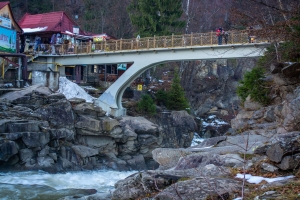
Yaremche is most Ukrainians’ first image of the Carpathians — and a hidden gem for international visitors. There is the Probii Waterfall right in the town centre, the old railway bridge from the late 19th century above the Prut river, and a long stretch of craft stalls selling Hutsul goods along the embankment. Nearby — Dovbush Rocks: stone megaliths up to 30 metres tall in the forest, where the opryshky outlaws once hid and where, according to legend, an untouched treasure still lies buried.
Bukovel — Ukraine’s number-one ski resort
In the village of Polianytsia near Yaremche lies Ukraine’s largest ski resort. Over 60 km of runs, lifts, an apres-ski scene, and hotels ranging from hostel to five-star. In winter there are queues of cars at the entrance — the price of fame. But snow quality and slope preparation justify the trip. In summer Bukovel opens for mountain biking, zip-lining, and mountain golf — if the last one appeals to you.
Halych — capital of a medieval state
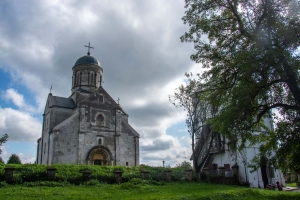
Halych was once the heart of the Principality of Galicia-Volhynia. Little survives of its former glory, but what does is unique. Halych Castle on the hill above the Dnister river, the Church of the Nativity, and nearby — the 12th-century Church of St Panteleimon in Shevchenkove — a rare surviving example of Galician Romanesque architecture. All within 30 minutes of Ivano-Frankivsk.
Kolomyia — a museum shaped like an egg
Kolomyia is the unofficial capital of Pokuttia and the city where the Pysanka Museum stands — the only museum in the world built in the shape of a giant decorated Easter egg (pysanka). Inside: 12,000 pysanky from every region of Ukraine and beyond. Next door — the Museum of Hutsul and Pokuttia Folk Art with one of the finest collections of Hutsul craftsmanship. Kosiv, 30 km away, has a Sunday craft market where you buy lizhnyky (woven blankets), pottery, and embroidery directly from the makers.
Maniava Hermitage — Athos in the Carpathians
A monastery in the forest near Maniava, founded in 1606. Defensive walls, a tower, a Baroque bell-tower, and a spring believed to have healing properties. After two centuries of abandonment it has been fully restored. The atmosphere is genuine medieval in a forest valley — no reconstruction theatre, no props.
Ivano-Frankivsk — a city with a centre worth lingering in
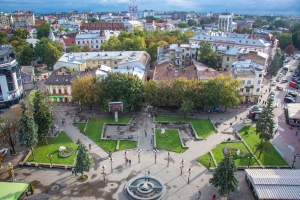
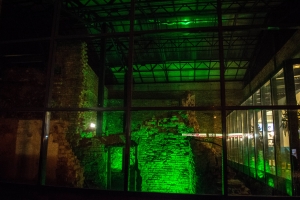
Ivano-Frankivsk is not just a transit hub before the mountains. The Town Hall with its local history museum, the remains of the Stanyslaviv fortress-bastion, the Collegiate Church of the Blessed Virgin Mary — a Baroque gem in the centre. The pedestrian Nezalezhnosti Street fills with people and coffee in the evenings, making the whole thing feel like a smaller, quieter version of Lviv — only closer to the mountains.
Colonel Hrim’s Bunker — the UPA underground in the mountains
The bunker of Colonel Hrim on Berezovachka mountain is a preserved hideout of a Ukrainian Insurgent Army (UPA) commander — real evidence of real underground resistance in the Carpathians. A small but telling landmark for anyone who wants to understand 20th-century history in this region.
Day Trips and Weekend Itineraries
Route 1. Ivano-Frankivsk + Halych in a day
Morning — Town Hall and the Collegiate Church, stroll through the historic centre. Lunch. Afternoon — 30 minutes by car to Halych: the castle on the hill and the Church of the Nativity. If time allows — the Church of St Panteleimon in Shevchenkove (5 min from Halych). Return in the evening. Perfect for those who want «city and medieval heritage» in one day.
Route 2. Yaremche — Hoverla — Bukovel over a weekend
Day 1: Yaremche — Probii Waterfall, Dovbush Rocks, the railway bridge. Overnight in Yaremche. Day 2: early start for Hoverla (depart from Zaroslyak, ascent 3–4 h), return to Yaremche — or drive on to Bukovel. The itinerary is physically demanding but entirely doable.
Route 3. The Hutsul Circle (2 days)
Kolomyia (Pysanka Museum, Museum of Hutsul Art) → Kosiv (Sunday craft market) → Maniava Hermitage → Verkhovyna (Hutsul guesthouses, alpine meadows). Optionally — a detour to Kryvorivnia, where Ivan Franko and Mykhailo Kotsiubynsky found inspiration and where «Shadows of Forgotten Ancestors» became Parajanov’s celebrated film. One of the most culturally rich routes in the Carpathians.
Must-Do Experiences in Prykarpattia
- Summit Hoverla at least once. Ukraine’s highest point demands good fitness and good weather. Both have to be earned.
- Eat bryndza (Hutsul sheep cheese) on an alpine meadow — with bread and spring onions, while there is still no mobile signal in the valley below.
- Buy a lizhnik blanket in Kosiv at the Sunday market — a hand-woven Hutsul wool throw with no real equivalent, not replicable by online shopping.
- Visit Maniava Hermitage. After two hours in a forest valley with a working monastery and a healing spring, you come back a different person. Or at least a rested one.
- Have coffee on Nezalezhnosti Street in Ivano-Frankivsk. The city has perfected the «smaller Lviv» rhythm — cafes, bookshops, pedestrians with dogs.
- Photograph the railway bridge in Yaremche at dawn. The 19th-century metal span above the Prut in morning mist is the most iconic image of the Carpathians.
- See the Pysanka Museum in Kolomyia. 12,000 decorated eggs inside a building shaped like an egg — absurd, artistic, and quintessential Hutsulshchyna at once.
- Take a wood-carving or pottery lesson at one of the Hutsul folk art centres in Verkhovyna or Kosiv.
In Kryvorivnia on the Verkhovyna highlands, Ivan Franko spent every summer. Mykhailo Kotsiubynsky wrote «Shadows of Forgotten Ancestors» here. Serhiy Parajanov filmed his masterpiece here. Hutsulshchyna inspired everyone who made the journey to reach it. That is not a coincidence.
Frequently Asked Questions
What to see in Ivano-Frankivsk in one day?
The Town Hall, the Collegiate Church, Nezalezhnosti Street with its cafes, and in the evening — the fortress bastion. If time allows — head to Halych (30 min).
Where to go on a weekend trip from Ivano-Frankivsk?
Yaremche + Dovbush Rocks — classic Carpathians and about six hours of active sightseeing. Halych — half a day in any weather. Maniava Hermitage + Kolomyia — cultural immersion in Hutsul heritage. Hoverla — if you are ready for the climb.
When is the best time to hike Hoverla?
The ideal window is June–September. July and August are safest but most crowded. May and October are beautiful but the summit may have snow. After October the ascent requires winter trekking gear.
Is it currently safe to visit Ivano-Frankivsk region?
The region is one of the safest in Ukraine with respect to active combat. There are occasional missile strikes on infrastructure, but tourist sites have not been affected. Monitor alerts via the «Air Alarm Ukraine» app.
Where to take children in Prykarpattia?
The Probii Waterfall in Yaremche — accessible right from the promenade, no difficult climbing required. Bukovel in summer — zip-lines, mountain bikes, and alpine atmosphere without skis. The Pysanka Museum in Kolomyia — children love the egg-shaped building before they even get inside.
When is the best season for Bukovel?
The ski season runs December–March (sometimes into April with good snowfall). The resort is open in summer for active outdoor pursuits. The least appealing time is November and early spring — no snow, no greenery, but at least no queues.
What are the most famous dishes of Hutsulshchyna?
Banosh — cornmeal porridge cooked in sour cream and topped with bryndza (sheep cheese) and cracklings. Bryndza — best bought directly from a shepherd on the alpine meadow. Hutsul bean borscht. Stuffed cabbage in fermented leaves. And horilka (spirit) infused with silver fir needles — though that one is not for everyone.
Ivano-Frankivsk region is a place people visit once and then return to every year. Not because they did not see everything. But because every visit offers something different: in summer — mountains and alpine meadows, in winter — snow-covered slopes, in spring — apple blossom in the foothills and melting snow on Hoverla.
If you have not decided where to start — start with Yaremche. It forgives any level of experience and leaves no one indifferent. The rest will take care of itself.
JoomShopping Download & Support