


- You are here:
-
Sights by Regions

-
Chornobyl Exclusion Zone
- Chornobyl
Chornobyl



Most people are convinced that Chornobyl is a nuclear plant and the ghost town of Pripyat. That's not quite right. Chornobyl is an ancient town with 830 years of history, first mentioned in 1193, back in the days of Kyivan Rus. Ukrainians, Poles, Lithuanians and Tatars lived here — and for 200 years, so did one of the most influential Hasidic dynasties in the world. The Chornobyl NPP and Pripyat appeared only in the 1970s. The real history of Chornobyl came long before them.
And one more thing: Chornobyl isn't exactly a «ghost town». Unlike Pripyat, people still live and work here — the administration of the Exclusion Zone, NPP staff, security, foresters, a handful of self-settlers. This is the capital of the Zone: dormitories, a canteen, a church, a shop, a museum, and the only working Lenin monument left in the country.
Important. Chornobyl has been closed to tourists since February 24, 2022. Following the occupation of the Zone by Russian troops and its subsequent liberation in April 2022, the territory is under a special regime. Tourist access has not been reinstated, and there are no official reopening dates. This article describes the town — to make sense of its history, and for those who will one day be able to return.
Town Fact Sheet
| Year Founded | First mentioned — 1193 (Hypatian Codex) |
| Administrative Status | Former town of district significance; now the administrative center of the Exclusion Zone |
| Historical Region | Kyiv Polissya (northern Kyiv region) |
| Population | Before 26.04.1986 — ~14,000. Now — ~100–150 rotational staff and a few self-settlers |
| Total Area | ~14 km2 |
| Main River | Pripyat (with its tributary, the Uzh) |
| Nicknames | Capital of the Zone, town of wormwood, old Chornobyl |
| Current Status | CLOSED to tourists since February 2022 |
In This Article
- What kind of town it is and why people go
- Location and character of the town
- History in brief
- Legends and mysticism
- Top things to see in Chornobyl
- Routes around the town
- What to do for sure (once it reopens)
- FAQ
What kind of town it is and why people go
Chornobyl is one of the oldest towns in the Kyiv region, with an unbroken history of more than 830 years. Its name comes from the herb chornobyl (common wormwood, Artemisia vulgaris), which grows in abundance along the banks of the Pripyat. In Slavic folk tradition, chornobyl is the «black herb» — a charm against evil spirits and a remedy against illness. It's the very same wormwood that the Book of Revelation calls the «Star Wormwood» (Revelation 8:11), poisoning a third of the waters.
People came (and will come again, when it becomes possible) for five things. First — to see the town whose name the whole world knows, yet almost no one has actually seen. Second — to walk past the «Wormwood Star» memorial with its plaques for 162 destroyed villages. Third — to stand by the last Lenin monument in Ukraine, never torn down because of the Zone's special status. Fourth — to feel the capital of the Zone in action: dormitories, a canteen, a church holding services for NPP workers. Fifth — to understand what the Hasidic capital of Polissya once looked like: until 1941, Chornobyl was one of the most important centers of Hasidism in the world.
Location and character of the town
Chornobyl sits on the right bank of the Pripyat River, where it meets the Uzh. The Chornobyl NPP is ~16 km to the north. The uninhabited Pripyat is ~20 km away. The border with Belarus is 16 km off. Kyiv lies 90 km to the south.
The town is small — its historic core fits inside a single walkable kilometer. There's no «central square» in the usual sense — Chornobyl grew as a trading town at a crossroads of trade routes, with a market square, churches, synagogues and a Jewish quarter. For most of the 19th–20th centuries Chornobyl was split into two parts: a Christian one (Ukrainians, Poles) in the north and a Jewish one in the south, with the market and bazaar on the dividing line.
Today the town has a clear functional structure: an administrative center of the Exclusion Zone with offices of the State Agency, hotels and dormitories for rotational staff, a canteen, a shop, a church, a museum. Everything else is abandoned houses, overgrown cobblestones, trees pushing through roofs. The town lives at two tempos at once: a working one (Monday to Thursday) and a memorial one (all the rest of the time).
When ordinary life still ran here. Before 1986 Chornobyl was a quiet district center of 14,000. It had a school, a hospital, the «Ukraina» cinema, a market, a river pier, several churches and three synagogues. A range of enterprises worked here: a furniture factory, metalware, food processing. When to visit. Until 2022 — April to October as part of organized tours. Now — no way. Access is closed.
History in brief
Ancient era and the Lithuanian principality
Chornobyl is first mentioned in 1193, in the Hypatian Codex, as a hunting spot of Prince Rostislav Rurikovich. In the 12th–13th centuries it was part of the Principality of Kyiv, a fortified frontier town. After the Mongol invasion of 1240, Chornobyl falls into serious decline. In 1362 it passes to the Grand Duchy of Lithuania, then to the Polish-Lithuanian Commonwealth (1569). In the 16th–17th centuries it becomes a town within the Kyiv Voivodeship, with its own castle, churches and marketplace.
The Russian Empire and the Hasidic capital (18th–20th c.)
In 1793, after the Second Partition of Poland, Chornobyl joins the Russian Empire, in the Kyiv Governorate. It is around this time that Rabbi Menachem Nachum Twersky (1730–1797) settles here — a disciple of the founder of Hasidism, the Baal Shem Tov. He founds the Chornobyl Hasidic dynasty, one of the most influential in the world. His descendants lead the community until the 1920s; some branches of the dynasty still live today in Israel, the USA and Belgium. To this day, Hasidim from all over the world come to Chornobyl's old Jewish cemetery — to the grave (ohel) of Menachem Nachum and his sons.
In 1897, 10,800 people lived in Chornobyl, 60% of them Jewish. The town was a typical shtetl: narrow streets of wooden houses, a market, synagogues, cheders (Jewish schools), batei midrash (houses of study and prayer).
World wars and the Holocaust
In the early 20th century Chornobyl endures pogroms (1905, and 1919–1920 during the Civil War) and the Holodomor of 1932–1933, which struck the surrounding villages. In 1941–1943 the town is under German occupation. Almost the entire Jewish population (~3,500 people) is murdered in mass shootings: the main execution took place on November 19, 1941. The old Jewish cemetery and the synagogues are partly looted; the center of the Hasidic dynasty ceases to exist in Chornobyl. After the war the population recovers on a new basis — now exclusively Slavic.
The Soviet period and the atomic age
In 1970, construction of the Chornobyl NPP and its satellite town of Pripyat begins nearby. Chornobyl remains a quiet district center, but its economy becomes tied to the plant. By 1986 around 14,000 people live here. On April 26–27, 1986, after the disaster at the NPP, Chornobyl is partly evacuated: most residents were moved out on May 5. The Zone administration, the foresters and the plant's security were not evacuated.
Capital of the Zone and the war of 2022
Since 1987, Chornobyl has been the administrative center of the Exclusion Zone. It holds the dormitories and offices of the State Agency managing the Zone, the «Chornobyl Forest» service, NPP security, and research institutes. In the 2010s the town became a base for tourism — with excursion offices, the «10» hotel, a few cafés. On February 24, 2022, Russian troops occupy Chornobyl within hours. The occupation lasts until March 31, 2022. The town itself was only lightly damaged, but the surrounding areas were mined and the infrastructure partly looted. After liberation, tourist access was discontinued.
Chornobyl is 777 years older than Pripyat. While Pripyat didn't yet exist even as an idea, a town already stood here, a trading square bustled, synagogues and three churches were at work. The great paradox of the 20th century: the name of an ancient town became the name of the worst man-made disaster of the century. Even though the plant itself stands not in Chornobyl, but between Pripyat and Yaniv.
Legends and mysticism
1. The Star Wormwood from the Book of Revelation
The most famous «legend» of Chornobyl isn't a legend at all — it's an apocalyptic prophecy. The Book of Revelation (8:10–11) speaks of a great burning star falling from the sky, whose name is Wormwood, turning a third of the waters bitter. In Ukrainian, «wormwood» (polyn) is precisely chornobyl (Artemisia vulgaris). After April 26, 1986, Christians around the world began pointing to the coincidence: Chornobyl = Wormwood = the Star of the Apocalypse. The town's memorial itself is named «Wormwood Star» — a direct reference to this biblical parallel.
2. The treasure of the Chornobyl rebbe
According to Hasidic tradition, before his death in 1797 Menachem Nachum Twersky, founder of the Chornobyl dynasty, hid away a silver chest for the good of his community: ritual ornaments from the synagogues, manuscripts by disciples of the Baal Shem Tov, correspondence with other tzaddikim. Until 1941 it was passed from rebbe to rebbe; during the Holocaust the trail of the treasure goes cold. Some Hasidim believe it lies buried in a vault beneath Chornobyl's old synagogue — a building of which only the foundations remain. Expeditions searched (up to 2022) and found nothing.
3. Seven days of weeping and the self-settlers
Among the self-settlers of the Chornobyl Zone there's a tale: when the evacuation began in 1986, the forest and the water cried out in pain for seven days and seven nights. Old people (especially those who later returned) used to say voices could be heard, like a choir that isn't allowed to sing. On the seventh day everything went quiet. The self-settlers believe that ever since, the land of Chornobyl «keeps its silence», and whoever listens at dawn can hear it — more real than anywhere else. That's also how they explain the Zone's distinctive hush (no cars, no advertising, no people) — not merely acoustic, but something that rises from the earth.
Top things to see in Chornobyl
The «Wormwood Star» Memorial
The «Wormwood Star» memorial is the central place of remembrance for the entire Zone. An alley lined with plaques for 162 evacuated villages, each with its name and the date it vanished. It's the town's most powerful emotional landmark: walking between the plaques, you read the names of villages still remembered by the parents and grandparents of people from all across Polissya. The memorial's name is a direct reference to the Book of Revelation (8:11). It was created in 2011 for the 25th anniversary of the disaster.
The last Lenin monument in Ukraine
The last Lenin monument in Ukraine is the only public Lenin statue left in the country after the «Leninopad» (the toppling of Lenin statues) of 2014–2017. It was never removed because of the Exclusion Zone's status (formally, monuments inside the Zone fell outside the scope of the decommunization law). Paradoxically, this makes Chornobyl the only town in Ukraine where such an object still stands. A small bronze figure on a pedestal, already deeply sunk into nature and time.
St. Elijah Church — alive in a dead zone
The St. Elijah Church is the oldest surviving temple in Chornobyl. Originally wooden, built in the 17th century, rebuilt in stone in the 19th. It's one of the few active Orthodox churches in the Zone: services are still held here for NPP workers and self-settlers. Inside is a 19th-century iconostasis and icons, some brought in after the disaster from evacuated villages. In October 2017, Ecumenical Patriarch Bartholomew visited — the first visit of that rank in the Zone's history. It is not yet covered on the site as a separate page.
The Twersky ohel — the grave of the Chornobyl rebbe
In Chornobyl's old Jewish cemetery stands an ohel (a Jewish mausoleum) over the grave of Menachem Nachum Twersky — founder of the Chornobyl Hasidic dynasty — and his son Mordechai. In the 2000s the site was fully restored through the efforts of the dynasty's descendants abroad. Hasidim came here from Israel, the USA and Britain — on the anniversary of the rebbe's death (the 11th of Cheshvan in the Jewish calendar), up to 200 pilgrims would gather in Chornobyl. It is a religious site and calls for respect for local customs. It is not yet covered on the site as a separate page.
The Memorial Alley to the liquidators and the firefighters’ monument
In the center of Chornobyl stands a monument to the firefighters and liquidators of the NPP, the first to arrive at the disaster site on the night of April 26, 1986. The sculpture depicts a group of firefighters in protective gear holding pocket lamps. On the pedestal are the names of those who died of radiation sickness in the weeks and months that followed. Nearby is the Memorial Alley with plaques bearing village names and surnames. It is not yet covered on the site as a separate page.
The «Star Wormwood» museum and the equipment exhibit
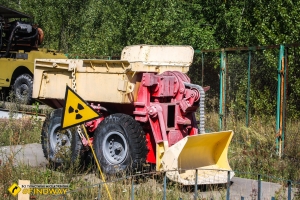
In the building of a former cinema in Chornobyl is a museum of the disaster's history, with photographs, documents, the personal belongings of evacuees, dosimeters and the protective suits of the liquidators. Beside it is an open-air exhibit of the liquidators’ equipment: the «Joker» robot (a West German machine that couldn't withstand the radiation), Soviet APCs, tracked bulldozers. It's one of the best themed museums in the Zone.
The Zone administration and the «living» Chornobyl
What sets Chornobyl apart from Pripyat: there's life here. The administrative building flies the flag of the State Agency managing the Zone; there's the «10» hotel for rotational staff, a canteen in classic Soviet architecture, the «Raduga» (Rainbow) shop with a bare-minimum range of goods, a playground by the dormitory (even if there are no children). You might see people in work clothes returning from the NPP, or foresters coming out of the woods with their gear. It's not a tourist attraction, but it's a scene you'll find nowhere else in the Zone.
Abandoned quarters and the old Jewish cemetery
Most of Chornobyl is abandoned development: one- and two-story houses from the 1950s–1970s, overgrown gardens, old cobblestones. The most atmospheric spot is the old Jewish cemetery on the southern edge of town, with stone matzevot (gravestones) from the 18th–19th centuries. Cyrillic and Hebrew inscriptions side by side, some fallen, some standing straight. This is where the town's pre-1986 ancient history can be felt in the flesh.
Routes around the town
The routes below are the classics for tourists of 2010–2021. Closed for now. Keep them as reference points for a future reopening.
Route 1. Chornobyl in half a day (as a stop en route to Pripyat)
Entry through the «Dytiatky» checkpoint (~90 km from Kyiv). The «Wormwood Star» memorial → the last Lenin → the firefighters-and-liquidators monument → St. Elijah Church → a short walk through the center → on toward Pripyat. ~3 hours.
Route 2. Deep Chornobyl (a full day)
All the stops of Route 1 + the museum of the disaster's history with the open-air equipment exhibit + the Twersky ohel at the old Jewish cemetery + a walk through the abandoned quarters + lunch in the canteen with the NPP's rotational staff. A meeting with a self-settler in one of the open villages around — by arrangement with your guide. A full day for those who've already seen Pripyat and want to go deeper.
Route 3. Hasidic Chornobyl (themed)
For lovers of Jewish history and Hasidism. The old Jewish cemetery with the ohel of Menachem Nachum Twersky and his sons. The sites of former synagogues (foundations only). The former Jewish quarter with its abandoned houses. The 1941 execution site with a memorial marker. It pairs beautifully with the Hasidic pilgrimage routes across Ukraine (Uman, Medzhybizh, Berdychiv).
Route 4. Chornobyl + Duga (one day)
Half a day in Chornobyl on Route 1, then on to the Duga over-the-horizon radar deep in the forest. The most «Cold War» route of all: an ancient town plus a Soviet mega-object. A route for anyone who's read about the USSR's espionage technology.
Route 5. Winter Chornobyl
Especially for the lucky few who got to be in the Zone in winter (it was rarely done). The silence doubles under the snow. The «Wormwood Star» memorial, the Lenin monument, St. Elijah Church — in completely different light. The road to the NPP under snow. Not a tourist route as such, but an atmospheric chance for those who get lucky.
What to do in Chornobyl for sure (once it reopens)
- Walk the entire alley of the «Wormwood Star» memorial slowly and read all 162 plaques with the names of the evacuated villages. It's the town's most important experience.
- Photograph the last Lenin in Ukraine against a crumbling facade — a historical snapshot that won't exist anywhere else.
- Step into a service at St. Elijah Church (when it's open) — one of the few active parishes in the Zone.
- Stand by the Twersky ohel — one of the oldest surviving Jewish sacred sites in Ukraine.
- Take a close look at the equipment exhibit: the «Joker» robot, APCs, bulldozers — machines that protected the world at the cost of their own «health».
- Have lunch in the canteen with the NPP's rotational staff — a one-of-a-kind experience: eating borscht with the people who service the sarcophagus every day.
- Talk to a self-settler guide, if you manage to meet one — the richest oral history in the Zone.
- Stroll the old Jewish cemetery at dawn: one of the quietest places in Ukraine.
- Buy a souvenir at the «Raduga» shop — a postcard, a magnet, a mug. Support for the economy of those who stay in the Zone.
- Listen to the silence in the center. The self-settlers say there's something more to hear — see for yourself.
According to archaeologists, a settlement existed on the site of Chornobyl as far back as the 10th–11th centuries — long before the first written mention in 1193. That makes Chornobyl an actual contemporary of Kyiv in the age of Volodymyr the Baptizer. The great paradox of the 20th century: the name of an ancient town, a peer of Kyivan Rus, is associated in world culture with 1986 — a brief instant in its very long history.
Frequently asked questions
How is Chornobyl different from Pripyat?
In almost everything. Chornobyl is an ancient town from 1193, with 800 years of history, churches, a Jewish heritage, a Hasidic dynasty. Pripyat is a Soviet project of the 1970s, built as a satellite of the NPP. Chornobyl is partly inhabited (administration, rotational staff, self-settlers). Pripyat is completely uninhabited. Chornobyl is 16 km from the NPP, Pripyat just 3.
Can you visit Chornobyl right now?
No. Tourist access has been suspended since February 24, 2022. The Zone is under a special regime because of the war, the mining of the territory, and changes to NPP security. The Zone's administrative center in Chornobyl keeps operating, but it's open only to staff, not tourists.
Do people live in Chornobyl now?
Yes. ~100–150 rotational staff (administration, security, science, foresters, technical personnel) work in shifts: 4 days in the Zone, 4 days outside. Plus a few dozen self-settlers — elderly people who returned after the disaster and live in abandoned houses. There is no permanent civilian population in Chornobyl.
Where does the name «Chornobyl» come from?
From the herb chornobyl — common wormwood (Artemisia vulgaris), which grows in abundance along the banks of the Pripyat. In Slavic tradition, chornobyl is the «black herb», a charm against evil spirits. This same wormwood is called the «Star Wormwood» in the Book of Revelation (8:11), poisoning a third of the waters. After 1986 the parallel became known worldwide.
What happened to Chornobyl in 2022?
On February 24, 2022, Russian troops entered the Zone from Belarus and seized Chornobyl and the NPP within hours. The town was under occupation until March 31, 2022. The NPP was held in a hostage-like regime: staff were rotated only once during the entire month. Russian soldiers dug trenches in the Red Forest (with signs of acute radiation sickness). After the Kyiv counter-offensive of April 2022, the Zone was liberated.
Do Hasidim come to Chornobyl?
Until 2022 — yes, regularly. The Chornobyl Hasidic dynasty of the Twerskys is one of the most influential in the world, with centers in Israel, the USA and Belgium. They came to the grave of Menachem Nachum Twersky (founder of the dynasty, 1797) on the anniversary of his death (the 11th of Cheshvan in the Jewish calendar). Access is now restricted, as it is for all other visitors.
Why is there still a Lenin monument in Chornobyl?
The 2015 decommunization law called for the removal of all monuments to figures of the communist regime across Ukraine. However, monuments inside the Exclusion Zone legally fell outside the scope of the law: formally, they are «preserved Soviet heritage», part of the historical context of the disaster. That's why the Lenin monument in Chornobyl remained the only public monument of its kind in Ukraine.
How can you understand Chornobyl without going there?
Books: «Chernobyl Prayer» (Voices from Chernobyl) by Svetlana Alexievich, and «Midnight in Chernobyl» by Adam Higginbotham. Documentaries: «The Battle of Chernobyl» (Discovery), «The Babushkas of Chernobyl» (about the women self-settlers). The HBO series «Chernobyl» (2019) is the best reconstruction of the first year after the disaster.
Chornobyl is a town of two histories. The first — 800 years of an ancient Polissyan town with markets, synagogues, Hasidic rebbes, churches and craftsmen. The second — 40 years as the administrative center of the most famous man-made disaster in the world. The second history completely overwrote the first in the eyes of the planet — but the first never went anywhere. It simply hid behind a word that the whole world now says with dread.
One day Chornobyl will reopen. Until then, the town lives on in memory, in books, in documentaries. And in the stone matzevot of the Jewish cemetery, which will stand here as they have stood for 200 years — silent and unshaken.
JoomShopping Download & Support