


- You are here:
-
Sights by Regions

-
Chornobyl Exclusion Zone
- Over-horizontal radar station «Duga», Chornobyl-2


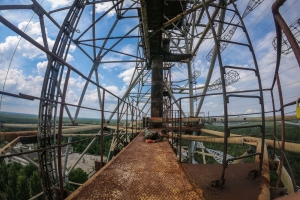


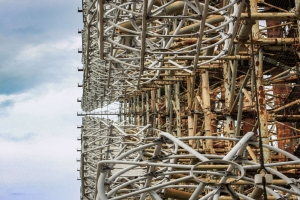
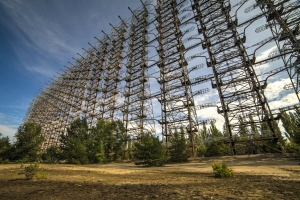
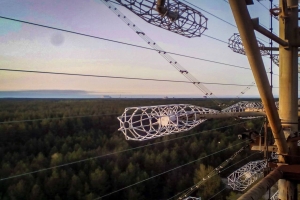


Picture a steel wall 150 metres tall and almost 750 metres long. Picture it standing among Ukrainian forests for over 13 years, eavesdropping on half the planet — and officially "not existing" at all.
On Soviet maps, its location was marked as a children's summer camp. On aerial photos — empty woods. On the radio waves — only a sharp, rhythmic tapping that drove ham operators from Alaska to Antarctica out of their minds. This is Duga radar — the most expensive, and arguably the most absurd, Soviet radar you can still see with your own eyes.
Quick facts
| Location | Chornobyl Exclusion Zone, near the former village of Chornobyl-2 (Ivankiv Raion, Kyiv Oblast, Ukraine) |
| Antenna height | ~150 m (large array) + ~100 m (small array) |
| Antenna length | approx. 750 m |
| Years in operation | 1976–1989 |
| Access | only as part of an official Exclusion Zone tour (currently restricted due to the war) |
| Time to explore | 1–1.5 hours (usually within a full-day Zone tour) |
In this article
- What Duga is and why the Soviets built it
- Tech specs that drop your jaw
- Chornobyl-2: the secret town that wasn’t on any map
- Why it was nicknamed the "Russian Woodpecker"
- How it worked (and why it annoyed the world)
- Why the radar went silent
- Legends, conspiracies, and "Chornobyl was no accident"
- Duga in pop culture
- Duga today
- What to see on site
- How to get there
- Traveller’s checklist
- Frequently asked questions
What Duga is and why the Soviets built it
Duga was a Soviet over-the-horizon (OTH) radar designed for early ballistic missile warning. Its job was simple and paranoid in equal measure: to detect the launch of American intercontinental ballistic missiles within minutes of liftoff and give Moscow precious extra time to respond.
A normal radar can only see as far as the horizon — beyond that, the curvature of Earth gets in the way. Duga cheated physics elegantly: it bounced its powerful shortwave signal off the ionosphere to "peek" beyond the horizon. From a clearing in the Ukrainian forest, the radar could theoretically watch missile launches on US soil up to 4,500 km (≈ 2,800 mi) away.
The Soviet budget for this project came in around 7 billion rubles. Building the entire Chornobyl Nuclear Power Plant cost roughly half that. In money terms, Duga was "two ChNPPs."
And this was just one of three identical sites — the other two stood near Mykolaiv (Ukraine) and Komsomolsk-on-Amur (Russian Far East).
Tech specs that drop your jaw
Numbers explain better than any hype why Duga was nicknamed the "eighth wonder of the world":
- Height: 150 m for the large array (about as tall as a 50-storey building); 100 m for the smaller one.
- Antenna length: up to 750 m.
- Transmission power: over 10 MW.
- Construction: hundreds of massive dipoles mounted on a steel mesh.
For comparison: the average kitchen microwave puts out 0.8 kW. Duga was 12,500 times more powerful.
Up close, it’s a silent geometric forest of steel rebar visible from tens of kilometres away. Soviet engineers built it to be visible from space — and at the same time to be unrecognisable to the West for as long as possible.
Chornobyl-2: the secret town that wasn’t on any map
The radar was operated by a small, classified military settlement called Chornobyl-2. Around a thousand servicemen and their families lived here in ordinary-looking five-storey apartment blocks — they shopped at the local store, walked their kids to kindergarten, celebrated New Year. All of them under strict non-disclosure.
On Soviet topographic maps, the entire complex was labelled as... a children’s pioneer camp. To this day, on the road to the site there’s a bus stop decorated with a mosaic of Misha — the bear mascot of the 1980 Moscow Olympics.
It looks like a piece of children’s storybook scenery. Who would ever guess that behind that bear hid one of the largest radars on the planet.
Today Chornobyl-2 is abandoned barracks, a school with peeling walls, a gym with collapsed rafters, and an endless silence. The antenna stays visible for kilometres in every direction — wherever you walk in the forest, it will always be there above the pines.
Why it was nicknamed the "Russian Woodpecker"
In July 1976, ham radio operators around the world started picking up something strange in their gear: a sharp, rhythmic tapping at roughly 10 Hz, blanking out dozens of bands from commercial to civilian.
The signal pushed itself across the airwaves so brazenly that thousands of complaints poured in from the US to Australia — from commercial airlines, maritime communications, even ministers whose Sunday morning church radio kept getting cut.
For years, the West couldn’t figure out what it was. First guess — a new Soviet communications system. Then — a psychotronic weapon (yes, seriously). Then — a weather control device. Eventually radio amateurs settled on an unofficial name: The Russian Woodpecker. The nickname stuck to Duga forever.
How it worked (and why it annoyed the world)
The principle was brutally simple: the radar fired a powerful radio pulse upward, the pulse bounced off the ionosphere, came back down over the target territory, bounced off the target (say, the body of a missile), travelled the same path back — and the antenna caught the returning echo.
The catch was that Duga’s frequencies overlapped with international radio bands. Its pulses jumped chaotically across frequencies, and every "landing" of the signal would blank out whatever happened to be playing on the air at that moment.
Soviet engineers, to put it mildly, didn’t care — those priorities had been set long before them. Western countries filed official protests for years; radio manufacturers developed special notch filters to cut out "the tapping." Some guitar effects pedals from that era literally had a "Russian Woodpecker filter" button. That’s not a joke.
Why the radar went silent
Duga officially operated from 1976 to December 1989. In 13 years, it was never accepted into combat duty. The radar saw "too much" and "the wrong things": false targets from auroras, magnetic storms, ordinary commercial flights. Its target-discrimination systems just couldn’t cope.
And then came Chornobyl. On 26 April 1986, Reactor No. 4 of the Chornobyl Nuclear Power Plant exploded — and Chornobyl-2 found itself right inside the evacuation zone. The military shut down the equipment, packed up the documentation, locked the doors, and left.
A little over three years later, the project was officially closed. Some equipment was dismantled and shipped to the Soviet Far East (where nobody needed it either). The antenna stayed standing. There was simply no point in dismantling it — too massive, too radioactive around it.
Legends, conspiracies, and "Chornobyl was no accident"
This is where it gets juicy. Duga is a darling of conspiracy theorists on every continent, and their versions range from goofy to creepily logical. Here are the three big ones.
1. A psychotronic weapon
The "Woodpecker’s" tapping supposedly affected human psyches within thousands of kilometres — causing depression, insomnia, and headaches. Believers point to graphs claiming that suicide rates rose in certain Soviet regions during Duga’s active years. Engineers just laugh: physics doesn’t allow a low-frequency signal to do that. But the theory lives on anyway.
2. Weather control
Some authors argued that Duga could affect the ionosphere so powerfully that it changed the weather. No serious meteorologist takes this seriously, but "Duga the weather cannon" still drifts around the internet.
3. Chornobyl as a cover-up (the darkest version)
Ukrainian filmmaker Fedir Aleksandrovych made the documentary The Russian Woodpecker (2015), which won the Sundance Grand Jury Prize. In it, he proposes that the Chornobyl disaster was orchestrated on purpose. The radar didn’t work, billions had been spent, and the people responsible needed cover — so the explosion of Reactor No. 4 conveniently buried Duga’s failure under a planet-scale catastrophe.
The theory is — to put it mildly — exotic. But the film is worth watching regardless, even just as a piece of Cold War provocation cinema.
Whether to believe any of this is a matter of taste. Reality is far less dramatic: the radar simply didn’t work properly, the USSR was falling apart, money ran out, the project got shelved. Still, "Duga as a mysterious weapon" is the image around which an entire subculture has grown.
Duga in pop culture
The antenna is so photogenic and ominous that since the 2010s it has become a Cold War icon:
- S.T.A.L.K.E.R.: Shadow of Chernobyl — a key location in this cult Ukrainian video game, named "the Brain Scorcher."
- Chernobyl (HBO, 2019) — the antenna appears repeatedly in frame, adding extra dread to the show.
- The Russian Woodpecker (2015) — Aleksandrovych’s investigative documentary mentioned above.
- Call of Duty: Black Ops Cold War — Duga shows up here too.
Thanks to all of this, the radar has gone from a classified military object to a cultural icon of the Cold War — the kind of place travellers want to be photographed in front of.
Duga today
Until 2022, Duga was one of the most visited stops on official tours of the Chornobyl Exclusion Zone. Tourists got the full story, were allowed to walk right up to the base of the antenna, and tried (in vain) to capture its scale on camera — it’s genuinely impossible to convey through photos. You have to see it live.
After 24 February 2022, everything changed. The Exclusion Zone was briefly under Russian occupation; after liberation, access was closed because of mine danger and the area’s status as a frontline territory.
Tours into the Zone are currently suspended or heavily restricted. If you’re planning a visit, check the latest status with licensed operators and Ukraine’s State Emergency Service. Even so, the antenna is still standing — silent, rusting, unforgettable. When the war ends, people will come back to it.
What to see on site
The antenna itself. The main reason to come. Walking right up to the base of a 150-metre steel grid and looking up is something photographs can’t convey. Less talking, more standing — that’s the rule here.
The command post and equipment halls. Concrete bunkers that once held racks of Soviet electronics. Today — emptiness, graffiti on the walls, leftover cables. Pure 1980s sci-fi atmosphere.
The residential part of Chornobyl-2. Abandoned five-storey blocks, school, kindergarten, gym. A quiet domestic tragedy sitting next to the radar’s gigantomania.
The "bus stop with the bear." That same bus stop with the Olympic Misha mosaic. Probably the most photogenic Soviet artefact within 100 km — a tiny detail that tells the whole absurd story of Soviet secrecy better than any plaque.
How to get there
Official Exclusion Zone tour. This is the only legal way. Licensed operators run tours from Kyiv (one-day or with overnight in Chornobyl). The itinerary almost always covers Pripyat, the ChNPP, and Chornobyl-2 (i.e. Duga). Pre-2022 prices started at $80–120 per person for a one-day tour. Today availability is limited.
On your own, illegally. Strongly discouraged. The Exclusion Zone is a restricted territory; entering without a permit is a criminal offence, and post-2022 there are real minefields. "Stalking" the Zone today isn’t romance — it’s a criminal record plus the risk of being blown up.
The smart move. Wait for tours to resume and follow updates from the State Agency of Ukraine on Exclusion Zone Management (DAZV) and licensed tour operators.
Traveller’s checklist
What to bring:
- Passport or photo ID — without it you won’t pass the Zone checkpoint.
- Sturdy boots with thick soles — there’s a lot of rebar and broken glass around the radar.
- Long sleeves and trousers — minimises contact with dust.
- A dosimeter — even if you’re not nervous, watching the numbers is half the fun.
- A flashlight — for the equipment halls and bunkers.
- Cash — cards barely work inside the Zone.
What NOT to do:
- Fly drones without permission — strictly prohibited, the fine is steep.
- Sit on the ground, touch moss, or take "souvenirs" out of the Zone.
- Drink alcohol on the tour — sober guides will not forgive it.
Frequently asked questions
Is it safe to stand near Duga? Is the radiation high?
Right under the antenna, background radiation is usually 0.5–2 µSv/h — close to natural levels. The radar itself isn’t radioactive; it just happens to stand in an area later contaminated by the Chornobyl fallout. On nearby "hotspots" the level can spike tens of times higher — but guides don’t take you there.
How much time do I need on site?
Usually 1–1.5 hours within a one-day Zone tour. If you have a chance, allow more — the location is genuinely large.
Can I climb the antenna?
No. Strictly forbidden. The structure is old, corrosion is heavy, the risk to life is real. Guides won’t let you, and security will fine you.
Why hasn’t Duga been scrapped for metal?
People have tried. But the scale and logistics of dismantling a 150-metre structure inside the Exclusion Zone is its own multi-million-dollar project. For now it’s simply cheaper to leave it standing — and now that it’s a Cold War landmark, it’s worth more in tourism than in scrap.
When is the best season to visit Duga?
Late April to May (greenery hasn’t covered the concrete yet, weather isn’t too hot) and September to early October (golden forest plus moodily grim buildings). Winter is beautiful but bitterly cold standing in the open under the antenna.
Duga isn’t just an abandoned radar in the woods. It’s a physical monument to the paranoia of an entire era — a state that decided spotting missile launches mattered more than half the planet’s normal radio reception, built a steel wall as tall as a 50-storey building, poured the budget of two nuclear power plants into it, hid the whole thing behind an Olympic teddy bear on a bus stop — and then quietly switched it off and walked away.
Standing under this monster and looking up, you start to understand: the Cold War wasn’t about two flags and grainy black-and-white photos. It was about kilometre-long antennas in Ukrainian forests that were supposed to save the world and, instead, just tapped on the radio for years.
And yes — that tapping that drove American hams crazy is now silence. You came here to listen to silence. That’s the whole point.
JoomShopping Download & Support
Attention! Part of Ukraine was occupied during Russia's unfounded military aggression against us and other democratic countries!
russia is a terrorist country, russians are murderers, thieves and rapists.
Russia's unhuman aggression against Ukraine since 2014 has led to the loss of homes and lives not only of many Ukrainians, but also of citizens of other countries and nationalities.
We consider any military actions against any state in the 21st century unacceptable and stupid, but unfortunately the Russians do not think so, and therefore many democratic countries, including Moldova, Georgia and our homeland, suffer from barbaric aggression.
Therefore, until the occupied parts of Ukraine are demilitarized and returned to our state, we remind users about the real danger of visiting the territories occupied by russia.