


- You are here:
-
Sights by Regions

-
Chornobyl Exclusion Zone
- Abandoned railroad Pripyat-Ovruch


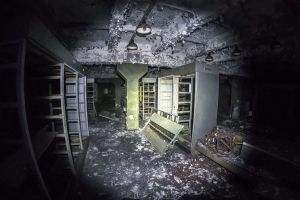





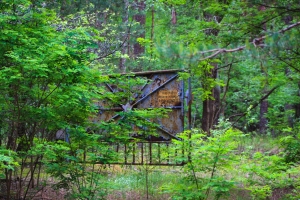
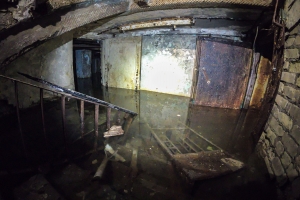

Among the pines of the Exclusion Zone stand antenna fields that no tour trail leads to. While thousands of tourists were photographing the giant "Duga", a few kilometers away its quiet partner was working — a station without which the radar would have been deaf.
This is VNZ "Kruh" — an oblique-incidence ionosphere sounding facility. It never sent a signal over the horizon. It listened to the sky and told "Duga" at what altitude radio waves were bouncing back that day.
Location card
| Location | Chornobyl Exclusion Zone, next to the Chornobyl-2 complex |
| Distance | ≈ 120 km north of Kyiv |
| Time on site | part of a Chornobyl-2 route (1–2 hours) |
| What to bring | official permit, dosimeter, sturdy footwear, water, flashlight |
What it is and why visit
"Kruh" is an oblique-incidence ionosphere sounding station. In simple terms: it sent a diagnostic radio signal upward at an angle, picked up the echo bouncing back from the ionosphere, and calculated how the upper atmosphere over Ukraine — and beyond the horizon — was behaving that day.
Why did the over-the-horizon "Duga" radar need this? Because "Duga" didn't see its targets directly — it relied on shortwave reflections off the ionosphere. And the ionosphere is moody: it shifts with solar activity, magnetic storms, and the time of day. Without constant measurements, the radar would have been "missing the mark". This is exactly where "Kruh" came in: it gave operators an up-to-date "map of the sky".
People don't come here for a giant-antenna spectacle — "Duga" itself provides that. "Kruh" is interesting for a different reason: it's a rare chance to see the invisible engineering of the Cold War, the technical "ear" of the system that almost nobody writes about.
History
In the late 1970s, in the forests north of Chornobyl, the USSR built the Chornobyl-2 complex — the receiving node of the "Duga" over-the-horizon radar. The antenna itself stood about 150 meters tall, and on the airwaves the station earned the nickname "Russian Woodpecker" for its distinctive tapping sound, picked up by radio amateurs worldwide from 1976 to 1989.
The over-the-horizon principle only worked when the system knew the exact state of the ionosphere. So alongside the combat antennas ran a network of auxiliary diagnostic stations — sounding sites, "Kruh" among them. They measured the "transparency" and altitude of the reflective layers around the clock, feeding the data to the command post.
The most expensive radar of its era was only as accurate as the modest sounding station that measured the sky each minute.
It all stopped in April 1986. After the Chornobyl disaster the zone was evacuated, and the entire radar complex fell silent along with it. The military removed equipment for a while afterward, but "Duga" never returned to duty. The sounding stations were left standing in a forest that slowly swallowed them.
Legends and lore
More myths have grown up around "Duga" and its stations than there are pines in the zone. Here are the most persistent ones.
1. Psychotronic weapon
A favorite of conspiracy theorists: the complex supposedly "mind-controlled" the population from a distance. In reality there's no evidence for this — the stations only listened to and sounded the ionosphere. But the "woodpecker" tapping on the airwaves added a layer of eeriness to the story.
2. Weather control
Locals used to say "the antennas scatter the clouds". A simple coincidence: powerful transmitters, a closed zone, and total secrecy generate any theory faster than an official explanation ever could.
3. Chornobyl as a cover story
The boldest legend claims the Chornobyl nuclear plant was built "to mask" the radar. The timeline doesn't support this, but the proximity of a nuclear plant and an ultra-secret radar forever wove their histories together.
What to see on site
Antenna fields. Rows of posts and guy-wires, between which the sounding antennas' panels used to stretch. A geometry still readable even through young forest growth.
Equipment buildings. Low concrete structures that housed the diagnostic hardware. Inside — empty racks, cable runs, and silence.
The neighboring "Duga". The main reason to come to this corner of the zone. "Kruh" makes sense as part of the same route as the giant Chornobyl-2 antenna.
How to get there
The most important thing about its status. The Chornobyl Exclusion Zone borders Belarus and, since 2022, has been a border and military area. Under martial law, regular tourist visits to the zone are closed. There is no such thing as an "independent" trip to the Chornobyl-2 objects.
When it might reopen. Access to the zone is regulated by the state and can change. Check the current status before planning anything — on the official resources responsible for the zone.
Roughly. The site sits in the northern part of the zone, about 120 km from Kyiv, next to the Chornobyl-2 complex.
Traveler's checklist
- An official permit and escort — the only legal way to get near the site.
- A dosimeter — background radiation in the zone is uneven, with local hotspots.
- Covered clothing and sturdy footwear — forest, metal, concrete.
- Water and snacks — there's no infrastructure here.
What not to do: don't leave the route, don't touch or pick up objects, and definitely don't plan any illegal entry into a border military zone.
Frequently asked questions
Can I visit now?
No. Because of martial law and its border status, the Exclusion Zone is closed to tourist visits. This isn't a place you can plan a "weekend trip" to.
What's the difference between "Kruh" and "Duga"?
"Duga" is the combat over-the-horizon radar. "Kruh" is an auxiliary ionosphere sounding station that supplied "Duga" with data on the state of the upper atmosphere.
Is the radiation level there dangerous?
Background radiation in the zone is uneven: there are relatively clean areas and local "hot" spots. That's why a dosimeter and an escort are mandatory.
Was it really a psychotronic weapon?
No. It was a technical ionosphere-diagnostics station. The "mind control" stories are a myth born from the site's secrecy.
"Kruh" is easy to overlook next to the giant "Duga" — and that's exactly its quiet greatness. The most expensive radar in the USSR could see over the horizon only because something nearby was measuring the sky every minute.
Today the antennas are silent, the forest is closing in, and the zone is shut. But the story of this Cold War "ear" hasn't gone anywhere — it's just waiting for the day Chornobyl can be visited again.
JoomShopping Download & Support
Attention! Part of Ukraine was occupied during Russia's unfounded military aggression against us and other democratic countries!
russia is a terrorist country, russians are murderers, thieves and rapists.
Russia's unhuman aggression against Ukraine since 2014 has led to the loss of homes and lives not only of many Ukrainians, but also of citizens of other countries and nationalities.
We consider any military actions against any state in the 21st century unacceptable and stupid, but unfortunately the Russians do not think so, and therefore many democratic countries, including Moldova, Georgia and our homeland, suffer from barbaric aggression.
Therefore, until the occupied parts of Ukraine are demilitarized and returned to our state, we remind users about the real danger of visiting the territories occupied by russia.