


- You are here:
-
Sights by Regions

-
Chornobyl Exclusion Zone
- Radioactive sedimentation of vehicles «Buryakovka»


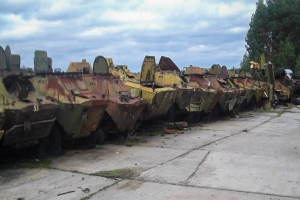


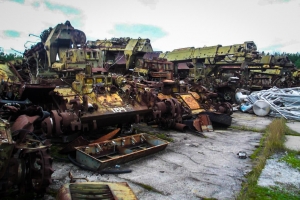

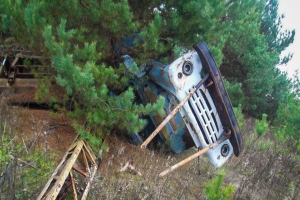
From the air, Buriakivka looks like a cemetery. Not of people — of machines. A field 1,200 by 700 metres wide, thirty rectangular trenches, thousands of vehicles. Mi-8 and Mi-26 helicopters, armoured personnel carriers, bulldozers, fire tankers, trucks, mining machines. All of them parked at the same moment, in 1986–1987. None of them going anywhere ever again.
This is the Buriakivka Radioactive Waste Disposal Site — known in the Exclusion Zone by its Ukrainian acronym PUZRV. Everything that took the first blows of the disaster was brought here: vehicles that flew over the reactor, dug tunnels beneath it, hauled sand to the burning block. Not a single component in any of these machines could ever be scrubbed clean of radionuclides.
Location Card
| Location | near former village of Buriakivka, ~17 km west of ChNPP, Exclusion Zone, Kyiv Oblast |
| Site area | ~1,200 × 700 m (approx. 84 ha) |
| Number of trenches | 30 |
| Active intake years | 1987–1996 |
| What was buried here | helicopters, APCs, bulldozers, tankers, IMRs, fire engines, the «Joker» robot |
| Status | active disposal site managed by the State Radioactive Waste Management Enterprise |
| Access | special permit from the State Agency of Ukraine on Exclusion Zone Management only; no tourist groups |
| What to bring (if permitted) | respirator, dosimeter, permit, closed footwear and clothes you’re willing to discard |
In This Article
- What Is the Buriakivka Disposal Site
- Why This Location Was Chosen
- What Was Buried Here: A Vehicle Catalogue
- The Helicopters — A Story of Their Own
- The «Joker» Robot: The German That Failed on the Roof
- How It Works: Trenches, Layers, Monitoring
- Where the Vehicles Went: The Looting
- Today: War, Occupation and Access
- Legends and Folklore
- Buriakivka in Popular Culture
- Getting There (and Why It’s Not Simple)
- Checklist (for Those Permitted)
- Frequently Asked Questions
What Is the Buriakivka Disposal Site
The full official name is the Buriakivka Radioactive Waste Disposal Site. It is an engineered facility: a large compound divided into thirty rectangular trenches several metres deep, lined with waterproof membranes, drained and equipped with a radiation monitoring network. Its purpose is the permanent storage of solid low- and intermediate-level radioactive waste generated during the cleanup of the Chernobyl nuclear disaster.
Unlike the open-air vehicle parks found in other countries, where contaminated machines simply stand on concrete, at Buriakivka the vast majority of the transport is physically buried. Only the largest objects — big helicopters, heavy tankers, a few bulldozers — are visible above ground, sticking out from beneath layers of soil and sand. Everything else lies entombed.
During the site’s active years (1987–1996), approximately 30,000 cubic metres of waste were deposited here, along with an estimated 1,500–2,000 vehicles at various times. The exact figure was never fully published — some equipment arrived without documentation, quietly and fast.
Why This Location Was Chosen
The village of Buriakivka existed until 1986 as a small settlement 17 kilometres west of the Chernobyl Nuclear Power Plant. After the disaster, like dozens of other Polissia villages, it was evacuated and demolished. The almost-empty land that remained was chosen for the burial site.
Why here? Soviet planners followed three practical criteria.
Distance from waterways. The primary requirement. The Chernobyl zone is threaded with floodplains and rivers — any seepage of radionuclides into groundwater would have been catastrophic. The Buriakivka field sits on elevated ground, well away from the Pripyat and Uzh rivers.
Geology. Beneath the site lies a layer of water-resistant clay that prevents liquid from seeping downward. A perfect natural barrier for a burial ground.
Road access. A good road connected the site to the ChNPP, allowing rapid transport of equipment. Not one liquidator vehicle arrived under its own power — every contaminated machine was towed.
Buriakivka was chosen the way you choose a cemetery. Except what was buried here was not people — it was the machines that did what people could not.
What Was Buried Here: A Vehicle Catalogue
The inventory reads like a memorial to Soviet military-industrial engineering of the 1980s. Every piece of equipment here worked near the reactor — some for just a day or two before becoming permanently contaminated.
Mi-8 and Mi-26 helicopters. The most recognisable element of Buriakivka. These machines hauled sand, lead and boron into the burning reactor in the first weeks. In doing so they absorbed radionuclides through their rotors and fuselage. Some made only a single flight before being sent here.
Armoured personnel carriers. Used to transport soldiers, officers and soil samples. They offered better radiation shielding than an ordinary truck, but became «dirty» in the process.
Combat engineering vehicles (IMR). Armoured machines with a front blade, working directly in the rubble around the reactor. The most heavily contaminated vehicles on the list.
Bulldozers and scrapers. They stripped the radioactive topsoil, dug trenches and buried contaminated forest.
Fire engines. Including those that responded in the first hours of 26 April. Several of the most «dirty» engines were kept separately in Chernobyl for years because of the extreme radiation readings they still gave off decades later.
Trucks and tankers. Hauled sand, concrete, chemicals and fuel. Dozens of units.
Mining machines. Used in the excavation of the tunnel beneath the reactor (for the installation of the under-reactor slab). A distinct category — small but extraordinarily contaminated.
Rail cars and tractors. Individual wagons from the ChNPP working train that also came out anything but clean.
The Helicopters — A Story of Their Own
If Buriakivka has a calling card, it is the rows of heavy helicopters. Photographs from the 2000s show neat lines of Mi-8s and several massive Mi-26s, their rotor blades drooping. Those images spread across the internet as an emblem of «the end of Soviet aviation that still flew.»
Why so many helicopters? Because in the first weeks after the disaster, they were the only tool capable of effectively «bombing» the reactor from above. Hundreds of helicopters took part in the operation in total, each making dozens of sorties over the destroyed fourth unit. Radiation levels in the cockpit reached tens of roentgens per hour. Crews received substantial doses. So did their machines.
When the active phase of the cleanup wound down, none of these aircraft could be returned to service. Decontamination would have reduced the readings by only a fraction — not enough to make them safe for carrying passengers again. Economically, it made no sense. There was only one destination left: the burial site.
A single helicopter cost millions of Soviet roubles. Buriakivka holds so many of them that the combined total is beyond any ordinary accountant’s comprehension. That is the real price of the disaster — not in lives, but in money.
The «Joker» Robot: The German That Failed on the Roof
Among the hundreds of Soviet machines at Buriakivka stands one «foreigner» — the robot known as Joker. It was a West German remote-controlled device, brought to Chernobyl in 1986 specifically to clear the roof of the third reactor block of graphite chunks and fuel assemblies blown out by the explosion.
The logic was sound: radiation levels on the roof reached hundreds of roentgens per hour, and a human being could survive there for only seconds at a time. If a robot could be programmed to perform the same task, hundreds of human doses could be saved. In theory, it was a compelling plan.
In practice, Joker did not survive. The radiation burned out its electronics faster than its designers had anticipated. The robot failed right there on the roof and had to be retrieved. After that, the roof was cleared by what became known as «bio-robots» — soldiers who sprinted across it for 30–60 seconds at a time, shovelling graphite into the breach and running back.
Joker itself, as one of the most contaminated and historically significant objects, ended up at Buriakivka. Various accounts of the site mention roughly where it stands, but visitors rarely find it — the machine is small and disappears in the grass. For those who understand what it is, it may be the heaviest exhibit at Buriakivka: a monument to the moment radiation proved stronger than technology.
How It Works: Trenches, Layers, Monitoring
A typical Buriakivka trench is a long rectangle — several dozen metres in length, roughly 10–15 metres wide and a few metres deep. The walls and floor are sealed with layers of clay and polymer membranes.
The operational process during the active years (1987–1996) went like this:
- A tractor-tug hauled a vehicle onto the site.
- A bulldozer pushed it into the trench.
- A layer of clean soil, crushed concrete or sand was added on top.
- When a trench was full, it was covered with a compacted layer and sealed.
- Fixed radiation monitoring stations were installed above the site — they continue operating to this day.
Helicopters and the largest vehicles physically could not fit into the trenches whole. They were either partially dismantled (without removing the «dirty» components, which would have meant additional contamination exposure) or left protruding above the soil layer. The classic photographs of Buriakivka show precisely these surface-exposed machines.
Radiation monitoring is continuous. Groundwater is tested several times a year. No serious leaks have been recorded throughout the site’s operating history — widely regarded as an engineering success of the Soviet-Ukrainian project.
Where the Vehicles Went: The Looting
An uncomfortable but important chapter. Compare photographs of Buriakivka from around 2010 with those taken in the 1990s and the difference is stark. A large proportion of the surface vehicles have simply disappeared.
The reason is metal. In the 1990s, when the Zone was left under only loose supervision, scavengers began breaking into the burial sites. First they came from Belarus, then from Ukraine. They cut away anything removable with an oxyacetylene torch: aluminium rotor blades, copper and brass wiring, engine components, non-ferrous metals of every kind.
The neighbouring Rossokha vehicle park was hit especially hard — between 2007 and 2010, looting there reached the scale of an organised business. Buriakivka fared somewhat better due to stricter security, but losses occurred here too. The helicopters were gradually stripped: rotor blades removed, instrument panels torn out, anything saleable carried off.
This was not only economic theft but a radiological crime: the scavenged metal carried caesium-137 and entered the civilian scrap trade. How much «dirty» aluminium ended up in Ukrainian, Belarusian and Moldovan households during the 1990s and 2000s is unknown. Isolated cases were detected at scrap yards equipped with portal dosimeters — but those were the visible tip of the iceberg.
What remains at Buriakivka today is mostly what could not be carried away: heavy hulls, armoured vehicles, badly rusted tankers, some helicopters. But the «field of thousands of machines» from 1990s photographs no longer quite reflects reality.
Today: War, Occupation and Access
In February–March 2022 the Exclusion Zone was temporarily occupied by Russian forces who crossed from Belarusian territory. The western part of the Zone — where Buriakivka lies — was one of the main corridors of the Russian advance on Kyiv. The site found itself inside a zone of actual military presence, and part of the monitoring infrastructure was damaged.
After de-occupation, Ukrainian specialists conducted a thorough inspection of the burial site. No serious damage to the trenches themselves was found — the structure proved resilient. But the overall situation has changed: perimeter security, already imperfect before, needs reinforcement in the aftermath of the occupation.
As of 2026, Buriakivka remains an active disposal site managed by the State Enterprise for Radioactive Waste Management. Tourist visits are not conducted even theoretically — this is not Pripyat or the Duga radar. Access is granted only with a special permit from the State Agency of Ukraine on Exclusion Zone Management and relevant institutions: credentialled journalists, researchers and IAEA inspectors.
Legends and Folklore
1. «The Last Flight»
One of the most widespread stories holds that the last helicopter flew to Buriakivka under its own power — the pilot landed it on the site, cut the engines and walked away on foot. The reality is more prosaic: no helicopter could have flown itself in, because the cockpit radiation levels made piloting suicidal. Every machine was towed. But the romantic version has proved surprisingly durable.
2. «The Flight Log in the Cockpit»
Stalkers who entered the site illegally in the 2000s reported finding a flight log inside one of the helicopters — dated 1986, supposedly bearing crew names and sortie times. No one ever produced the document, but the story persists. It is entirely plausible that fragments of onboard paperwork were left inside some vehicles — no one cleaned them out before burial. Whether anyone found intact records is another matter.
3. «Glowing» at Night
The perennial myth about radioactive objects emitting light. Nothing at Buriakivka glows. What visitors sometimes perceive as a glow is either moonlight reflecting off bare metal, or phosphorescent paint from instrument dials — which has nothing to do with radiation.
Buriakivka in Popular Culture
HBO’s «Chernobyl» (2019). The series devotes a key episode to the helicopter operations over the reactor; later episodes feature scenes of vehicle graveyards. Buriakivka itself does not appear as a named location, but viewers recognised the helicopter field from real photographs that circulated heavily around the time of the premiere.
Documentary films. Footage of the helicopter rows appears in dozens of Chernobyl documentaries, from Soviet-era productions of the late 1980s to more recent projects by BBC, Netflix and Vice. Buriakivka is the standard visual shorthand for «the cost of the cleanup.»
S.T.A.L.K.E.R. The game series contains no location explicitly named Buriakivka, but vehicle graveyards are a defining feature of its Zone. The visual concept was drawn directly from Buriakivka and the neighbouring Rossokha site.
Getting There (and Why It’s Not Simple)
To be honest with the reader: Buriakivka is not a tourist site. Unlike Pripyat, where licensed tour operators once ran regular visits, a radioactive waste burial ground was never part of any standard itinerary.
Before 2022: occasional «technical urbex»-style tours sometimes included a Buriakivka stop by special arrangement, at a premium price and with advance notice. It was rare, never a mass-market offering.
As of 2026: access is even more restricted. Tourist travel into the Exclusion Zone has not resumed, and Buriakivka is open only by special permit — to accredited journalists, representatives of scientific institutions, IAEA inspectors and enterprise staff.
For the ordinary traveller curious about the Zone, the realistic way to experience Buriakivka right now is: through photographs, documentary films and archival footage. If you have a professional reason to visit (journalistic, scientific, engineering), contact the State Agency of Ukraine on Exclusion Zone Management and the State Radioactive Waste Enterprise through official channels.
Private vehicles are not permitted inside the Zone under any circumstances. Entering independently is a criminal offence.
Checklist (for Those Permitted)
What to bring if you have obtained a permit:
- Passport or national ID card plus your accreditation permit.
- A respirator — mandatory. Dust on this site is «dirtier» than anywhere in Pripyat.
- Closed footwear with a thick sole (plus disposable overshoes).
- Work clothing with long sleeves that you leave at the checkpoint on the way out (or accept you won’t be taking home).
- A professional-grade dosimeter — consumer models will peg out here.
- Separate bags for your camera and phone, to avoid carrying contaminated dust home.
- Water and food (consumed ONLY outside the Zone after passing the sanitary checkpoint).
What NOT to do:
- Do not touch any vehicle with bare hands; do not climb into cabins.
- Do not walk through grass between the trenches — that’s where localised «hot spots» concentrate.
- Do not attempt to «find the Joker» independently without an enterprise escort.
- Do not smoke, eat or drink anywhere on site.
- Do not leave anything behind — not a bag, not a cigarette butt, not a receipt.
- Do not take anything away — not even «just a small bolt.»
Frequently Asked Questions
Can I visit as a tourist?
No. Buriakivka has never been a standard tourist attraction, and as of 2026 tourist access to the entire Exclusion Zone is restricted because of the war. Entry is granted only by special permit from the State Agency on Exclusion Zone Management — to journalists, researchers and IAEA inspectors.
Is it true that hundreds of helicopters are standing there?
They were. At peak storage, the site held over a thousand vehicles, including Mi-8 and Mi-26 helicopters. By the 2020s a large proportion had been stripped for scrap by looters. Today far fewer machines are visible above ground than in the photographs from the 1990s.
Where did the vehicles go?
Most of the surface vehicles were looted in the 1990s–2000s. The metal was cut with oxyacetylene torches and taken to scrap dealers. This was both economic theft and a radiological crime: the «dirty» metal entered the civilian market. The neighbouring Rossokha site suffered worst.
What is the «Joker» robot and why is it here?
Joker was a West German remote-controlled robot brought to Chernobyl in 1986 to clear graphite from the roof of reactor three. Its electronics failed under the radiation exposure and it broke down on the roof. As one of the most heavily contaminated «landmark» objects, it was brought to Buriakivka.
Is it dangerous to live near the burial site?
There are no inhabited settlements near Buriakivka — the entire area is inside the Exclusion Zone. The burial site itself has recorded no serious groundwater contamination throughout its operational history. Outside the Zone, background radiation is normal.
How many vehicles are here?
Estimates put peak storage at around 1,500–2,000 vehicles. The precise figure was never fully published. The majority of equipment is buried in trenches under layers of soil; only the largest objects that did not fit entirely underground are visible from the surface.
Buriakivka is not «an interesting place for tourists.» It is the final stop on a logistical chain that began at 1:23 in the morning on 26 April 1986. Every machine standing on this field — or buried beneath it — has its own short biography: where it flew, what it carried, how many sorties, how many roentgens it brought back. Those biographies are mostly unrecorded, but they can be read in the machines themselves.
The paradox is that as fewer and fewer vehicles remain on the surface, Buriakivka looks less and less like a memorial. First it was stripped by looters, then it became a frontline corridor in 2022, and now it sits behind locked gates, far from public attention. An entire era of liquidators’ work is slowly becoming an abstraction, surviving only in archival footage and a handful of intact helicopters.
If you never see Buriakivka with your own eyes, that’s all right. It is enough to know that the site exists — that roughly two thousand pieces of Soviet machinery lie on that field, and that somewhere among them is one small German robot that went to fight a catastrophe and never came back. That is the memorial. Quiet, rusting and, for now, nearly without visitors.
JoomShopping Download & Support
Attention! Part of Ukraine was occupied during Russia's unfounded military aggression against us and other democratic countries!
russia is a terrorist country, russians are murderers, thieves and rapists.
Russia's unhuman aggression against Ukraine since 2014 has led to the loss of homes and lives not only of many Ukrainians, but also of citizens of other countries and nationalities.
We consider any military actions against any state in the 21st century unacceptable and stupid, but unfortunately the Russians do not think so, and therefore many democratic countries, including Moldova, Georgia and our homeland, suffer from barbaric aggression.
Therefore, until the occupied parts of Ukraine are demilitarized and returned to our state, we remind users about the real danger of visiting the territories occupied by russia.