


- You are here:
-
Sights by Regions

-
Chornobyl Exclusion Zone
- Abandoned railroad Pripyat-Ovruch

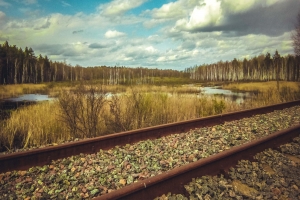


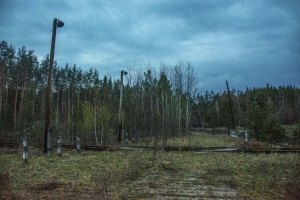


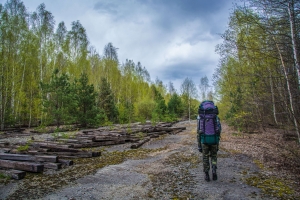
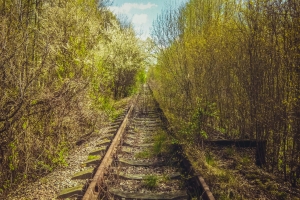
In 1925, a small railway station appeared among the Polissia forests. From it, over half a century, a nuclear city of nearly 50,000 people grew. Today neither trains nor city remain — only rusting carriages with trees growing through them.
The abandoned Prypiat–Ovruch railway and its centrepiece, Yaniv station, is one of the quietest and most powerful places in the Chornobyl Exclusion Zone. History can be read here literally along the rails: here is the track that brought the atom in, and here is that same track that carried people away forever.
Location Card
| Location | Yaniv station, near Prypiat, Chornobyl Exclusion Zone, Kyiv region |
| What it is | Abandoned railway line Ovruch–Chernihiv (via Yaniv) and derelict station |
| Station opened | 1925 |
| Last train | 29 April 1986 |
| Access | inside the Zone only; tourist access currently closed |
| Time needed | 20–40 minutes |
In this article
- What it is and why people come
- History: from a 1925 station to the exclusion zone
- Legends and mystique
- What to see on site
- How to get there and access
- Visitor checklist
- Frequently asked questions
What it is and why people come
This is the Ovruch–Chernihiv railway line, which ran through Yaniv station — the very station near which Prypiat was later built. Today both the track and the station are abandoned: the rails are overgrown, dismantled carriages stand on the tracks, and between them a genuine young forest has risen.
People come for two things. The first is the stunning post-apocalyptic landscape: trains going nowhere, a platform without passengers, a silence you can physically feel. The second is history. Because this modest track largely determined the fate of the entire region.
History: from a 1925 station to the exclusion zone
The station that became a city
Yaniv station opened in 1925. It served freight and passenger traffic on the line between Chernihiv and Ovruch and gave its name to the small settlement around it. When in the 1970s a location was chosen for a new nuclear power plant and a city for its workers, the existence of a ready-built railway was one of the key deciding factors.
Prypiat effectively grew out of the station. Branch lines ran from Yaniv to the ChNPP itself, warehouses, an oil depot, and other industrial facilities — the railway was the circulatory system of the whole nuclear project.
The last passenger train — the Moscow–Khmelnytskyi service — passed through Yaniv on 29 April 1986. Three days after the explosion. No civilian train has passed since.
The track that carried people away
After 26 April 1986, the Ovruch–Chernihiv line instantly changed its purpose. Transit traffic was halted, and the railway began operating in a new, «Chornobyl» mode: evacuating surrounding villages and bringing in equipment and materials for the clean-up.
Two diesel trains with a combined capacity of 1,500 places were sent to Yaniv station — one of several channels for evacuating people from the disaster zone. The track that once brought life and atomic energy here now carried people away into an uncertain future.
Electrification that came too late
In 1986–1987 the Chernihiv–Yaniv section was reconstructed and electrified to carry ChNPP staff and workers building the new city of Slavutych. The overhead wiring was later partly dismantled, and the station fell permanently silent. Today Yaniv is an abandoned platform, rusting tracks, and carriages colonised by trees.
Legends and mystique
An abandoned railway is a natural magnet for ghost stories. Yaniv is no exception.
1. The train that is still expected
Urban explorers describe catching a strange feeling on the empty platform in certain weather: as if the timetable still holds and a train is about to arrive. A station designed for thousands of passengers a day retains that «readiness» even decades after its last service.
2. The forest that boarded the carriages
Yaniv’s most striking image is trees that have grown directly inside and between the carriages. Nature has not merely reclaimed the station — it has literally grown into the machinery. Locals joke that there is now a «green express» here, which will only depart along with the forest itself.
3. The station that witnessed everything
Yaniv is one of the few sites that «remembers» every era of the region: the pre-revolutionary track, the birth of Prypiat, the night of the disaster, and the evacuation. Hence the local saying that this place «remembers more than people do» — and that is precisely why the silence here feels so unsettlingly loud.
What to see on site
Yaniv station itself. The abandoned platform and station buildings — the must-have shot. The atmosphere of a «frozen timetable» registers instantly.
Abandoned carriages on the tracks. Dismantled trains with trees growing through them — one of the most recognisable images in the entire Zone.
The Prypiat railway bridge. An engineering feature of the same rail junction — a striking object for anyone interested in the history of the line’s construction across the Prypiat River.
Connection to the wider route. Yaniv is usually visited together with Prypiat and the ChNPP — everything is close together. For the full context, see our overview of the Chornobyl Exclusion Zone.
How to get there and access
Important about access. Yaniv station and the entire former line are inside the Chornobyl Exclusion Zone. This is a controlled area: entry is only possible on an organised basis, with an official permit, as part of a guided tour. Independent access is prohibited.
Current status. Due to the full-scale war, the temporary occupation of the Zone in early 2022, and the mining of parts of the territory, tourist access to the Chornobyl Exclusion Zone is currently closed. Before making any plans, always check the latest official decisions and operator updates.
Orientation. Yaniv lies to the north-west of Prypiat, near the approach tracks to the ChNPP. On an organised tour, the station is usually combined with a visit to the ghost city itself.
Visitor checklist
For whenever you go (once the Zone reopens):
- Official tour and permit: no entering the Zone without them.
- Dosimeter: the tracks and carriages have radiation hotspots.
- Sturdy closed footwear: lots of rusty metal, railway sleepers, and broken glass.
- Water and snacks: no infrastructure in the Zone.
- Caution around structures: the carriages are structurally unsound — climbing on them is dangerous.
What NOT to do: climb onto carriage roofs for a dramatic shot, take away «little metal souvenirs,» or wander off the route into the undergrowth.
Frequently asked questions
When did the last train pass through Yaniv station?
The last passenger train — the Moscow–Khmelnytskyi service — passed on 29 April 1986, three days after the disaster. Civilian traffic ceased after that.
Why was the railway so important to the history of Prypiat?
Yaniv station opened as early as 1925, and the existence of a ready-built railway line was one of the decisive factors in why the ChNPP and the city of Prypiat were built precisely here.
Can I visit now?
Not yet. Tourist access to the Chornobyl Exclusion Zone is closed due to the war and the mining of parts of the territory. Follow official updates.
Why do trees grow through the carriages?
Because the station has stood abandoned since the 1980s. Over decades without people, nature reclaimed the tracks, and a young forest grew up between the carriages and across the platform.
Is it safe to be there?
Only with a tour, a dosimeter, and adherence to the rules. The tracks have radioactive hotspots, and the carriages and buildings are structurally unsound.
The Prypiat–Ovruch railway is a rare place where the fate of an entire city can be traced along a single line of track. It brought the atom here, raised Prypiat, and then along those same rails carried people away into the unknown.
Now at Yaniv station, the only «timetable» is drawn up by the trees. And the only train that will ever truly depart from here is the forest itself — slowly, carriage by carriage, taking the station back.
JoomShopping Download & Support
Attention! Part of Ukraine was occupied during Russia's unfounded military aggression against us and other democratic countries!
russia is a terrorist country, russians are murderers, thieves and rapists.
Russia's unhuman aggression against Ukraine since 2014 has led to the loss of homes and lives not only of many Ukrainians, but also of citizens of other countries and nationalities.
We consider any military actions against any state in the 21st century unacceptable and stupid, but unfortunately the Russians do not think so, and therefore many democratic countries, including Moldova, Georgia and our homeland, suffer from barbaric aggression.
Therefore, until the occupied parts of Ukraine are demilitarized and returned to our state, we remind users about the real danger of visiting the territories occupied by russia.