


- You are here:
-
Sights by Regions

- Rivne region
Rivne region
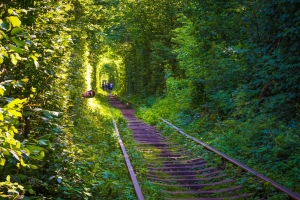

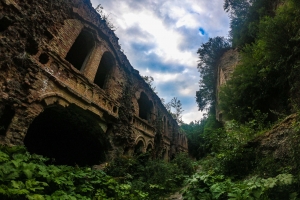
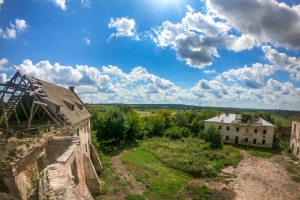


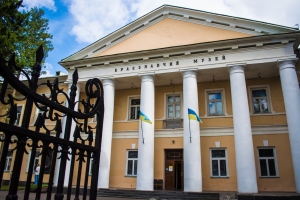


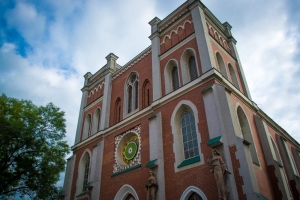
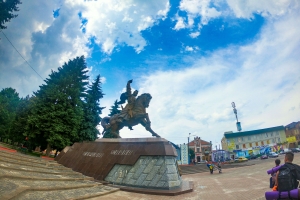




Rivne region is a place people come to for two things. The first is castles: Ostroh, Dubno, Klevan, Korets. Not the “Golden Horseshoe” circuit with tourist buses, but quiet provincial Volyn, where you can walk an entire castle courtyard and not meet a single other visitor. The second is the Tunnel of Love: a stretch of forest railway that became a romantic internet sensation before the people of Rivne themselves had heard of it.
There is also the place where the first complete printed Bible in a Slavic language was made, where the first university in Eastern Europe once stood, where one of the largest forts of the former Russian Empire still stands, and where basalt columns rise from the earth looking exactly like Ireland’s Giant’s Causeway — only in the Ukrainian forest-steppe.
Region at a Glance
| Administrative centre | Rivne |
| Area | 20,047 km2 |
| Population | ~1.1 million |
| Historic land | Western Volyn (centre-south), Polissia (north) |
| Main rivers | Horyn, Styr, Sluch, Ikva, Stokhid |
| Best time to visit | May–October for castles and nature; late spring (May) — for the green Tunnel of Love |
In This Article
- What Kind of Place Is This and Why People Come
- Geography, Landscapes, Climate
- History in Brief
- Legends and Local Lore
- Top Places to Visit
- Day Trips and Weekend Routes
- What You Must Do
- FAQ
What Kind of Place Is This and Why People Come
Rivne region is a quiet star of Ukrainian tourism. It gets overlooked in favour of neighbouring Lviv and Volyn oblasts — but that is precisely why it offers something those more celebrated regions can no longer deliver: castles without queues, towers you can climb in peace, museums where the staff are genuinely glad to see you, and romantic locations unspoiled by selfie-stick crowds.
People come for three reasons. The first is a Volyn castle tour: in one or two days you can see Ostroh, Dubno, Klevan and Korets — four castles from the 15th–17th centuries. The second is the Tunnel of Love: one of Ukraine’s most photogenic locations, known far beyond the country’s borders. The third is Polissia: for those who want silence, bog lakes, wooden churches and the particular, gentle wilderness you find nowhere outside northern Volyn.
Geography, Landscapes, Climate
The region divides clearly into two parts. The south and centre is Western Volyn: forest-steppe, fertile farmland, the winding banks of the Horyn and Ikva rivers, castle towns on hillsides. The north is Polissia: pine forests, peat bogs, marshes, slow rivers, wooden churches on rises, cranberries in September. The border with Belarus runs through the Polissia section.
A separate geological treasure of the region is the Basalt Columns in Basaltove village (formerly Berestovets). This is a volcanic formation unique in flat Ukraine: hexagonal columns of solidified lava that resemble Ireland’s Giant’s Causeway or Poland’s Mała Praga. Nearby are the basalt quarries, where basalt is still extracted commercially today.
When to go. Castles and landscapes are at their best from May to October. The Tunnel of Love has a clear season: green from late April to late October, most “viral-worthy” in late May (fresh foliage) and mid-October (golden tunnel). Polissia is ideal in summer (lakes) and autumn (cranberry bogs). Winter is quiet and few museums are open.
History in Brief
In the princely era Rivne region belonged to the Galicia-Volhynia state. After its fall it passed to the Grand Duchy of Lithuania, then to the Polish-Lithuanian Commonwealth. This is where one of the most important chapters of Ukrainian cultural history unfolds in the 16th century: the princes Ostrozky — a dynasty of magnate-patrons — established in Ostroh the first Slavic university (1576) and a printing house where Ivan Fyodorov produced the Ostroh Bible (1581) — the first complete printed Bible in Church Slavonic.
Two centuries later the region ended up in the Russian Empire. It fell within one of the westernmost edges of the Pale of Settlement, so Ostroh, Dubno and Korets became centres of Jewish culture. In the 19th century the Russian army built Tarakaniv Fort here — a massive brick bastion forming part of the “Dubno defensive front” along the potential border with Austria-Hungary.
The 20th century brought World War I, the Second Polish Republic (1921–1939), World War II with Nazi occupation and the destruction of the Jewish population, Soviet occupation, UPA partisan fighting in Volyn lasting until the mid-1950s. In 1986 the north of the region was touched by Chornobyl contamination — some Polissia districts still register above-average radiation. In the 2010s the Rivne Nuclear Power Plant launched its second and third units — one of Ukraine’s key energy facilities. The 2022 war has not directly hit the region — it is a rear area, with periodic missile strikes on infrastructure (especially the power grid).
Ostroh Academy was the first university in Eastern Europe, founded 100 years before the Kyiv-Mohyla Academy and 50 years before Lviv University. Its successor, the National University “Ostroh Academy,” operates there today, preserving that unbroken line of tradition.
Legends and Local Lore
1. The Ostroh Bible and the Book That Outlived Empires
In 1581 Ivan Fyodorov printed a Bible in Prince Kostiantyn-Vasyl Ostrozky’s printing house in Ostroh — the first complete printed Bible of the Slavic world. The prince gave one copy to the King of Sweden and another to the Pope. Pope Gregory XIII accepted it but could not read it (the papal court had no Slavicist). Over the following centuries the Ostroh Bible outlasted more empires than any of its printers. Originals are now held in Kyiv, Moscow, London, Krakow — and three remain in Ostroh itself. Visit the Museum of the Book and Printing in Ostroh.
2. The Tunnel of Love and the Wishing Ritual
In the village of Klevan, a 4-kilometre stretch of forest narrow-gauge railway serving a chipboard factory has been so densely overgrown by birch branches that it forms a natural green “tunnel.” Local legend says: if a couple walks the tunnel hand in hand and makes a wish, it will come true — as long as the wish concerns the couple rather than, say, winning the lottery. See the Tunnel of Love.
3. The Peresopnytsia Gospel and the Presidents’ Oath
In the village of Peresopnytsia in Rivne region, between 1556 and 1561, scribes produced the Peresopnytsia Gospel — the first handwritten translation of the New Testament into Ukrainian literary language. An ordinary book that changed history: every Ukrainian president has sworn the oath of office on it since 1991. Its cultural standing is comparable to that of the Reims Gospel for France. Peresopnytsia does not yet have its own page on the site, but the village has a memorial and cultural centre where a facsimile edition of the book can be seen.
Top Places to Visit in Rivne Region
Ostroh — Capital of the Ukrainian Renaissance
Ostroh is the most culturally significant town in Rivne region. In the 16th century it was effectively the capital of Ukrainian Orthodoxy and learning. Here stands Ostroh Castle with the princely residence and the Epiphany Church; the Ostroh Academy with its famous dungeons; the Tatar Tower — a surviving fragment of the town’s medieval fortifications; and the Great Synagogue — a reminder of the once-thriving Jewish community. Ostroh alone is worth a full day.
Dubno — Castle and Tarakaniv Fort
Dubno is another castle gem of the region. The 15th-century Dubno Castle, the ancestral seat of the Ostrozky princes, features a moat, earthworks and a chapel. Five kilometres away is Tarakaniv Fort: one of the largest brick forts in the former Russian Empire, built between 1885 and 1890. Hectares of casemates, ramparts, ditches and passages — a genuine paradise for urban explorers.
The Tunnel of Love in Klevan
Ukraine’s most romantic location, known worldwide. The Tunnel of Love is a 4-kilometre stretch of working narrow-gauge track that has been completely overgrown by a natural green corridor of birch and ash branches. Thousands of couples from around the world come here every year. Nearby are the Klevan railway station and the abandoned Klevan Castle of the Chartoryiski family — an extra draw for lovers of derelict places.
Korets — Castle and Convent
Korets is a small town with a weighty history. The 14th-century Korets Castle stands over a deep canyon of the Korchyk river — the view from its ruins is the kind that makes you want to stay. Alongside it is the Korets Holy Trinity Convent: one of Ukraine’s oldest active monasteries, with a museum of its own history.
Basalt Columns in Basaltove
The Basalt Columns in Basaltove village are a geological wonder of Ukraine. Hexagonal columns of solidified magma up to 30 metres tall, formed 100 million years ago. It looks as though someone stacked giant pencils into a wall in the middle of a forest. Next door are the working basalt quarries.
Rivne — The Regional Capital
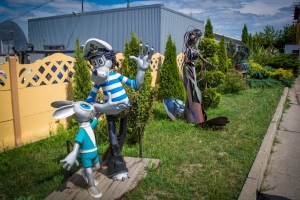
Rivne itself is a restrained but rewarding city. Highlights include the excavations of the Lubomirski princes’ palace, the regional local history museum, the chamber and organ music hall, and the singular art gallery of blacksmithing with its museum of steel figures.
Polissia Nature Reserve and the North
The north of Rivne region is home to the Polissia Nature Reserve, one of Europe’s largest bog-biosphere reserves. Cranes, elk, white-tailed eagles, cranberries in late August. Not yet listed on the site as a separate page, but a compelling destination for wildlife lovers. Nearby is the ethnographic museum in Sarny, with a collection of Polissia folk life.
Derman Monastery
The Holy Trinity Derman Monastery in the village of Derman is one of the oldest monastic sites in Volyn, founded in the 15th century by the Ostrozky princes. In the 16th–17th centuries it housed a printing house and school, and served as an important centre of Orthodox resistance to the Union. Not yet on the site as a separate page, but unmissable for anyone interested in Volyn’s sacred heritage.
Day Trips and Weekend Routes
Route 1. Volyn Castles in One Day
The classic for castle lovers. From Lviv or Kyiv in the morning — Dubno Castle with a tour and lunch in Dubno. On to Tarakaniv Fort (~5 km). Afternoon — Ostroh Castle with the Academy. Evening — return. A tight but realistic day.
Route 2. Tunnel of Love + Klevan in a Day
The region’s most popular tourist route. The Tunnel of Love in the morning (best before midday when the light is finest), then Klevan Castle and the Church of the Annunciation. Afternoon — an organ concert in Rivne at the chamber and organ music hall. A romantic day that writes its own script.
Route 3. Korets + Hoshcha in a Day
The southern branch of the route. Korets Castle with the viewpoint over the Korchyk canyon, then the Korets Holy Trinity Monastery. Via Hoshcha heading south towards Ostroh. A less-trodden route, but full of atmosphere.
Route 4. Geological Rivne Region — Basalt and Quarries
A route for geology enthusiasts. The Basalt Columns in Basaltove, then the basalt quarries with viewing platforms. On the way back, stop at the forest museum in Kostopil — a rare chance to explore the history of Polissia forestry.
Route 5. Polissia Loop — Weekend in the North
A two-day route into the north of the region. Day 1: the ethnographic museum in Sarny, then the Polissia Nature Reserve and Polissia villages with wooden churches. Overnight in Sarny. Day 2: Varash with the Rivne Nuclear Power Plant information centre (for those interested in energy technology). A route for those who want the authentic Ukraine.
What You Must Do in Rivne Region
- Walk the Tunnel of Love in late May, when the foliage is fresh and vivid. Make a wish on the way.
- Climb the tower of Ostroh Castle and imagine Prince Kostiantyn-Vasyl standing here, waiting for a messenger from the printing house below.
- Explore the dungeons of Ostroh Academy by torchlight — a complete world beneath a modern university campus.
- Descend into the casemates of Tarakaniv Fort — best done with a guide, since the two-storey underground structure is easy to get lost in without one.
- Stand over the Korchyk canyon from the ruins of Korets Castle — one of the finest views in all of Volyn.
- Put your hands on a basalt column — 100 million years old, and cool to the touch even in summer heat.
- Try Polissia bread in Sarny — baked over wood in ovens following 19th-century recipes.
- Listen to the organ in Rivne’s concert hall — one of the best organ venues outside the major cities.
- Buy a “Korets blanket” — traditional Volyn weaving that survives in the Korets district to this day.
- Eat a cranberry pie in a Polissia village at the end of August — exactly when the berry season peaks.
An old diesel train passes through the Tunnel of Love every day, serving the chipboard factory at the far end. The timetable is approximate — but if you hear a horn, step off the track, because the tunnel is wide enough for the rolling stock, not for a couple with a camera.
Frequently Asked Questions
What can I see in Rivne region in one day?
The fastest option is the Tunnel of Love in Klevan plus the city of Rivne. For castles: Dubno Castle + Tarakaniv Fort + Ostroh in one full day.
What is the Tunnel of Love?
A 4-kilometre stretch of working narrow-gauge railway in Klevan village, completely overgrown by a natural green corridor of birch and ash branches. It is green from late April to late October. The most “viral” look comes in late May (fresh foliage) and mid-October (golden tunnel). Walking it has become a ritual for couples.
What is Ostroh Academy?
The first university in Eastern Europe, founded by Prince Kostiantyn-Vasyl Ostrozky in 1576. Its students included Meletiy Smotrytsky, Yov Kniahynytsky and Ivan Vyshensky. Today the National University “Ostroh Academy” operates there. You can visit the Academy itself and its dungeons.
Where should I go for a weekend from Kyiv to Rivne region?
Classic formula: Friday evening drive from Kyiv to Rivne (~330 km, ~4 hours). Saturday — Tunnel of Love + Klevan Castle. Sunday — Dubno with the castle and Tarakaniv Fort, then home.
Is it safe to visit Rivne region now?
Rivne region is a rear-area oblast, far from the front line. Missile strikes on infrastructure occur periodically (especially targeting the Rivne Nuclear Power Plant in Varash and the power grid). Tourist sites have not received direct hits. Before travelling, monitor air alerts via the official “Povitriana tryvoga” app.
Where should I take children in Rivne region?
Rivne Zoo, the art gallery of blacksmithing and steel figures, the forest museum in Kostopil. The Tunnel of Love also works well for children — it is simply a walk through the woods.
What are the most famous dishes of Rivne region?
Polissia cuisine based on mushrooms, wild berries (cranberry, bilberry) and river fish. Classics: Volyn borscht with beans and mushrooms, deruny potato pancakes, cabbage rolls with buckwheat, Polissia wood-fired bread. In the south (Dubno, Ostroh areas) — traditional Volyn cooking: potato varenyky, “kyselytsia” and “paliushky.”
What should I bring back from Rivne region?
Cranberries and bilberry jam from Polissia; woven textiles from the Korets district; facsimile editions of the Ostroh Bible from the museum in Ostroh; ironwork by Rivne smiths. The most atmospheric souvenir of all is a jar of cranberry jam with a Tunnel of Love label.
Rivne region does not market itself loudly. It simply waits for you to arrive and discover for yourself that between Lviv and Kyiv there is not empty space but another Ukraine entirely — with its own culture, its own castles and its own legends.
If the Tunnel of Love was the only thing on your list — add Ostroh, Dubno and Korets. One visit here is never enough.
JoomShopping Download & Support