


- You are here:
-
Sights by Regions

-
Kharkiv region
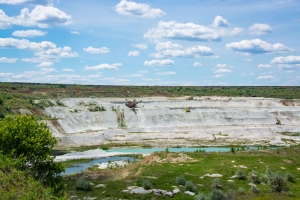
- Ruins of Kolokoltsev manor , Rubizhne


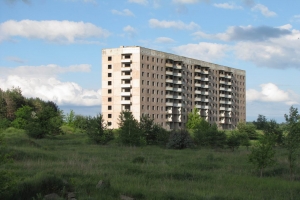


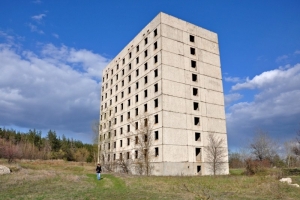

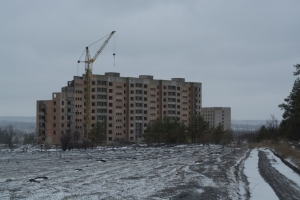
On Soviet blueprints this was meant to be an atomic workers’ town: housing, a school, buses, heat and electricity for Kharkiv from its very own nuclear plant. Instead, two nine-storey shells have been standing in a field outside the city for over 40 years — a place where no one ever switched on a light or cooked a meal.
This is Atomni Birky (locals also say «Atomni Borky») — the unfinished Kharkiv Nuclear Power Plant, a dream project that ran straight into the Chornobyl reality. It is also one of the most enigmatic spots in Slobozhanshchyna (eastern Ukraine’s historic region), complete with its own legend about a meteorite, a «red lake» and an extraterrestrial substance.
Location Card
| Location | Kharkiv Oblast, Novovodolazka hromada, village of Birky (≈ 26 km from Kharkiv) |
| Coordinates | 49.6879, 36.0681 |
| Type | Abandoned site, hidden gem, rooftop views |
| Entry | Free |
| Parking | No designated parking |
| Accessibility | Not accessible for people with mobility impairments |
| Interest level | High |
| Time needed | 2–3 hours |
| What to bring | Torch, sturdy shoes, water, power bank and common sense |
In This Article
- What it is and why visit
- History: how a dream collided with Chornobyl
- Legends and mysteries: the meteorite and the «red lake»
- What to see on site
- How to get there
- Traveller’s checklist
- Frequently asked questions
What It Is and Why Visit
In short: this is the unfinished Kharkiv Nuclear Power Plant (KhAES) and the workers’ settlement that was meant to grow up around it. If history had played out a little differently, a few thousand nuclear engineers would have lived here, a school would have been running, buses would have been coming and going, and Kharkiv would have been drawing power from its own plant.
Instead, there are two windowless, doorless nine-storey concrete shells, the skeleton of a third building, a construction pit that has slowly turned into a pond — and one of the most photogenic abandoned sites in the region. This is not Pripyat: the scale is smaller, there is no radiation, the vibe is rawer. That is exactly why you can comfortably make it a day trip from Kharkiv and come back with a camera full of great shots.
The plant was stopped four kilometres short of completion. A new law prohibited building nuclear stations within 30 km of a major city — and Birky turned out to be just 26 km from Kharkiv.
History: How a Dream Collided with Chornobyl
In the 1980s the village of Birky was chosen as the site of the Kharkiv Nuclear Power Plant. Construction began with the workers’ housing blocks — a full nuclear town with flats, a school and all the infrastructure was planned to follow.
Then Chornobyl happened. After April 1986 the nuclear safety rules were rewritten: no atomic station could be built within 30 km of a large city. Birky stood at 26 km from Kharkiv — four kilometres closer than the new law allowed. The project was cancelled.
By that point two nine-storey blocks had been finished and a third had been started. The workers left; the buildings stayed — forever unoccupied.
Why the atmosphere hits so hard
Most abandoned buildings carry a biography: someone lived here, fell in love here, celebrated New Year here. At Atomni Birky there is no biography at all. These are buildings without a past — concrete skeletons with not a single memory inside. An eerie feeling, like walking onto the set of a film that was never made.
Legends and Mysteries: the Meteorite and the «Red Lake»
The site is said to sit in a geopathic zone where strange phenomena — up to and including UFO sightings — are regularly reported. Naturally, local lore has grown up around it.
1. The Meteorite of 1873
According to local accounts, in 1873 the villagers of Birky witnessed a meteorite fall early one morning. A small fireball traced across the sky from south-east to north-west and vanished behind the forest, followed seconds later by a thunderous boom and tremors felt underfoot. A lake formed in the impact crater, and for several days afterwards locals reported an unusual aurora-like glow in the night sky.
2. Two Expeditions and a Secret Settlement
In 1885 the first expedition to the impact area was sent out under M. B. Monstrov. Its findings remain unknown — the archive was destroyed during the upheaval after the 1917 revolution. A second expedition under A. S. Rusinov followed in 1969, and in 1974 a small settlement was even established to study the mysterious substance of the Borkivka meteorite.
3. The «Red Lake» and the Otherworldly Substance
The «Red Lake» got its name from a strange phenomenon: stones on the bottom glowed with a vivid red light. Scientists retrieved and analysed these stones, which had an unusual, seemingly extraterrestrial chemical composition. The glow, it turned out, appeared on contact with water — the stones released a substance with a sharp odour somewhere between sulphur and mint.
More than that, this substance apparently had a psychotronic effect: elderly locals still recall an unusually high number of suicides, mysterious deaths and researchers who disappeared without trace.
After the Soviet collapse the expedition was wound up, the mystery of the «red lake» unsolved. The bottom has silted over and grown in, but close to the bank a faint dim light can sometimes be seen.
And in the corridors of the abandoned buildings, people say, a strange hum and a red glow occasionally appear. Those who happen to be nearby at that moment either vanish without a trace or lose their minds. Believe it or not — that’s your call. But you have to admit: taking a selfie feels quite different under stories like that.
What to See on Site
The two nine-storey shells. The money shot of the location. One block has been heavily vandalised inside: the stairwells are badly damaged and going up is possible only via the intact sections — entirely at your own risk. The second block is in better shape; according to reports from visitors, it is possible to reach the rooftop. Both buildings have been slowly swallowed by trees over the years.
The «red lake» near the old construction pit. The very lake from the legend — a quiet mirror of water in the middle of a field. Perfect at dawn: mist, silence, a glassy surface.
A stroll through the village of Birky. The village itself is a perfectly ordinary Ukrainian settlement: quiet, with geese and grandmothers by the gate. A great contrast to the abandoned monumentality of the nuclear site.
Heads up! The site has already been partially demolished, and how long it will survive is anyone’s guess. If you want to see Atomni Birky with your own eyes, best not to put it off.
How to Get There
By commuter train (easiest). Take a commuter rail service from Kharkiv’s Pivdennyi (Southern) railway station. Check the timetable for the Birky stop; from there it is roughly 5 km on foot to the abandoned buildings. Upside: cheap and atmospheric. Downside: those 5 km in each direction.
By car. About 40–50 minutes from Kharkiv in the direction of Birky. No designated parking near the site — park sensibly. GPS coordinates: 49.6879, 36.0681.
Traveller’s Checklist
What to bring:
- Sturdy shoes — broken glass, rebar and concrete are not a smooth floor.
- A torch or headlamp — the stairwells are dark even in daylight.
- Water and a snack — there are no facilities on site.
- A power bank — you will take a lot of photos.
- Common sense — the upper floors without safety gear and a companion are a bad idea.
What NOT to do:
- Climb damaged staircases or trust questionable floor slabs — this is the real risk at this location.
- Fly a drone without checking current airspace restrictions — restricted facilities may be nearby.
- Bring alcohol «for the atmosphere» — it does not mix well with crumbling floors.
Frequently Asked Questions
Is there radiation here?
No. This was never an operational nuclear plant — only a construction site where a few buildings were put up. The real hazards here are everyday physical ones: holes in floors, exposed rebar, broken glass and damaged staircases.
How much does entry cost?
Nothing. The site is unmanaged, with no tickets, no ticket office and no security. Entry is free.
Can you bring children?
For an exterior look — yes. Inside the abandoned buildings or onto the roof with children — absolutely not.
Is it safe to visit during the war?
Birky is in Kharkiv Oblast, a frontline region that has suffered shelling. Before visiting, check the current security situation in the area, do not ignore air-raid alerts, and follow official announcements from the local community.
How long should I allow for a visit?
2–3 hours for the site itself. If you are travelling from Kharkiv, the full round trip — getting there, exploring, getting back — will take around 5–6 hours.
Atomni Birky is not Pripyat and not the Exclusion Zone. It is a small but powerful reminder that history can reverse course in a single paragraph — and whole cities, schools and lives can end up existing only on paper.
It’s worth coming at least once — to walk in silence among concrete skeletons, to listen to the quiet, to photograph the thing that was meant to be but never was. And if a red light flickers in the corridor — keep it to yourself. Or tell someone. Either way, nobody will believe you.
Вот видео с Атомных Борок, если интересно посмотрите:
День - https://www.youtube.com/watch?v=qjCzR-Ba9-c&t=17s
Ночь:
https://www.youtube.com/watch?v=yQ4PKubRBkQ




JoomShopping Download & Support
Attention! Part of Ukraine was occupied during Russia's unfounded military aggression against us and other democratic countries!
russia is a terrorist country, russians are murderers, thieves and rapists.
Russia's unhuman aggression against Ukraine since 2014 has led to the loss of homes and lives not only of many Ukrainians, but also of citizens of other countries and nationalities.
We consider any military actions against any state in the 21st century unacceptable and stupid, but unfortunately the Russians do not think so, and therefore many democratic countries, including Moldova, Georgia and our homeland, suffer from barbaric aggression.
Therefore, until the occupied parts of Ukraine are demilitarized and returned to our state, we remind users about the real danger of visiting the territories occupied by russia.