


- You are here:
-
Sights by Regions

-
Kyiv region
-
Pereiaslav-Khmelnytskyi
- Church of St. Volodimyr, Pereyaslav-Khmelnitsky


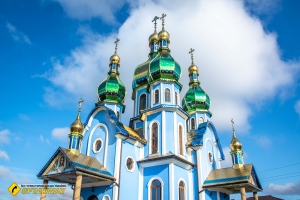
Pereiaslav is nine centuries older than Moscow. When chronicles first mentioned this city at the confluence of the Trubizh and Alta rivers — in the year 907 — the land where the Russian capital would one day stand was still forest.
And it is here, in the city that Prince Volodymyr the Great made one of the pillars of his state, that a church stands bearing his name. St. Volodymyr Church is not a museum ruin or an abandoned site, but an active church you can simply walk into. To understand why it is here, and why it is named for Volodymyr, you need to know what Pereiaslav meant to Rus.
Location Card
| Location | Pereiaslav, Boryspil district, Kyiv Oblast |
| Coordinates | 50.08975, 31.48794 |
| Type | Religious, active church |
| Entry | Free |
| Parking | Available on site |
| Time needed | 20–40 minutes (or a half-day combined with other Pereiaslav sights) |
What this church is and why it’s worth visiting
The Church of the Holy Equal-to-the-Apostles Prince Volodymyr is a modern Orthodox church in Pereiaslav, consecrated in honour of the prince who baptised Rus in 988. At first glance, it looks like an ordinary town church: neat, well-kept, with free entry and a car park for pilgrims and tourists.
But the value of this place is not its architectural age — it’s the address. Pereiaslav was one of the three principal cities of Kyivan Rus, alongside Kyiv and Chernihiv. Dedicating a church to Volodymyr here is like placing a monument to a founder in his own home. The church is best understood not in isolation, but as a key to the whole city-museum.
If you’re planning a day in Pereiaslav — and there are more than a dozen museums here plus a unique open-air museum — this church makes a natural spiritual «full stop» to the route: a quiet place to pause between exhibitions.
Pereiaslav and Prince Volodymyr: why this place is no coincidence
Pereiaslav is first mentioned in the 907 treaty between the Rus and Byzantium — making it one of Ukraine’s oldest cities. Under Prince Volodymyr the Great, it became a frontier outpost on the southern border of his state, shielding Kyiv from steppe raids.
It was under Volodymyr and his son Yaroslav the Wise that a separate diocese was established here, and later the Pereiaslav Principality, one of the most important in Rus. Volodymyr Monomakh ruled in Pereiaslav and, according to chronicles, built a «beautiful» stone church here — and died in his beloved church on the Alta in 1125.
The city where an entire state was baptised may even have given Ukraine a word: one theory holds that «Pereiaslav» comes from «pereiniaty slavu» — to seize glory in battle. A city whose very name is a battle cry.
Against this historical backdrop, St. Volodymyr Church reads differently. It makes no claim to a thousand-year pedigree — but it stands on ground that genuinely has one. And that is precisely why a dedication to the baptiser of Rus sounds so apt here.
Legends and local lore of Pereiaslav
Pereiaslav is a city where history and legend have grown so tightly together that separating them is sometimes impossible. Three stories to know before you visit.
1. The city that «seized glory»
According to the most popular legend, the name comes from a single combat in which a young Rus warrior defeated a Pecheneg champion, thereby «seizing the glory» of his enemy. The story is told in the Primary Chronicle (Повість временних літ). Historians debate whether it’s history or attractive etymology — but locals tell it with obvious pleasure.
2. The church that sank
When the Kaniv Reservoir was built in the 1960s–70s, several nearby villages went underwater, along with their ancient wooden churches. The grandest of them — a church from the village of Andrushy dating to 1769 — was dismantled and relocated to the Pereiaslav open-air museum in time. They say that in calm weather, fishermen on the reservoir can still «hear the bells» of the sunken villages. Legend, of course — but a very Pereiaslav kind of legend.
3. The land of the first saints
Near here, on the Alta river, Prince Borys — a son of Volodymyr the Baptiser and one of the first Rus saints — was killed according to tradition. A Borys and Hlib church was later built on that spot. In local consciousness, all of Pereiaslav’s land is the «land of firsts»: the first diocese, the first saints, the first baptism on the southern border of Rus.
What to see nearby
Coming to Pereiaslav just for a single church would be a missed opportunity. The city is compact, and a single day can take in several world-class sights.
Museum of Folk Architecture and Life of the Middle Dnieper Region. Ukraine’s first open-air museum (skansen), founded in 1964. On 25 hectares: around 300 exhibits including authentic wooden churches, farmhouses, and windmills from the 17th–19th centuries. The crown jewel is the wooden St. George’s Church from Andrushy village (1769). More than a dozen individual museums operate on the grounds.
Kanevsky Rotunda. An elegant family mausoleum-rotunda, one of the city’s architectural gems and a natural next stop after the church.
Borys and Hlib Church. A church built on the site linked to the death of Prince Borys — a direct thread back to the age of Volodymyr and his sons.
Together these make for a rich one-day itinerary: ancient history, wooden sacred architecture, and a modern active church as a calm end to the day.
Getting there
By car. From Kyiv — approximately 90 km via the M-03 highway (towards Poltava/Boryspil), roughly 1.5 hours. Parking is available in the city; there is a dedicated car park at the church.
By public transport. Regular buses and minibuses run from Kyiv to Pereiaslav, mostly departing from metro stations on the left bank (Boryspilska, Kharkivska). Journey time is approximately 1.5–2 hours. From there, explore the city on foot or by local transport.
Tip. Pereiaslav is an ideal day trip from Kyiv. Leave in the morning to have enough time for both the open-air museum and the churches without rushing.
Traveller’s checklist
What to bring:
- Comfortable shoes — the open-air museum and city require a lot of walking.
- Modest clothing for the church visit (shoulders and knees covered) — as in any active place of worship.
- Water and a snack, especially in summer.
- A charged phone or camera — the wooden churches of the open-air museum are exceptionally photogenic.
- Cash for museum entry tickets (card terminals are not always available).
What not to do:
- Make noise or speak loudly in the church during a service.
- Use flash photography inside the church without asking permission first.
- Rush through Pereiaslav — it deserves at least half a day.
Frequently asked questions
Is there an entrance fee?
Entry to the church is free, as with most active places of worship. Pereiaslav’s museums have separate entry fees.
Can tourists go inside?
Yes — it is an active church open to visitors. Standard church etiquette applies: modest dress, quiet behaviour, and respect for anyone praying.
Pereiaslav or Pereiaslav-Khmelnytskyi?
The city was officially renamed back to its historic name, Pereiaslav, in 2019. The old form «Pereiaslav-Khmelnytskyi» still appears on some maps and signs, so don’t be confused by the discrepancy.
How much time should I allow?
The church itself takes 20–40 minutes. Since the open-air museum and other sights are nearby, plan at least half a day in the city.
Is it worth visiting with children?
Yes. Pereiaslav is one of the best family day-trip destinations in Kyiv Oblast — children tend to be captivated by the windmills and traditional farmhouses of the open-air museum.
St. Volodymyr Church is, in itself, modest. But it stands where Ukrainian statehood was born, and where the Baptism of Rus is not an abstraction from a history book but part of the local landscape.
The reason to come is not one building — it’s a feeling: standing on ground older than most European capitals. And a church named for the man who started it all is the best place to feel that.
JoomShopping Download & Support