


- You are here:
-
Sights by Regions

-
Kyiv region
-
Kyiv
- Park «Kyiv in miniature», Kyiv

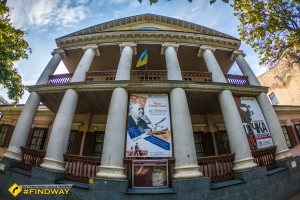

The suitcase a person carried onto a steamship to Canada in 1947 held everything: two shirts, a photo of their parents, a handful of soil in a linen pouch, and a language that was already banned back home. This museum is built from suitcases just like that one.
The Museum of the Ukrainian Diaspora in Kyiv isn't really about the geography of emigration. It's about how several million people, scattered from Winnipeg to Buenos Aires, carried Ukraine in their hands for an entire century — a Ukraine that didn't exist on any map.
Quick facts
| Location | 40B Kniaziv Ostrozkykh St, Pechersk district, Kyiv |
| Building | The "Staropecherskyi House" — a manor from the late 18th century |
| Founded | 1999 (as the Museum of Cultural Heritage), renamed Museum of the Ukrainian Diaspora in 2015 |
| Exhibits | seven halls: documents, photographs, personal belongings of diaspora figures |
| Time needed | 1–1.5 hours |
| Bring | comfortable shoes, curiosity about family stories, a phone for photographing exhibits |
What it is and why it's worth a visit
"A museum about emigrants" sounds dull right up until you step inside. There are no dry panels reading "in such-and-such year, this many people left." Instead, there are things you can get close to: manuscripts, paintings, vyshyvankas (embroidered shirts), documents, and personal archives of people who were born in Ukraine but created their life's work thousands of kilometers away.
The museum tells the story of four great waves of Ukrainian emigration — from the labor migrants of the late 19th century to the postwar refugees and dissidents. One thread runs through all seven halls: these people didn't just leave. They carried statehood out in their suitcases and kept it safe while back home, the very word "Ukraine" could get you arrested.
It's a perfect addition to a walk around Pechersk: nearby are the old streets of the historic center, and the manor itself is worth a look even without the exhibits.
History
The house where the museum lives is about two centuries older than the idea of the museum itself. This is the so-called "Staropecherskyi House" — one of the few Kyiv manors to survive the 19th century, two world wars, and the Soviet redevelopment of Pechersk. The brick manor from the late 18th century has miraculously survived amid a much later city.
The museum itself was founded in 1999 as the "Museum of Cultural Heritage." For a long time it collected items returned to Ukraine from abroad — objects passed on by emigrant families, communities, and individual collectors. In 2015, once it became clear the core of the collection was really about Ukrainians worldwide, the institution was renamed the Museum of the Ukrainian Diaspora.
Behind that name lie four waves. The first, a labor wave at the turn of the 19th–20th centuries: Galician and Transcarpathian peasants headed to Canada, the US, and Brazil in search of land and bread. The second came between the World Wars. The third, postwar wave consisted of "displaced persons" who, after 1945, didn't return to Soviet Ukraine because they knew exactly what awaited them there. And the newest wave is the post-Soviet one.
For decades, it was the diaspora that did what was impossible inside the Ukrainian SSR: publishing Ukrainian books, running Sunday schools, funding scholarship, and reminding the world that this country existed at all.
Legends and stories of the house
Old Pechersk manors rarely come without legends — and this one is no exception.
1. The house developers couldn't touch
Locals say the Staropecherskyi House was slated for demolition back in Soviet times, to make way for yet another institutional building. But every time, the project fell through — funding issues, a redesign, or simply nobody got around to it. The house survived all the way to independence, as if waiting for its true purpose: to become a home for those who never made it back to theirs.
2. Items that find their own way back
Museum staff love telling stories about exhibits that "find their way home." An elderly woman from across the ocean writes that she wants to donate her grandfather's archive; before her letter even arrives, a photograph from the very same village, the very same community, turns up from a completely different family. Coincidence? Maybe. Or maybe the suitcases are slowly making their way back to the same place.
What to see
Seven exhibition halls. A chronological journey through the waves of emigration, from the first settlers to today's communities. Documents, photographs, personal belongings — material that's easier to take in with a guide.
An art collection. Works by artists of the Ukrainian diaspora — people who created in Paris, New York, and Toronto while bringing Ukrainian motifs into their art.
The manor itself. The interiors and architecture of the "Staropecherskyi House" — a rare surviving example of late-18th-century civic architecture in Kyiv.
Temporary exhibitions and events. The museum regularly hosts lectures, book presentations, and small-scale concerts — worth checking the schedule before you go.
How to get there
Metro. The nearest station is "Pecherska" (blue line), then a 10–15 minute walk. "Klovska" is an alternative.
On foot. The museum is within walking distance of the Pechersk historic center, so it fits easily into a stroll around the district.
By car. Reaching central Pechersk isn't hard, but parking on the narrow streets can be tricky — public transport is more convenient.
Hours. During martial law, the museum usually operates daily except Mondays and Tuesdays, roughly 11:00 AM–6:00 PM. Hours can change — check before visiting.
Traveler's checklist
- Comfortable shoes — the manor and the surrounding Pechersk streets are made for walking.
- Time to spare — the museum opens up best with a guided tour, not a quick run-through.
- Phone or camera — for photographing exhibits (check the on-site photo policy).
- Family stories — if your family has emigrants in its history, they'll sound different here.
What's not worth it: arriving in the last half hour before closing — that's not enough time for seven halls; and don't expect a large souvenir shop like the big state museums have — this is an intimate, small-scale museum.
Frequently asked questions
Where exactly is the museum located?
At 40B Kniaziv Ostrozkykh St, in Kyiv's Pechersk district — in a late-18th-century manor known as the "Staropecherskyi House."
How much time should I set aside?
Roughly 1–1.5 hours for the seven halls. With a guided tour, a bit longer — and that's when the museum really comes alive.
Is it interesting for kids?
For middle and high schoolers — yes, especially with a guide who brings the stories to life. For very young children, the exhibits are more for quiet looking than interaction.
Is the museum open during the war?
Yes, it's usually open (except Mondays and Tuesdays). But the schedule and access can change due to air raid alerts — check the current hours before your visit.
It's easy to walk right past this museum — it doesn't shout for attention with signage and isn't on any list of top tourist routes. And that's exactly why it hits the mark. Because the diaspora's story is about how a country can be preserved even when an ocean and half a century stand between you and it.
Step inside not as if visiting a museum, but as if visiting a family that has finally come home — if only in the form of its belongings.
JoomShopping Download & Support