


- You are here:
-
Sights by Regions

-
Kyiv region
-
Kyiv
- Mount Schekavitsa, Observation point, Kyiv
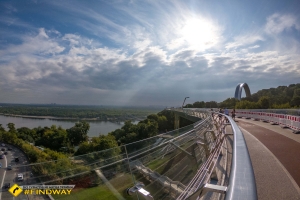
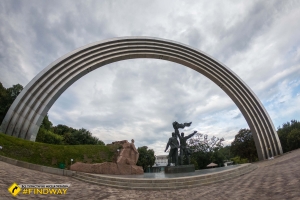


In 1982, this titanium arc was put up to mark the "reunification of Ukraine with Russia." In 2022, the bronze workers beneath it were removed and a painted crack on the metal was repainted — and the very same monument came to mean exactly the opposite.
That's how central Kyiv ended up with its most paradoxical landmark: an arch that outlived the idea it was built for. Today it's mainly one of the best viewpoints over the Dnipro — and a vivid lesson in history changing right before your eyes.
Quick facts
| Location | Khreshchatyi Park, near the Ukrainian House, central Kyiv |
| Built | 1982 |
| Material and size | titanium, arc diameter about 50 m (164 ft) |
| Current name | Arch of Freedom of the Ukrainian People (since 2022) |
| Admission | free (open-air site) |
| Time needed | 20–40 minutes (longer with a walk along the embankment) |
What it is and why it's worth a visit
A massive titanium arc stands on the slope above the Dnipro, in Khreshchatyi Park, next to the Ukrainian House. People come here less for the structure itself and more for the view: it's one of the best panoramas of the left bank, the river, and the bridges.
The second reason is that this is a place where you can watch Kyiv rewrite its own symbols in real time. Over forty years, the arch has been a monument to Soviet friendship, the subject of an art installation featuring a "crack," and finally an arch of freedom. Few places make the story of decommunization this visible.
The location fits perfectly into a walk through the center: nearby are riverside parks, a pedestrian bridge, and a path down to the embankment.
History
The arch was unveiled in 1982 to mark the 60th anniversary of the USSR. Soviet ideology loved monumental gestures, and this one was textbook: a giant titanium arc was meant to "crown" two sculptural groups. Beneath it stood a bronze composition of Ukrainian and Russian workers jointly holding the Order of Friendship of Peoples. Next to it stood a granite stele commemorating the 1654 Pereiaslav Council.
For decades it was simply a popular viewpoint, and Kyivans walked past its symbolism without a second thought — until that symbolism became a matter of principle.
The "crack" that foreshadowed the future
In 2018, as part of a citywide art project, a large black crack was painted across the titanium arc — a symbol of the rift between the two nations after Russia's aggression began in 2014. Around the same time, the arch was temporarily lit up in rainbow colors, which is how Kyivans came to call it the "rainbow arch."
2022: the figures come down, the name changes
With the start of the full-scale invasion, the monument's fate was decided quickly. In April 2022, the bronze composition of the workers and the order was dismantled — during the work, one of the figures even lost its head, a moment that made headlines everywhere. In May 2022, Kyiv City Council officially renamed the structure the Arch of Freedom of the Ukrainian People.
The Ukrainian Institute of National Remembrance maintains that, despite the renaming, the arc itself still carries Soviet connotations and should be dismantled. In 2024, Kyiv authorities decided not to demolish the arch for now, choosing instead to rethink the surrounding space. So the monument still stands — but now as a subject of debate rather than pride.
City stories
1. The rainbow nobody planned
The 2018 rainbow lighting was meant to be a temporary art piece. But the nickname "rainbow arch" stuck so firmly that many young Kyivans are genuinely surprised to learn the structure was never officially "rainbow," nor a symbol of anything beyond Soviet friendship.
2. The head that traveled the world
When the bronze figure of the "Russian" worker was being removed in 2022, its head broke off — and the photo instantly went viral as a symbol of the era. Kyivans joked that the monument itself had realized the friendship was over.
What to see
The viewpoint. The main reason to come here: a wide panorama of the Dnipro, the left bank, and the bridges. Especially striking at sunset.
The arch itself. Up close, the titanium arc impresses with its sheer scale — and bears the traces of how the city has reshaped its meaning.
The pedestrian and cycling bridge. Right nearby is the famous "glass" bridge with glass panels set into the floor — easy to combine with the arch in one walk.
Khreshchatyi Park and the slopes. Well-kept paths, benches with a view, and a way down to the embankment — the green heart of the center.
How to get there
Metro. The most convenient stations are "Maidan Nezalezhnosti" or "Khreshchatyk," followed by a 10–15 minute walk toward the Ukrainian House and the park.
On foot. From Maidan, it's a pleasant walk along the slopes. The location pairs naturally with the glass bridge and the embankment.
By car. You can't drive right up to the arch — it sits within the park; leave your car on the edge of the center and continue on foot.
Cost. Free — it's an open-air public space, accessible around the clock.
Traveler's checklist
- Camera or phone — the Dnipro panorama begs to be photographed, especially at sunset.
- Comfortable shoes — expect slopes, stairs, and long walking routes.
- A windbreaker — it's often windy up here above the river.
- Time to spare — to also reach the glass bridge and the embankment.
What's not worth it: coming here purely to "check the box" — without a walk through the surrounding parks, the location only shows half of what it's got.
Frequently asked questions
What is the arch officially called now?
Since 2022, its official name has been the Arch of Freedom of the Ukrainian People. Locals still often call it the "rainbow arch" or by its former name, the "Arch of Friendship of Peoples."
Were the Soviet sculptures removed?
Yes. The bronze composition of the workers and the Order of Friendship of Peoples was dismantled in April 2022. The titanium arc itself remains in place for now.
How much does it cost to visit?
Nothing — it's an open public space above the Dnipro, free to access at any time.
When is the best time to visit?
At sunset — that's when the panorama of the Dnipro is most striking. It's good for a walk during the day, and the location is lit up in the evening.
Few monuments tell a country's story as honestly as this arc. It was built for an idea Kyiv long ago stopped believing in — and instead of hiding it, the city simply rewrote its meaning. Now people pose under the titanium arch not against a backdrop of "friendship," but against the Dnipro and their own freedom.
Come at sunset. And consider how many other symbols around us are quietly waiting for their own renaming.
JoomShopping Download & Support