


- You are here:
-
Sights by Regions

-
Kyiv region
-
Kyiv
- National Museum of Ukrainian History, Kyiv
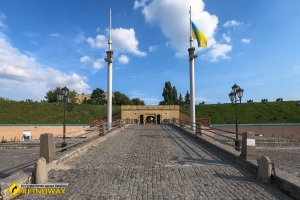
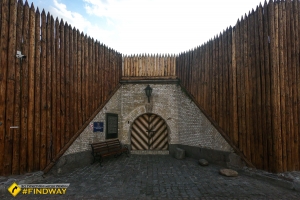
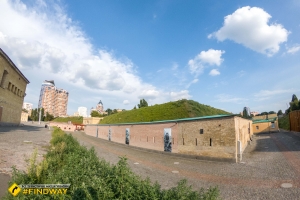
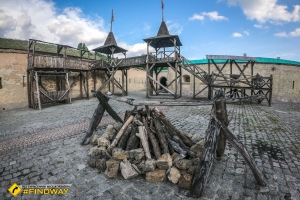


This fortress took nearly half a century to build, ringed by ramparts and moats covering dozens of hectares — and in its entire existence, not a single enemy ever stormed it. Europe's largest earthen fortress of its era turned out to be useless as a fortress.
But it made a perfect prison. Kyiv Fortress is one of those rare cases where a military site is remembered for cells, casemates, and the names of the people held there — not for any battle.
Quick facts
| Location | Pechersk district, Kyiv (core site — 24A Hospitalna St) |
| Built | mostly 1830s–1860s |
| Status | "Kyiv Fortress" historical and architectural museum |
| Key sites | Kosyi Caponier, Hospital Fortification, towers, ramparts |
| Time needed | 1.5–3 hours |
| Bring | warm clothing for the casemates, comfortable shoes, a phone flashlight |
In this article
- What it is and why it's worth a visit
- History: the fortress that never fought
- Kosyi Caponier: from casemate to prison
- Underground legends
- What to see
- How to get there
- Traveler's checklist
- Frequently asked questions
What it is and why it's worth a visit
"Kyiv Fortress" isn't a single building — it's an entire system of 19th-century fortifications scattered across Pechersk: ramparts, moats, brick towers, caponiers, and barracks. Today part of it is united into a historical and architectural museum, and it's one of the most underrated spots in the capital.
People come here for two things. First, the atmosphere of old fortifications sitting right in the middle of a residential city: massive brickwork, gun loops, underground passages. Second, for the story of the Kosyi Caponier — a place where political prisoners, from rebels to revolutionaries, were held and executed.
It's a great route for anyone tired of "postcard" Kyiv and curious about the side of the city the brochures don't mention.
History: the fortress that never fought
Fortifications in Pechersk were built up in stages, but large-scale construction took off under Emperor Nicholas I, starting in the 1830s. Kyiv was seen as a strategic outpost on the empire's western edge, and the city ended up with one of the largest fortification systems of its time — ramparts, moats, towers, and casemates designed for serious defense.
The paradox is that it never actually functioned as a real fortress. By the time it was finished, both warfare and weaponry had moved on: with the arrival of rifled artillery, earthen ramparts quickly became obsolete. Kyiv Fortress never faced a classic siege — the enemy simply never reached its walls in the way its designers had planned for.
In its day, this was one of the largest earthen fortification complexes in Europe. And in its entire history — not a single battle at its walls. The weapons became obsolete before they ever fired a shot.
Once it became clear the complex wasn't needed as a fortress, its buildings found other uses: barracks, warehouses, hospitals — and prisons.
Kosyi Caponier: from casemate to prison
The Kosyi Caponier ("Skewed Caponier") is the heart of the museum and the fortress's most famous part. Built as a defensive structure for flanking fire along the moat, it almost immediately took on a grim "specialty": a prison for political detainees.
Over the decades, its casemates held participants in the Polish uprisings, revolutionaries, and members of underground organizations. Conditions were inhumane: damp walls, cold, overcrowding. Some prisoners were executed here and buried nearby — which earned the caponier a reputation as one of the most sinister places in old Kyiv.
Today its casemates house a museum exhibit recreating prison life and telling the stories of specific inmates. This is exactly the place to go for that shiver down your spine that's the whole point of visiting an old fortress.
Underground legends
A place with this kind of history was bound to grow its share of legends.
1. Tunnels running under all of Pechersk
Kyivans have long claimed that a network of underground tunnels runs beneath the fortress — supposedly reaching the Lavra, the Dnipro, even cutting across most of the city. Some of these galleries do exist, but their scale is usually exaggerated in the telling. Still, that very mystery has drawn adventure-seekers here for decades.
2. Ghosts of the caponier
Staff and visitors love stories of "voices" and footsteps in the caponier's dead-end corridors. Given how many people suffered and died here, it's no surprise that imagination fills in the rest. Whether it's drafts in old walls or something else — that's for you to decide on the spot.
What to see
Kosyi Caponier. The main draw: the prison exhibit, casemates, and inmates' stories. This is where the complex's atmosphere is strongest.
Hospital Fortification. A large-scale section of the fortress with ramparts, towers, and casemates — this is what really gives you a sense of the citadel's true size.
Towers and bastions. Well-preserved 19th-century brick defensive structures with gun loops, photogenic in any weather.
Ramparts and moats. A walk around the perimeter shows just how grand the original plan was — and how completely the city has swallowed it up.
How to get there
Metro. The nearest stations are "Pecherska" and "Klovska" (blue line), then a 10–15 minute walk to Hospitalna St.
On foot. The fortress's sites are scattered across Pechersk, so it's worth mapping a walking route from the caponier to the fortifications.
By car. You can drive close to the core of the complex, but parking in Pechersk is limited — allow extra time to find a spot.
Hours and tickets. The museum operates on a schedule (usually with a day off early in the week), and admission is paid. During martial law, hours may change — check before visiting.
Traveler's checklist
- Warm clothing — the casemates are cool even in summer.
- Comfortable shoes — expect a lot of walking on ramparts and stairs.
- A phone with a flashlight — some areas are dim.
- Time to spare — the sites are spread out, and a full visit can easily eat up half a day.
What's not worth it: treating this as a "one museum, thirty minutes" stop — the fortress is large and spread out; and don't venture into closed-off or unsafe underground areas just for a dramatic photo.
Frequently asked questions
Is it one structure or several?
Several. Kyiv Fortress is a system of 19th-century fortifications in Pechersk (the Kosyi Caponier, the Hospital Fortification, towers, and ramparts). Some of these sites are united into a museum.
How much time should I set aside?
From 1.5 hours for the Kosyi Caponier alone to half a day if you also want to cover the Hospital Fortification and the ramparts.
Is it interesting for kids?
Yes — towers, casemates, and underground passages usually fascinate school-age kids. Younger children may find the cold casemates uncomfortable, so bring warm clothes.
Is the museum open during the war?
Usually yes, but the schedule and access to certain sites may change depending on the security situation. Check current opening hours before your trip.
Kyiv Fortress is a story about irony: a grand defensive machine was built right at the moment such defenses had already become pointless. And instead of fame from battle, it earned a very different kind of fame — grim, carceral, and deeply human.
Go down into the casemates of the Kosyi Caponier and you'll feel a Kyiv you won't find from any viewpoint — a city with far more history under its feet than the sidewalk lets on.
JoomShopping Download & Support