


- You are here:
-
Sights by Regions

-
Kyiv region
-
Kyiv
- Yard with crows, Kyiv

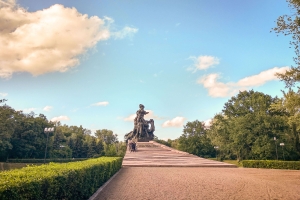


For half a century, not a single word at this site acknowledged what had actually happened here. The first Soviet monument went up as late as 1976 — dedicated to «Soviet citizens,» carefully sidestepping the fact that the overwhelming majority of those killed were Jewish.
The Menorah — a bronze seven-branched candelabrum and the first monument to call things by their true name — was unveiled only in 1991, fifty years after the shootings. Today, dozens of memorial markers are scattered across Babi Yar, and each one is a separate story of how a city learned to speak about its own wound.
Location Card
| Location | Kyiv, Shevchenkivskyi district, near Dorohozhytska and Melnykova Streets |
| What it is | A complex of memorials and markers at the site of mass executions in 1941–1943 |
| Main symbol | The Menorah (bronze seven-branched candelabrum, 1991) |
| Entry | free, 24/7 (open parkland) |
| Time needed | 1–2 hours |
| What to bring | comfortable shoes, water, respect for the place — and a little quiet inside |
In this article
- What it is and why people come
- History: 1941 and half a century of silence
- The dark stories of Babi Yar
- What to see on site
- How to get there
- Visitor checklist
- Frequently asked questions
What it is and why people come
Babi Yar is not a single monument but an entire field of memory. Across the grounds of the former ravine and the surrounding park, dozens of memorials are scattered: the Soviet monument of 1976, the Jewish Menorah, a memorial to executed children, a cross honouring executed priests and members of the OUN (Organization of Ukrainian Nationalists), markers for Roma victims, Ostarbeiter (forced laborers sent to Nazi Germany), and patients from a nearby psychiatric hospital.
People come here not for beauty, but for understanding. This is one of those places in Ukraine where the history of the 20th century is not behind museum glass — it lies right underfoot, in the shape of the land, in street names, in the way an unexpected hush falls the moment you step deeper into the park.
The shortest route of remembrance is called the «Road of Sorrow» — the very path along which people were marched to their deaths in September 1941. It ends at the Menorah, placed roughly at the edge of the old Jewish cemetery.
History: 1941 and half a century of silence
The Wehrmacht entered Kyiv on 19 September 1941. The first shootings began as early as 27 September. The next day, notices were posted across the city ordering all Jews to gather on the morning of 29 September at the corner of Melnykova and Dehtyarivska Streets — ostensibly for «resettlement.»
Over two days, 29–30 September 1941, the Nazis shot more than 33,000 Kyiv Jews in the ravine. People were stripped of their clothing, lined up along the edge of the ravine, and killed in volleys. It was one of the largest mass executions of the Holocaust in such a short span of time.
But the killings did not end in 1941. Over the following two years, Roma, Soviet POWs, underground fighters, psychiatric hospital patients, OUN members, and hostages were all executed at Babi Yar. Historians estimate the total number of victims exceeded 100,000.
The first memorial here appeared only in 1976 — 35 years later. And even then, the word «Jew» appeared nowhere on it: the Soviet authorities buried the Holocaust beneath the phrase «peaceful Soviet citizens.»
How the ravine was erased
In autumn 1943, retreating Nazis forced prisoners to dig up mass graves and burn the bodies to conceal the scale of the atrocity. After the war, Soviet authorities continued this erasure in their own way: the ravine was gradually filled in, pumped full of pulp from nearby brick factories, and eventually roads were built and a park laid out over it.
The silence itself doubled Babi Yar’s significance as a symbol. This place remembers not only those killed in 1941, but also how an entire society spent decades pretending nothing had happened.
The Menorah: a monument that finally spoke
The bronze Menorah — a seven-branched candelabrum, one of the oldest symbols of the Jewish people — was unveiled on 29 September 1991, on the 50th anniversary of the tragedy. The project was designed by architect Yurii Paskevych; the reliefs were created by artists Yakym and Oleksandr Levychi.
The monument stands at the end of the «Road of Sorrow,» roughly where the boundary of the old Jewish cemetery once ran — the very path along which people were led to their deaths. Every year on 29 September the main commemoration ceremonies begin here.
The dark stories of Babi Yar
This is one of those places people discuss in hushed voices. There are no cheerful legends here — only thoroughly documented stories that send a chill down the spine far more effectively than any fiction.
1. The Kurenivka flood: when the ravine «struck back»
As the authorities pumped the ravine full of factory pulp, they built a retaining dam. On 13 March 1961, it burst. A giant wave of liquid mud as tall as a building swept through the Kurenivka neighbourhood, flattening trams, buildings, and people. Officially, several dozen died; unofficial estimates run as high as 1,500. Kyivans still pass down the saying: «the ravine would not let itself be buried.»
2. A place that refused to forget
Despite the infill, roads, and parkland, Kyivans shared a persistent belief for decades that «nothing should be built here.» Every attempt to develop the territory met with resistance — and ultimately it was collective memory, not official decisions, that saved the ravine from disappearing completely under asphalt.
3. The witness who kept count
One of the most famous accounts is that of a woman who survived by falling into the ravine a split second before a shot was fired and lying among the bodies until nightfall. Testimonies like hers are what allowed the world to learn the details of what the Nazis had so methodically tried to burn and bury.
What to see on site
The Menorah. The must-visit anchor of any route. The seven-branched candelabrum at the end of the Road of Sorrow — start or finish your visit here.
The Soviet monument of 1976. A massive bronze ensemble dedicated to «Soviet citizens.» Its value is not artistic but documentary — look closely at what it does not say.
Memorial to executed children. One of the most emotionally powerful sites in the complex. Nearby stand markers for Roma victims and Ostarbeiter.
Cross for priests and OUN members. A reminder that people were killed here not only for their ethnicity but also for their beliefs.
Symbolic synagogue and contemporary installations. A wooden synagogue that «opens like a book,» plus a series of modern memorial objects that appeared on the slopes in 2021. The private memorial centre is controversial in Ukraine due to Russian funding behind some of its founders — worth knowing, but the physical objects are open to visitors.
How to get there
Metro. The easiest option — Dorohozhychi station (green line). The exit leads almost directly into the park: the TV tower and the first memorial markers are visible immediately.
Car. Head for Dorohozhytska / Melnykova Street, near the TV tower. Parking is available nearby, though weekdays can be busy due to the neighbouring hospitals.
Public transport. Numerous minibuses and trolleybuses serve the Lukianivka and Dorohozhychi area; look for stops near the TV centre.
Entry is free and round-the-clock — this is open parkland. For a meaningful visit, plan to come in daylight.
Visitor checklist
What to bring and keep in mind:
- Comfortable shoes: the grounds are large, hilly, and criss-crossed by paths — expect a fair amount of walking.
- Water: there are no cafes inside; the nearest options are by the metro.
- A map of the site: the markers are spread out — without a plan you can easily walk past half of them.
- Time: allow at least an hour so you’re not rushing.
- Respect: this is a site of mass death, not a backdrop for social media photos.
What NOT to do: picnic, make noise, or climb on monuments for a photo. This place calls for a different register entirely.
Frequently asked questions
How much does entry cost?
Nothing. It is an open park, accessible 24/7 and free of charge.
How long should I plan for a visit?
One to two hours if you want to walk the Road of Sorrow and see the main markers. In 20 minutes you will barely manage the Menorah and the Soviet monument.
Is it suitable for children?
Yes, but it is a site with a heavy history. Younger children should be given some context beforehand; very young ones will simply find it dull — there are no attractions here.
When is the site most crowded?
29 September — the anniversary of the tragedy — when ceremonies and the March of Memory take place at the Menorah. Thousands gather on that day.
Is it safe to visit now?
The site is in Kyiv and is accessible, but as anywhere in Ukraine during the war — monitor air-raid alerts and keep a warning app handy. In March 2022 a Russian strike near the grounds claimed lives, giving the place yet another, contemporary page of memory.
Babi Yar does not impress with architecture, and it cannot be «done» in 15 minutes. Its power lies elsewhere: standing above ground that remembers more than any textbook, you understand why these simple bronze markers appeared so late and with such difficulty.
The Menorah that lit up only after half a century of silence is the most precise symbol of this place. Sometimes the most important thing a memorial can do is simply, finally, name those who for so long were not meant to be named.
JoomShopping Download & Support