


- You are here:
-
Sights by Regions

-
Kyiv region
- Bila Cerkva


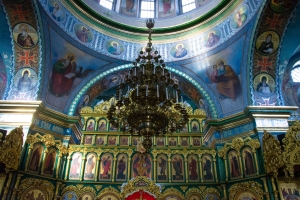
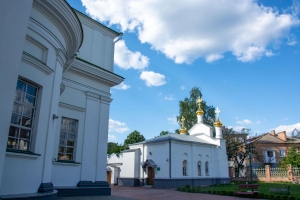
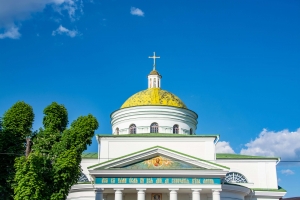
Countess Oleksandra Branitska built a grand cathedral in Bila Tserkva — and died in the very year it was completed. The locals were not surprised: the site on which the church was raised had long been considered ill-omened.
The Transfiguration Cathedral (Spaso-Preobrazhenskyi) is the principal Orthodox church of Bila Tserkva and one of the most striking structures in the city: a 40-metre Neoclassical giant visible from afar. Behind its solemn colonnade lies a story that weaves together Mazepa, the Polish magnate Branitski dynasty and a legend of a curse.
Quick Facts
| Location | Soborna Square, Bila Tserkva, Kyiv Region |
| Type | active Orthodox cathedral |
| Built | 1833–1839 |
| Height | approx. 40 m (130 ft) |
| Time needed | 20–40 minutes |
What it is and why visit
Bila Tserkva is most often associated with the Oleksandria Dendrological Park. But right in the city centre stands a building that deserves its own detour — the Transfiguration Cathedral. It is a textbook example of Neoclassicism from the first half of the 19th century: austere proportions, columned porticos, a monumental mass that anchors the entire central square.
People come here for two things: architecture — and history. Because behind every stone of this cathedral stand real people: Hetman Mazepa (the Ukrainian Cossack leader who founded a church on this very site) and Countess Branitska, who replaced it with a grander temple and, according to legend, paid for it with her life.
The cathedral was built at the expense of Countess Oleksandra Branitska. She died in the same year the construction was finished — and was buried in the very church she had commissioned.
History: from Mazepa’s church to the Branitski cathedral
The story begins long before the current cathedral. On this site, in 1706, a St. Nicholas Church was erected, its founder considered to be Hetman Ivan Mazepa (the Cossack leader who features in Pushkin and Byron as a romantic figure). By the 19th century the building had fallen into disrepair.
Bila Tserkva had been in the hands of the Polish Branitski magnate family since the 1770s. Countess Oleksandra Branitska, wife of Franciszek-Ksawery Branicki, decided to replace the old church with a new, far larger temple. Construction ran from 1833 to 1839, modelled on the Transfiguration Cathedral in Odesa — which explains the grand «metropolitan» Neoclassical look.
During the Soviet era the cathedral, like most religious buildings, had a difficult time. It was listed as an architectural monument in 1956 and returned to the religious community in 1989. Since 1994 it has held cathedral status and serves as the centre of the Bila Tserkva Diocese.
The curse legend
The cathedral’s most famous story is a dark one. Local tradition holds that whoever dares to build a new church on the site of the old St. Nicholas Church condemns themselves to an inevitable death.
Oleksandra Branitska, the story goes, was aware of this omen — and went ahead anyway. When the work was finished, the countess died that same year. She was buried inside the walls of the cathedral she had ordered built. Coincidence? Possibly. But it is precisely this kind of story that turns a simple walk past a church into a small detective tale.
The Branitski family as a whole accumulated a trail of «curse» legends — the cathedral story is just one of them.
What to see
The exterior and columns. The Neoclassical facade with its porticos is best appreciated from a distance, from Soborna Square — that vantage point reveals how massive the structure really is.
The interior. The cathedral is active, so you can go inside during services or during visitor hours. Remember: this is first and foremost a place of worship, not a museum — behave accordingly.
Soborna Square. The square itself is the historic heart of Bila Tserkva — a natural starting point for a walk through the city centre.
Getting there
The cathedral stands in the very centre of Bila Tserkva and is easy to find — the building is visible from a distance.
- By car from Kyiv: about 80 km south along the highway, roughly an hour and a bit.
- By public transport: regular buses and minibuses from Kyiv to Bila Tserkva; then local transport to the centre.
- In the city: aim for Soborna Square, the central square.
What’s nearby
Bila Tserkva is best explored as a full itinerary. Next to the cathedral is the historic city centre, and the area’s must-visit highlight is the Oleksandria Dendrological Park, one of the largest historic parks in Ukraine — also created by the Branitski family. The cathedral and Oleksandria make a natural pairing for a single trip.
Frequently asked questions
Can visitors go inside the cathedral?
Yes, it is an active church. You can enter during services or during visitor hours. Dress appropriately and behave respectfully.
Is there an entrance fee?
Entry is free. This is not a ticketed museum but an active cathedral.
Who built the cathedral?
The church was built in 1833–1839 at the expense of Countess Oleksandra Branitska, on the site of an earlier St. Nicholas Church attributed to Hetman Ivan Mazepa.
What else is worth seeing in Bila Tserkva?
The Oleksandria Dendrological Park is a must — one of the largest historic parks in the country. It pairs perfectly with the cathedral and the historic centre.
JoomShopping Download & Support