


- You are here:
-
Sights by Regions

-
Kharkiv region
- Ruins of Kolokoltsev manor , Rubizhne

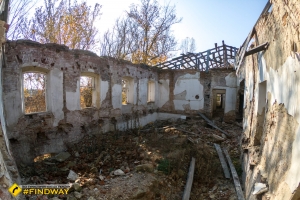


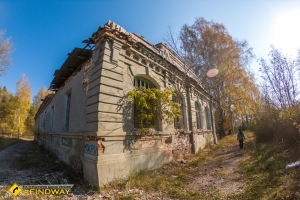
First the estate became ruins. A hundred years later, so did the town around it.
The Kolokoltsev manor on the bank of the Siverskyi Donets survived two world wars, a revolution, collectivization, and half a century of Soviet neglect — only to end up inside Rubizhne, which was reduced to ashes in 2022. Now it’s ruins within ruins: brick walls over a century old standing among fresh war scars.
Quick facts
| Location | Rubizhne, Sievierodonetsk district, Luhansk region |
| Distance | ~120 km north of Luhansk, on the left bank of the Siverskyi Donets |
| Time needed | currently inaccessible (see “Getting there”) |
| What to bring | for now — only respect for the place, old photographs, and patience for better times |
What it is and why it mattered
Everyone knows Rubizhne as a chemical town — pipes, the Zoria plant, dyes and explosives. But before the factory floors started rumbling, these riverbanks belonged to a different world: a world of manor houses, horse-drawn carriages and orchards. The Kolokoltsev estate is one of the few surviving witnesses of pre-revolutionary Sloboda Ukraine in the Luhansk region.
People came here (or rather, did until 2022) not for the polished beauty of a restored palace — there was none of that. They came for the feeling that genuine ruins give you: old brick that remembers other names and other eras, walls overgrown with wild grapevine, and a silence in which you could still hear an echo of an entirely different Rubizhne — not an industrial one, but a manor-house one.
History
The Kolokoltsevs were an old noble family of Sloboda Ukraine. Their lands stretched along both banks of the Siverskyi Donets, on the border between the then Kharkiv and Katerynoslav provinces — right where, decades later, the very “border” (rubizh) that gave the future town its name would run.
The estate was built long before Rubizhne existed on any map. Around it lay fields, floodplain meadows and a pine forest above the river. A manor house, outbuildings, an orchard — a typical 19th-century noble estate, one of hundreds across Sloboda Ukraine, of which only a handful survive today.
Everything changed in 1895. A railway was laid through these lands, and near Rubizhna station — named for its location on the border — a workers’ settlement began to grow. And when the “Russko-Kraska” chemical plant (the future Zoria) was built here in 1915–1917, it became clear once and for all: the era of manor estates was over, and the era of pipes and factory floors had begun.
The 1917 revolution put an end to the family’s story here. The estate was nationalized, the family scattered or emigrated, and the manor house went on to serve, as was typical, as an office, then a warehouse, then housing. During the Soviet era, it wasn’t fashionable to dwell on “class enemy” landowners — and the estate quietly decayed for decades, until it became the ruins that tourists knew in the 2010s.
The estate survived nationalization, two world wars, and half a century of being forgotten. The only thing it didn’t survive was 2022 — along with the rest of the town.
Legends and lore
Like every old estate, the Kolokoltsev manor is surrounded by local legends. None of them can be documented, but they’re exactly what turns ruins into Ruins, rather than just a pile of bricks. Here’s what the old-timers tell.
1. A tunnel to the river
The most popular legend at almost every manor house, and this one is no exception. They say a tunnel ran from the estate’s cellars all the way to the Siverskyi Donets — either as an escape route in turbulent times, or so the lady of the house could slip down to the water unseen. The tunnel was supposedly filled in back in Soviet times. No local historian has ever found it, but every other boy from the next street “definitely knew where the entrance was.”
2. A hidden treasure
The second obligatory plot: fleeing the revolution, the owners supposedly didn’t have time to take everything and walled their valuables up somewhere inside. Over a hundred years, the ruins have been dug over so many times that if a treasure existed, it would have been found long ago. But the legend lives on — it was never really about gold, but about the hope that something of the old world still remains.
3. The garden that blooms on its own
The warmest of the stories. The old manor garden supposedly went wild but never died: every spring, old apple trees and lilacs planted by the original owners stubbornly bloom among the ruins. Locals used to say: “The masters left, but the garden stayed — it’s the most loyal thing here.”
What to see on site
The walls of the main house. The reason people came here. Old pre-revolutionary brick, distinctive masonry, window openings without frames — the classic image of an abandoned noble estate that photographers of derelict places love so much.
The remains of the service yard. Near the main house, you can usually make out the outlines of outbuildings — stables, storehouses, servants’ quarters. They’re the clearest sign that this was not just a house, but an entire working estate.
The old garden and the riverbank. The surrounding nature is half the experience. The Siverskyi Donets, pines, the wild trees of the former orchard. Without them, the ruins would be just ruins; with them, it’s a place with its own atmosphere.
Getting there
To be honest and direct: right now — you can’t. Rubizhne has been temporarily occupied by Russia since May 2022 and was almost entirely destroyed during the fighting — the head of the Luhansk regional administration described the town as having “not a single intact building left.” Travel here is currently impossible and dangerous: occupation, destruction, and the risk of mines.
So the route to the Kolokoltsev estate today is a route for the future — for after de-occupation and demining. We’re keeping the directions for those better times exactly as they were.
By car (for reference, for later). Rubizhne sits on the left bank of the Siverskyi Donets, in the cluster of towns Sievierodonetsk — Lysychansk — Rubizhne, about 120 km north of Luhansk.
By rail. Historically, it was Rubizhna station (on the Lysychansk — Kupiansk line) that gave the town its life. There is currently no passenger service.
Traveler’s checklist
- Check the status of the area — before even thinking about a “someday” trip, follow whether the town has been de-occupied and demined.
- Add it to your “after the war” list — the smartest thing you can do with this estate right now.
- Save old photos and memories — while access is closed, archival images of the estate and the town are what hold real value.
- Support people from Rubizhne — residents who left can tell you best what Rubizhne was like before the destruction.
What NOT to do: attempt to enter temporarily occupied territory — it is life-threatening and illegal. No ruin is worth that risk.
Frequently asked questions
Can you visit it right now?
No. Rubizhne has been temporarily occupied since May 2022 and is heavily destroyed. Travel is impossible and dangerous. The location is relevant only as a plan for after de-occupation and demining.
Who were the Kolokoltsevs?
An old noble family of Sloboda Ukraine, landowners on the banks of the Siverskyi Donets long before Rubizhne existed. Their estate is one of the few remaining traces of the pre-revolutionary manor era in this industrial region.
Why is the estate in ruins?
The estate had been declining since Soviet times: after the 1917 nationalization it was used for various practical purposes and gradually abandoned. The 2022 war then completed the destruction, along with the rest of the town.
What else is worth seeing nearby?
Rubizhne is part of the cluster of towns Sievierodonetsk — Lysychansk — Rubizhne along the Siverskyi Donets. All of them suffered from the war, so full routes through the region will only become possible after de-occupation.
The Kolokoltsev estate is the story of how one old manor survived almost the entire 20th century, only to find itself inside a new war in the 21st. Nobility, revolution, factories, oblivion — and now, finally, ruins within ruins.
But there’s a stubborn hope in this too. If a wild manor garden could manage to bloom among the stones every spring, maybe Rubizhne itself will bloom again one day. And then it will finally be possible to return to these walls — not as a front line, but as a quiet place where one world ended and another began.
JoomShopping Download & Support
Attention! Part of Ukraine was occupied during Russia's unfounded military aggression against us and other democratic countries!
russia is a terrorist country, russians are murderers, thieves and rapists.
Russia's unhuman aggression against Ukraine since 2014 has led to the loss of homes and lives not only of many Ukrainians, but also of citizens of other countries and nationalities.
We consider any military actions against any state in the 21st century unacceptable and stupid, but unfortunately the Russians do not think so, and therefore many democratic countries, including Moldova, Georgia and our homeland, suffer from barbaric aggression.
Therefore, until the occupied parts of Ukraine are demilitarized and returned to our state, we remind users about the real danger of visiting the territories occupied by russia.