


- You are here:
-
Sights by Regions

-
Kharkiv region
- Dam, Staryi Saltiv
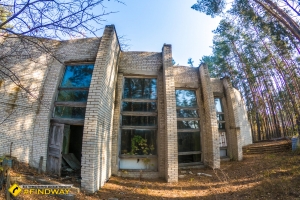
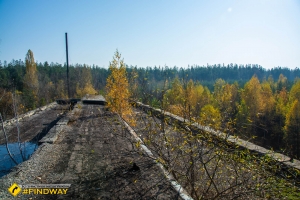
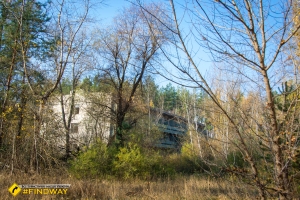


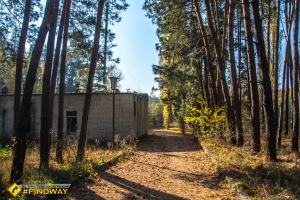

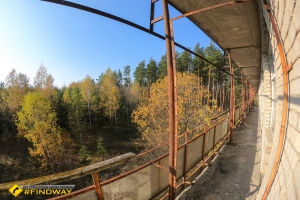
Until 2022, people came here for the simplest kind of happiness: pine trees, sand, and the waters of Pechenizke Reservoir stretching as wide as a small sea. Khvoina was one of dozens of holiday camps that lined the shore at Staryi Saltiv.
Now empty buildings with broken windows stand between the pines, and the footpaths are slowly disappearing under grass. The resort is still there — the people just left and never came back.
Location at a Glance
| Location | Staryi Saltiv urban-type settlement, Chuhuiv district, Kharkiv region |
| Distance from Kharkiv | approx. 50 km north-east |
| Time needed | 1–1.5 hours |
| What to bring | sturdy footwear, water, a power bank, and caution — this area was under shellfire |
What Is This Place and Why Do People Visit?
For decades, Staryi Saltiv was Kharkiv’s favourite weekend escape. The right bank of Pechenizke Reservoir filled up with sanatoriums and holiday camps: pine forests, beaches, and silence just an hour’s drive from a city of one million. Khvoina — «Pine Forest» in Ukrainian — was one of them, with wooden and brick buildings nestled among the conifers that gave it its name.
Today visitors come not to sunbathe but to witness what war leaves behind. This is a place about how quickly an ordinary resort can become a film set for an evacuation movie.
History
Resort life on this shore began in Soviet times, when the reservoir transformed a sleepy steppe village into a mass-leisure destination. Holiday camps were built by trade unions, factories, and government ministries — every enterprise wanted its own slice of the pine-fringed waterfront.
In peaceful years the season ran from May to September. Canteens, boat rentals, and dance floors were all in full swing. For many people from Kharkiv, childhood smelled exactly like this: pine needles warmed by the sun and reservoir water.
Staryi Saltiv was occupied in the opening days of the full-scale invasion and liberated on 4 May 2022. The settlement found itself in an active combat zone, and its resort infrastructure was among the first to be destroyed.
After liberation the settlement remained wounded: ruined houses, trees shredded by shrapnel, resort buildings stripped of windows and roofs. Khvoina shared that fate — from a lively holiday spot it became a quiet ruin in the forest.
Legends and Local Lore
Abandoned resorts quickly accumulate stories — the contrast between former laughter and present silence is simply too striking to ignore.
1. Music from the Empty Dance Floor
Locals say that on quiet evenings, something resembling old pop music sometimes drifts from the abandoned camps. Sceptics put it down to wind in the pines and surviving gutters. Romantics call it the memory of a place that spent too long growing used to the sounds of people.
2. The Caretaker Who Stayed
Among the Saltiv camps there is a rumour about an old caretaker who allegedly refused to evacuate and stayed behind to look after the empty buildings. No one has actually seen him — but someone once claimed to notice a light on in one of the windows.
What to See on Site
Buildings among the pines. The defining image of Khvoina is empty cottages being slowly reclaimed by the forest. The pines here are old and tall, casting the dappled light and shadow that bring photographers back time and again.
The shore of Pechenizke Reservoir. The water itself is unchanged. From the bank you look out over an expanse wide enough that the far shore is barely visible — hence the local nickname «the Saltiv sea.»
Traces of ordinary life. Remains of gazebos, concrete steps leading down to the water, rusting fairground frames — details that tell the story of this shoreline before the war better than any text can.
How to Get There
By car. From Kharkiv, take the road towards Staryi Saltiv via Pecheniky — about 50 km. The camps run along the right bank of the reservoir; Khvoina sits in the resort strip within the pine forest.
By public transport. Buses run from Kharkiv to Staryi Saltiv; from there it is a walk along the waterfront zone.
Important. This is a de-occupied frontline territory in Kharkiv region. Before you go, check the current security situation. Stay on known roads and paths: the risk of unexploded ordnance remains.
Traveller’s Checklist
- Bring: sturdy footwear, water, a charged phone, and a power bank.
- Bring: respect for the place — these are not just ruins, they are the marks of someone else’s loss.
- Check: the current safety situation in the area before you leave.
- Don’t: leave paved roads or touch any unfamiliar metal objects.
- Don’t: enter structurally unsafe buildings in the abandoned camp.
Frequently Asked Questions
Is it safe to visit?
Staryi Saltiv is a de-occupied frontline zone. The settlement has been liberated, but the area is periodically shelled and the risk of landmines on surrounding land remains. Only visit if the current security situation allows it.
Can you swim here, as people used to?
The resort infrastructure is non-functional, the beaches are unequipped and unchecked. Treat Khvoina as a place of memory, not as an active holiday base.
When is the best time to visit?
The site is most evocative in late spring and summer, when the green pines throw the empty buildings into sharp relief. That said, let safety — not seasonality — guide your timing.
Khvoina is not a ghost story — it is a quiet monument to ordinary happiness that once felt permanent. Pine trees, water, children’s laughter: all of that was here not so long ago.
And perhaps the most powerful thing about this place is that its story is not over: one day, people will come back to this shore.
JoomShopping Download & Support
Attention! Part of Ukraine was occupied during Russia's unfounded military aggression against us and other democratic countries!
russia is a terrorist country, russians are murderers, thieves and rapists.
Russia's unhuman aggression against Ukraine since 2014 has led to the loss of homes and lives not only of many Ukrainians, but also of citizens of other countries and nationalities.
We consider any military actions against any state in the 21st century unacceptable and stupid, but unfortunately the Russians do not think so, and therefore many democratic countries, including Moldova, Georgia and our homeland, suffer from barbaric aggression.
Therefore, until the occupied parts of Ukraine are demilitarized and returned to our state, we remind users about the real danger of visiting the territories occupied by russia.