


- You are here:
-
Sights by Regions

-
Kharkiv region
- Kharkiv
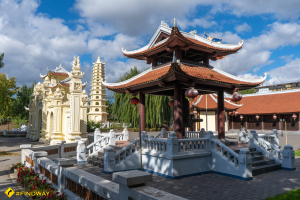
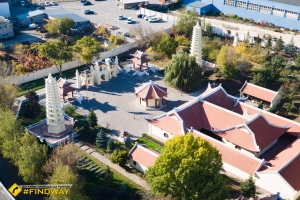
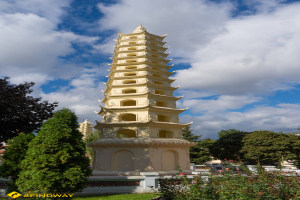


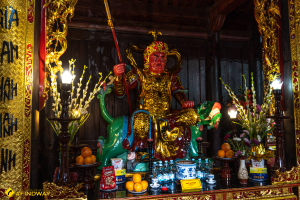


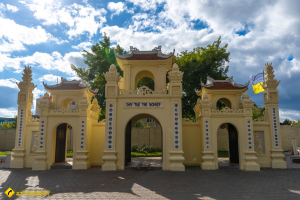


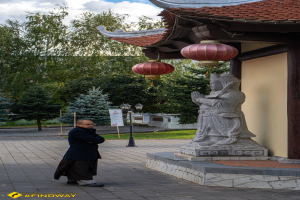
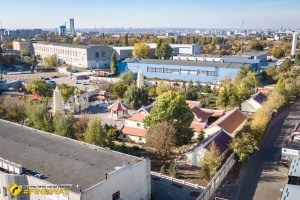
Among the ordinary residential blocks of Kharkiv’s Kyrghyzska Street, a 35-metre pagoda suddenly rises up — curved rooftop tiers, stone gates and a bronze bell. It feels like a piece of Vietnam accidentally landed in eastern Ukraine.
Chuk Lam Buddhist Temple — whose name translates as «Bamboo Forest» — is one of Kharkiv’s most unexpected landmarks and the spiritual home of the city’s Vietnamese community.
Location card
| Location | Kyrghyzska St, Nemyshlianskyi district, Kharkiv |
| What it is | Vietnamese Buddhist temple complex |
| Built | 2007, by the local Vietnamese community |
| Time needed | 30–60 minutes |
| Bring | a camera, modest clothing and respect for temple etiquette |
What it is and why visit
Chuk Lam is arguably Kharkiv’s most surprising hidden gem. There are no industrial ruins or Cossack heritage here — instead you get a genuine Asian pagoda, statues of Vietnamese Buddhist protectors and an atmosphere you won’t find anywhere else in the city.
People come for the contrast: curved rooflines against a backdrop of Soviet-era apartment blocks, ornate ceremonial gates, the hush of a temple courtyard. For some it’s a place of spiritual practice; for others it’s a chance to step into an entirely different culture without leaving Ukraine.
The complex covers a full hectare — by some accounts making it one of the largest Buddhist temple complexes in Europe.
History: how Vietnam came to Kharkiv
The temple was built in 2007 by the local Vietnamese community — one of Kharkiv’s most established ethnic groups, formed during the Soviet era and strengthened through the years of Ukrainian independence.
The name was chosen with care: «Chuk Lam» translates from Vietnamese as «Bamboo Forest» — an image of tranquillity and a reference to the Vietnamese Buddhist tradition. For the community the temple is not only a house of worship but a cultural centre that keeps their heritage alive far from home.
What to see on site
35-metre pagoda. The centrepiece of the complex, with layered curving roofs — visible from a distance and unmissable up close.
15-metre ceremonial gates. Elaborately ornamented in the traditional style — both a great photo opportunity and a symbolic threshold between worlds.
Bronze bell. According to belief, its sound wards off evil spirits — a detail that immediately draws you into the temple’s atmosphere.
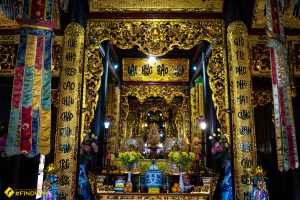
Statues of protectors. The grounds and interiors are adorned with figures of Vietnamese Buddhist guardian deities.
Getting there
By car. The temple is on Kyrghyzska Street in Kharkiv’s Nemyshlianskyi district. Use the pagoda as your landmark — it’s clearly visible above the rooftops.
Public transport. City buses serve the Nemyshlianskyi district; it’s then a short walk to the complex.
Before you visit. This is an active place of worship, so check in advance whether the grounds are open to visitors and follow all temple rules.
Traveller’s checklist
- Modest clothing: this is a religious site — dress appropriately.
- Camera: the pagoda and gates are ready-made shots.
- Quiet and respect: services may be taking place inside.
- Check access in advance: confirm visitor access before you go.
What NOT to do: make noise, enter restricted areas without permission or photograph worshippers without their consent.
Frequently asked questions
What does «Chuk Lam» mean?
Translated from Vietnamese, «Chuk Lam» means «Bamboo Forest» — an image of serenity and a reference to the Vietnamese Buddhist tradition.
Can ordinary tourists visit the temple?
Chuk Lam is the active temple of the Vietnamese community. The grounds are generally open to visitors, but it’s worth checking access in advance and behaving as you would at any religious site.
Is it safe to visit Kharkiv during the war?
Kharkiv is a frontline city subject to shelling and air-raid alerts. Always check the current security situation before travelling there.
Chuk Lam is proof that Kharkiv is far more diverse than it looks. Tucked between the usual apartment blocks stands a genuine Vietnamese pagoda — complete with a bell said to drive away evil spirits.
Come and see the «Bamboo Forest» in stone, take in the quiet of the temple courtyard, and let the city surprise you. Just remember to show respect — for someone, this is a house of prayer.
JoomShopping Download & Support