


- You are here:
-
Sights by Regions

-
Dnipropetrovsk region
-
Kryvyi Rih
- Video Gallery of historical museum in сlock, Kriviy Rig

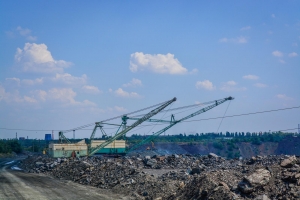


This is the only exhausted iron ore quarry in Kryvyi Rih to have filled with a large lake inside. And by current estimates, in ten to fifteen years it will be gone entirely: the pit is being gradually backfilled with waste rock.
So the exhausted iron ore quarry of the Novokryvorizky GOK is a location with a countdown timer. A landscape that looks more like another planet than the outskirts of a Ukrainian city — and one you might not catch next season.
Quick Facts
| Location | Kryvyi Rih, Dnipropetrovsk region |
| What it is | exhausted NKHOK iron ore quarry with a lake |
| Status | active industrial zone, restricted access |
| Time to visit | 1–2 hours (viewing from above) |
| What to bring | phone/camera, water, sturdy shoes, common sense |
What It Is and Why Visit
Kryvyi Rih stands on iron. Gigantic active quarries are a normal part of the landscape here: terraced walls hundreds of metres deep, dump trucks the size of buildings crawling across the floor. But this quarry is different: ore extraction has stopped, and a lake has collected at the bottom.
It is the contrast that makes the location special. Rusty-red and black walls of iron-bearing rock — and a calm body of water nestled among them. Locals have nicknamed it the «Kryvyi Rih Baikal»: for its scale, for the mirror of water in a stone bowl, for the almost cosmic atmosphere.
This is not a managed lake for recreation but a high-hazard industrial site. There is no safe route to the water and being at the bottom is dangerous. People come here to look, not to swim.
History: A Pit Born and Vanishing Before Our Eyes
Quarry operations began in the early 1960s — around 1961. For decades iron ore was extracted here for the Novokryvorizky Mining and Processing Plant, one of the giants of Soviet metallurgy.
When reserves at this section were exhausted, the quarry began to be gradually backfilled with waste (overburden) rock — a process that started in the late 1970s, around 1978, and continues to this day. At the same time the bottom filled with water. This is how the current crater lake formed: not by design, but as a by-product of mining operations.
This is why the location is temporary. While the plant stockpiles waste rock, the lake’s shores slowly contract. Media reports have estimated the lake could disappear within 10–15 years. Some will photograph the «Kryvyi Rih Baikal» in time; others will not.
Legends and Local Lore
Iron, depth and a restricted site — ideal conditions for urban legends.
1. Water That «Attracts»
Because of the high iron content of the surrounding rock, locals joke that the water here is «magnetic» and won’t release anyone who goes in too deep. Physicists will smile, but standing above an enormous red pit, it is somehow easy to believe.
2. A City Under Water
Stories circulate of abandoned mining workings, tunnels and machinery at the bottom — an entire «underwater city» buried under rock and water. How much of this is true and how much urban explorer fantasy cannot be verified: a safe descent is impossible.
3. The Lake That «Flees»
Regulars say: every time you come back, there is less water than before. And this is not even a legend so much as a near-documentary fact. The quarry is literally disappearing, and each new photo differs from last year’s.
What to See and Do
The panorama from above. The main (and safest) reason to come. From the quarry rim you see the «other-planet» view: red-black rock terraces and water at the bottom.
Drone footage. The true scale of the pit is only felt from the air. But first check whether there are flight restrictions in the zone — industrial and secure facilities are nearby.
Nearby mining equipment museum. The plant has an outdoor display of old dump trucks, excavators and other mining machinery — a good addition to the route.
Contrast photography. Industrial apocalypse + calm lake — a shot that exists nowhere outside Kryvbas.
Getting There
By car. The quarry is on the Novokryvorizky GOK site within Kryvyi Rih. Navigate to the NKHOK (NKHOK GOK) and the plant’s industrial zone. Access roads are for industrial use.
Access. This is not a public park but an active enterprise. The territory is restricted and may have security and a no-entry policy. To view the lake safely and legally, use open vantage points outside the plant perimeter without crossing the fence or security zone.
By public transport. Minibuses and trams to the nearest district, then on foot — but keep in mind the restricted access to the industrial zone itself.
Visitor Checklist
- Sturdy closed shoes: the rock is sharp and slopes are unstable.
- Camera or drone: the landscape is the whole point of the trip.
- Water and snacks: no facilities.
- Power bank: for navigation and photography.
What NOT to do: descend to the water via the quarry walls; enter the plant site without a permit; fly a drone without checking restrictions; underestimate that this is a high-hazard industrial zone, not a beach.
Frequently Asked Questions
Can you swim in the NKHOK quarry?
No. This is a high-hazard industrial site: there is no safe route to the water and the banks are unstable and steep. The location is suitable only for viewing from above.
Is visiting legal?
The quarry belongs to an active plant, so entry to the site is restricted. To view the landscape, use open vantage points outside the perimeter without crossing the fence or security zone.
Why do people say the quarry will soon disappear?
Because the pit is being gradually backfilled with waste rock. Estimates suggest the crater lake could vanish within 10–15 years, so the landscape is genuinely temporary.
Is it safe to visit during the war?
Kryvyi Rih is a frontline city under periodic shelling, and industrial sites may be targeted. Check the current situation and respond to air alerts.
The NKHOK iron ore quarry is a landscape with a built-in countdown. Red terraces, black rock, a quiet lake at the bottom — a scene Kryvyi Rih created by accident and will take away the same way.
So if you want to see the «Kryvyi Rih Baikal,» don’t wait. Just view it from where it is safe: from the rim, from above, without trying to «get closer.» Some landscapes are beautiful precisely at a distance.

JoomShopping Download & Support