

- You are here:
-
Sights by Regions

-
Chornobyl Exclusion Zone
-
Pripyat
- Sixteen-floor house Gerbovik, Pripyat
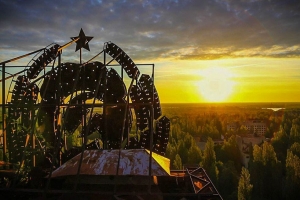


Look up above the rooftops of Pripyat and on one of the high-rises you’ll spot a massive Soviet coat of arms. It’s not painted on — it’s an actual metal structure mounted on the ridge of a sixteen-story building so it can be seen from a distance. That emblem is exactly why locals nicknamed the building “Herbovik” (loosely, “the Emblem House”).
This emblem once glowed against the sky as a symbol of the state's permanence. Today the state is gone, but the emblem is still there — it has outlived the country that put it up.
Quick facts
| Location | city of Pripyat, Chernobyl Exclusion Zone, Kyiv region |
| Access | restricted area; tourist access to the Zone has been limited since 2022 |
| Time needed | 15–30 minutes from outside, as part of a city walking route |
| Bring along | a telephoto lens for the rooftop emblem, a dosimeter, fully covering clothing, and the habit of watching where you step |
What it is and why people come
The "Herbovik" is one of the tallest residential buildings in Pripyat — a sixteen-story apartment block topped with a massive emblem of the USSR. Several such towers once stood across the city, shaping the recognizable skyline of this young atomic-era town.
The main reason to come here is the emblem itself. It’s one of the most photographed symbols of the Zone: a huge metal sign against the sky that has come to represent the entire ghost city. Even people who know little about Pripyat's history recognize this building.
The second reason is the view. From the upper floors and the roof, a panorama of the whole city opens up, and in the distance you can see the Chernobyl Nuclear Power Plant with the new protective arch over Reactor 4. From up here, it's easy to grasp just how close the city stood to the plant.
History
Pripyat was founded in 1970 as a town for workers of the Chernobyl Nuclear Power Plant. It grew quickly and was young and well-planned: wide avenues, new residential districts, and apartment blocks that were modern for their time. The sixteen-story buildings became the vertical landmarks of the cityscape.
The Soviet emblem on the roof wasn’t an accident — it was a deliberate statement. Such emblems on high-rises symbolized the strength and permanence of the Soviet state, while also serving as landmarks and decorative accents on the skyline. At night, the emblem was lit up.
The emblem, meant to symbolize the eternity of the state, outlived both the state itself and the city it was built for.
On April 26, 1986, an explosion occurred at the Chernobyl plant. The evacuation began the very next day: nearly 50,000 residents were bussed out within hours, told it would be temporary. Temporary turned into forever. The buildings emptied in a single day and have stood empty ever since.
Decades without maintenance have taken a heavy toll on the high-rises: shattered windows, collapsed staircases, unstable floor slabs. The forest is reclaiming the city, and the structures keep aging. Climbing to the roof has grown more dangerous with every passing year.
Legends and local lore
A ghost town generates legends faster than anyone can write them down, and the Herbovik has its own.
1. Lights in the windows
Among "stalkers" (the local term for people who explore the Zone, popularized by the famous video game series), there are stories of lights that supposedly flicker in the windows of abandoned high-rises at night. The mundane explanation is reflections from flashlights or vehicle headlights bouncing off surviving panes of glass. But in a dead city, any light in a window inevitably grows into a story.
2. The emblem nobody takes down
Some say the emblem was deliberately left on the roof — that no one wants to be the one to remove a Soviet symbol that has outlived its era. The real reason is simpler: dismantling anything on an unstable rooftop in the Zone is difficult and dangerous. But the image of the long-lived emblem that will outlast everyone only gains from this.
What to see on site
The rooftop emblem. The main shot. Best captured from below with a telephoto lens, framing the metal against the sky. It's the building's signature feature and one of the symbols of the entire Zone.
The tower's silhouette. Sixteen floors of Soviet panel architecture, now overgrown with bushes and trees around its base — a classic Pripyat view.
The city panorama (viewed from a distance only). From up high you can see the avenues, residential districts, and, in the distance, the Chernobyl plant with its arch. Climbing inside the building is dangerously unstable, so it's best to take in the panorama from safe vantage points nearby instead.
How to get there
A note on access. The building is located in Pripyat, inside the Chernobyl Exclusion Zone — a restricted area with limited entry. Since the start of the full-scale invasion in 2022, tourist visits to the Zone have effectively stopped, and the area was under occupation for a time. Before making any plans, check the current official status.
In peacetime. Entry to Pripyat was only possible as part of an organized visit: through licensed tour operators, with a permit, accompanied by a guide, and under checkpoint control. Independent entry is forbidden.
On site. The tower was viewed from outside as part of walking routes through the city. For years, climbing to the roof was officially discouraged due to the unstable condition of the structure.
Traveler’s checklist
- Official status. Check first whether access to the Zone is open at the time of your trip.
- Telephoto lens. The rooftop emblem is best photographed from below, zoomed in.
- Dosimeter and covering clothing. Basic Zone rules, no exceptions.
- Watch your step. Collapsed stairs, broken glass, and exposed rebar are the real hazards here.
What NOT to do: don't climb onto the roof or venture deep into the unstable building for a dramatic shot. The structures are old and unpredictable, and the view isn't worth a broken leg in a place that's hard to evacuate from.
Frequently asked questions
Why is the building called "Herbovik"?
Because of the large USSR emblem mounted on its roof. It's an unofficial nickname that became common among stalkers and tourists.
Can you climb to the roof?
The building is structurally unstable, and the stairs and floor slabs are dangerous. Climbing was officially discouraged even during active tourism. It's best to view the building from outside.
Can you visit it now?
Tourist access to the Chernobyl Exclusion Zone is limited because of the war. Always check the current official status before planning a trip — the situation changes.
What can you see from the tower?
A panorama of all of Pripyat, with the Chernobyl plant and its new protective arch visible in the distance. From here it's easy to see how close the city stood to the plant.
The Herbovik is a story about a symbol that outlived everything it was meant to represent. The emblem was hung as a sign of an eternal state. The state is gone, the city is empty, and the metal sign still clings to the roof ridge.
Look up at it from below, against the sky, and feel the paradox: the most enduring thing in Pripyat turned out to be neither the reactor, nor the housing, nor the people — but an empty sign that now means nothing except the simple fact that a city once stood here.
JoomShopping Download & Support