

- You are here:
-
Sights by Regions

-
Chornobyl Exclusion Zone
-
Pripyat
- Red Forest, Pripyat

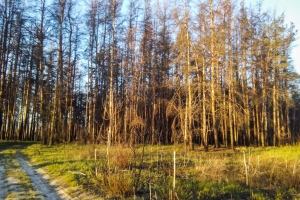
In 1986 this place was filled with rust-red dead pines — four square kilometres of coniferous forest that absorbed the reactor’s first radioactive blow. Within days the needles turned yellow, then brown, then rust. Hence the name.
Today not one of those trees remains. In 1986 they were felled by bulldozers, pushed into trenches, and buried along with the radionuclides they had absorbed. A new forest grew in their place — green this time, but just as contaminated. The Red Forest is a geographical name that no longer describes what you actually see. It is simply the most radioactive woodland on the planet.
Location card
| Location | between Pripyat and the ChNPP, ~4 km west of Reactor No. 4, Exclusion Zone, Kyiv Oblast |
| Original area | approximately 4 km2 of coniferous forest |
| Dose received by trees | up to ~80–100 Gy (orders of magnitude above the lethal dose for humans) |
| Time for the forest to turn red | a few days to a few weeks |
| Current radiation level | highest in the Zone; local hot spots reaching hundreds of µSv/h near the ground |
| Access | drive-through on the paved road in official tours only; walking into the forest is prohibited |
| Time at location | 2–5 minutes (slow drive-through + one stop for dosimeter demonstration) |
| What to bring | respirator mandatory, closed shoes, leave nothing on the roadside, dosimeter — it will alarm loudly |
In this article
- What the Red Forest is and why everyone has heard of it
- How a coniferous forest turned red in a matter of days
- How it was bulldozed and buried
- The second forest: what grows here now
- The paradox: why the most contaminated forest is full of wildlife
- The Russian trenches of 2022
- Legends and rumours
- The Red Forest in popular culture
- What to see (and what not to do)
- Today: war, access, risks
- How to get there
- Traveller’s checklist
- Frequently asked questions
What the Red Forest is and why everyone has heard of it
The Red Forest (also known as the Rusty Forest, or occasionally the Ginger Forest) is a woodland of around 4 km2 that in April 1986 found itself directly beneath the radioactive plume from the explosion. The wind in the first hours after the blast was blowing westward — straight towards this forest. So many radionuclides rained down on the trees that they received a dose lethal to virtually any living organism.
Within a few days the needles turned yellow, then brown, then rust-red. By the end of summer 1986 the entire stand looked like an enormous rust-coloured stain across the green Polissia. Every liquidator, every helicopter pilot, every photographer given access to the ChNPP saw that image.
Today the Red Forest is known as the most radioactive woodland on the planet. On a full Pripyat tour it is not a walking destination but a demonstration stop: the bus rolls slowly through it, the guide produces a dosimeter — and the device immediately starts screaming. The impression ranks among the strongest of the entire day.
How a coniferous forest turned red in a matter of days
Scots pine is among the trees most sensitive to ionising radiation. Its needles are structured so that cells are constantly dividing — and dividing cells are the most vulnerable to radiation. Experiments as far back as the 1960s showed that a dose of just 8–10 Gy is enough to kill a pine tree.
After the ChNPP explosion, the coniferous forest west of the reactor received an estimated 80–100 Gy — eight to ten times the lethal dose. The response was immediate:
- First 2–3 days: needles begin to yellow, especially on younger branches.
- First week: yellow gives way to brown; the trees look «autumnal».
- Second and third weeks: needles turn rust-red; the trees are effectively dead.
- By summer 1986: four square kilometres of coniferous forest stand as a vast rust-coloured snag.
A green forest transforms into a red field in roughly the same time it takes to organise an emergency response to a nuclear disaster. That is the Red Forest of the historical photographs.
The pine tree proved to be a more accurate radiation indicator than any Soviet dosimeter. It could not be «re-tested» or «recalibrated». It simply began to rust — and everyone could see it.
How it was bulldozed and buried
A dead forest covering 4 km2 is not only a spectacle. It is also an enormous reservoir of radionuclides. While the pines lived, they concentrated caesium-137 and strontium-90 in their needles and bark. Such a forest could not rot in any normal way — even the soil bacteria had been weakened by the radiation. The dead stand could have remained for years, raising radioactive dust with every gust of wind or forest fire.
Soviet military authorities made a hard decision: cut down everything that had turned red and bury it in place. Between 1986 and 1988, heavy machinery was brought in: bulldozers, excavators, forestry equipment. The trees were felled, trimmed, laid into trenches several metres deep, and covered with fresh soil.
This was a form of radiological housekeeping: the radionuclides were not decontaminated — they were simply interred inside the plants themselves. The reasoning was straightforward: if the material cannot be removed, keep it where it is, under a layer of sand that will block the gamma radiation.
There are dozens of burial sites. On satellite imagery the characteristic «scars» of the earth are still visible above them: long rectangular strips where the soil differs in colour and texture. Tourist routes do not mark these points — for safety reasons.
The second forest: what grows here now
A new forest has grown in place of the one that was cut and buried. These are not the same pines as in 1986 — they are predominantly young Scots pines, spruces, and birch groves that germinated from seeds and root fragments left in the soil. By the 2020s the stand looks like an ordinary 30-year-old mixed coniferous-deciduous forest.
Only when you get closer do you notice: not entirely ordinary.
Curved trunks. Some pines have trunks that are not straight but noticeably bent, with a visible «elbow». This is a consequence of mutations in the apical bud during the early years of growth: the tree «forgot» how to grow upward and veered sideways.
Multiple tops. Trees with two or three trunks rising from a single point are not uncommon. In a normal pine there is one central leader shoot — here there are several.
Uneven needle colour. Some trees have patchy needles ranging from deep green to yellowish. This is not an autumn colour; it is the result of localised radiation effects.
Dwarfism. Certain pines that are 30 years old look like 5–10-year-olds. Their root systems received fewer radionuclides than their neighbours, but also less soil cleared by bulldozers.
All of this stands on ground that is still «dirty». The Red Forest as a geographic point is alive and has doubled: beneath the surface lie the remains of the old trees, and above them grows the new forest, which is also accumulating radionuclides within itself.
The paradox: why the most contaminated forest is full of wildlife
One of the strangest facts about the Red Forest is that it holds an abundance of wild animals — more than any «clean» forest in the Kyiv region. Wild boar, red deer, elk, roe deer, foxes, and wolves pass through regularly. Beavers have established themselves here. Przewalski’s horses were reintroduced to the Zone in 2014 and appear on the periphery as well.
Why? Not because radiation «has no effect» on them. It does: lifespans shorten, mutation rates in offspring increase, strontium accumulates in bones. But at the population level this matters less than the presence of humans.
The logic is simple. In an ordinary forest, animals are killed by hunters, vehicles, farmers, and developers. In the Red Forest — by no one. Radiation shortens life by years on average. Humans shorten it by months.
It turns out that for most animals, the absence of humans matters more than the presence of radiation. A sad but precise equation.
This does not mean the forest is safe. A boar that has been rooting in Red Forest soil is potentially a very «dirty» animal: caesium and strontium go into the muscle and bone. Hunting is prohibited inside the Zone; the meat is not safe to eat.
The Russian trenches of 2022
In February 2022, following Russia’s full-scale invasion of Ukraine, Russian forces entered the Exclusion Zone from Belarusian territory. For several weeks they were stationed in Pripyat and around the ChNPP, and in the Red Forest — confirmed by satellite imagery and post-deoccupation inspection by Ukrainian specialists — they dug trenches and established vehicle staging areas.
The Russian servicemen, apparently, received no briefing about where exactly they were digging. Footage shot after the deoccupation shows characteristic trenches cut directly into soil layered with settled caesium.
By late March 2022 reports appeared in Western media that some Russian servicemen had been evacuated from Chornobyl to the Belarusian city of Homel showing symptoms consistent with radiation sickness. The IAEA did not publicly confirm this: the agency verified the existence of the trenches in the Red Forest but did not confirm a causal link between the symptoms and radiation exposure. Experts noted that the doses received over several weeks were insufficient to cause acute radiation syndrome — but that the long-term oncological risk for those individuals has increased measurably.
Ukrainian specialists who inspected the area after deoccupation found evidence of looting, dismantled monitoring equipment, and breaches in the radiation control system across the Red Forest and other parts of the Zone. A large number of radiologically hazardous areas went unsupervised for an entire month.
Legends and rumours
1. Giant mushrooms
One of the most widespread stories: mushrooms «the size of a bucket» grow in the Red Forest. There is a rational kernel here: fungi do accumulate caesium-137 efficiently, and in the damp radioactive soil some specimens may grow larger than average. But stories about mushrooms «half as tall as a person» are folklore. All documented finds are of ordinary dimensions. Picking mushrooms anywhere in the Zone is extremely dangerous to health — even if you cook them thoroughly afterwards.
2. The «two-headed deer»
A story circulates in stalker communities about a two-headed deer supposedly sighted in the Red Forest. No photographs exist. The testimony amounts to one or two accounts retold through third parties. Biologists note that mutations in Zone mammals are documented, but deviations as radical as this are not. The legend almost certainly repeats the classic «monsters from under the reactor» myth that has existed since the 1990s.
3. «Glowing» at night
Some stalkers claimed the forest «faintly glows» at night. This is pure myth. Radioactive materials at natural concentrations do not emit visible light — that is a property only of certain purified radioactive salts under very specific conditions. There is nothing to see in the Red Forest at night except stars through the canopy.
The Red Forest in popular culture
S.T.A.L.K.E.R. The Ukrainian game series by GSC Game World devoted an entire location to the Red Forest, using the same name. For a whole generation of post-Soviet gamers, «the Red Forest» is first and foremost a game location. The real place came later.
HBO’s Chernobyl (2019). The miniseries shows the forest in several scenes — including a sequence in which liquidators discuss the scale of contamination. Filming took place not in the Red Forest itself (for obvious reasons) but in other locations with a similar landscape.
Documentaries and photo projects. The Red Forest is a compulsory chapter in any major Chornobyl documentary. It is frequently cited in the context of «nature reclaiming space from humanity» — from BBC to Netflix.
What to see (and what not to do)
The Red Forest is not a location where you walk trails. It is a place where you must know your limits.
Drive-through on the road. A paved road connecting Pripyat and the ChNPP runs through the forest. Tour buses travel it slowly; the guide allows passengers to lower a window and switch on a dosimeter. This is the primary «contact» with the forest.
One roadside stop. Most itineraries include one brief stop (1–2 minutes) at a designated point. Radiation readings are taken, photographs are made, but no one steps into the grass or leaves the asphalt.
Dosimeter demonstration. The guide shows how the dosimeter alarms as it approaches the roadside vegetation. This is the best part of the Red Forest segment of the tour: the numbers speak for themselves.
What NOT to do:
- Do not leave the asphalt — the reading rises sharply in the grass.
- Do not touch the soil, moss, or tree bark with bare hands.
- Do not place belongings on the ground or roadside.
- Do not collect any «souvenirs» (this is both a criminal offence and a genuine health hazard).
- Do not smoke, eat, or drink within the forest boundary.
Today: war, access, risks
Between February and March 2022 the Exclusion Zone was temporarily occupied by Russian forces. Trenches and vehicle staging areas were dug in the Red Forest, significantly disrupting the soil layer that had been containing the buried radioactive material. This means that in parts of the Red Forest radiation levels today may be even higher than before 2022 — because radionuclides that were previously «sealed» have been partially brought back to the surface.
As of 2026, tourist access to the Exclusion Zone — including the Red Forest — is restricted. Occasional official visits are arranged by the State Agency of Ukraine for Exclusion Zone Management for journalists, scientific groups, and official delegations. The regular tourist trips that operated in 2018–2021 are currently suspended.
Before planning any trip, always check the current access status on the official SAEZM website. Independent entry into the Zone is a criminal offence. Independently entering the Red Forest on foot is, additionally, a serious health risk.
How to get there
By car (organised groups only): from Kyiv north along route P-02 through Ivankiv to the Dytyatky checkpoint. Distance — approximately 110 km. Private vehicles are not admitted beyond the checkpoint.
Tour from Kyiv: the only legal option. On any full-day Pripyat tour the drive through the Red Forest is automatic, since it lies along the road between the city and the ChNPP. There are no separate «Red Forest excursions».
No public transport serves the Zone. There are no scheduled buses, minibuses, or trains.
Approximate GPS coordinates: 51.3895° N, 30.0444° E (centre of the historical stand, between Pripyat and the ChNPP).
Documents: international passport or national ID card, a permit application submitted at least 7 days in advance. Foreign nationals face the same requirements plus an additional form.
Traveller’s checklist
What to bring:
- International passport or ID card (you will not pass the checkpoint without one).
- Respirator mandatory — in the Red Forest this is not atmosphere, it is a real barrier against dust.
- Closed shoes with a thick sole (disposable shoe covers on top are advisable).
- Long-sleeved clothing you are prepared to discard — dosimeter checks on exit may flag it.
- Dosimeter — this is exactly the location where it will perform most dramatically, the most «expressive» point on the route.
- Bottled water and snacks (consume only outside the forest boundary).
- Sunscreen — in winter too: keep exposed skin protected.
What NOT to do:
- Do not exit the vehicle in the Red Forest except at permitted points.
- Do not step off the asphalt onto soil or grass.
- Do not touch trees, moss, soil, or bark with bare hands.
- Do not collect mushrooms, berries, pine cones, or leaves.
- Do not leave anything in the forest — nothing, not even a bottle.
- Do not eat or drink while inside the forest.
- Do not smoke.
Frequently asked questions
Why is it called the «Red Forest» if it is green now?
The name is historical. In 1986 the pine needles turned yellow, then brown, then rust-red — that is the «Red Forest». Those trees were cut down and buried in the late 1980s. A new, green forest grew in their place. But the geographical name has remained attached to the location.
Can you get out of the vehicle here?
Only at a single designated point on the roadside where the guide conducts the dosimeter demonstration. Leaving the asphalt, or entering the forest on foot, is strictly prohibited — it is both a criminal offence and a genuine health risk.
How long can you spend in the Red Forest safely?
The standard tourist stop is 1–2 minutes on the roadside. The drive-through in the bus takes 5–7 minutes. The dose received by a passenger inside a vehicle during that time is minimal. The problem arises when someone steps into the grass or stands for hours on the roadside — neither of which is permitted.
Are there really mutated animals here?
Documented: animals in the Exclusion Zone show higher rates of genetic abnormalities, shorter lifespans, and radionuclide accumulation in bones. However, «two-headed deer» and other extremes from the legends are folklore. No radical visible mutations appear in the documented scientific record.
Are these actually the same red pines from 1986?
No. Those trees were felled and buried in 1986–1988. A new forest has grown in their place, which looks broadly indistinguishable from an ordinary mixed coniferous-deciduous stand. The original Red Forest, as such, disappeared from the surface almost 40 years ago.
What happened to the Russian soldiers who dug trenches in the Red Forest?
According to Western media reports from late March 2022, some were evacuated from Chornobyl to Belarus showing symptoms consistent with radiation sickness. The IAEA confirmed the existence of the trenches in the Red Forest but did not confirm a causal link between the symptoms and radiation. Experts consider the doses received over several weeks insufficient to cause acute radiation syndrome, but note that the long-term oncological risk for those individuals has increased measurably.
The Red Forest is the strangest point in the entire Zone. It has died twice and grown back twice. In 1986 radiation killed it. In 1988 bulldozers finished the job. In the 1990s it pushed green shoots back through the soil. In 2022 Russian trenches disturbed it again. And the name lives on — an archaic reminder of that first rust-red forest that no living tourist will ever see.
The paradox is that for animals this is one of the safest landscapes in Ukraine: no people, no hunters, no fields, no roads. Radiation shortens their lives by years; a human presence would end them in days. Nature chose the lesser harm — and populated the most contaminated forest on the planet more densely than any «clean» one.
If you ever pass through the Red Forest, do not lower the window for long, do not stand on the roadside. Just listen to the dosimeter hum and look at the new green forest outside the glass. It is the quietest memorial to the disaster. Greener than a thousand monuments.
JoomShopping Download & Support