


- You are here:
-
Sights by Regions

-
Chornobyl Exclusion Zone
-
Pripyat
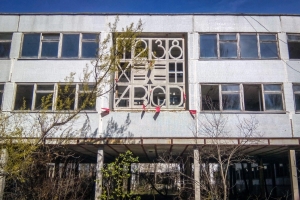
- High School №5, Pripyat


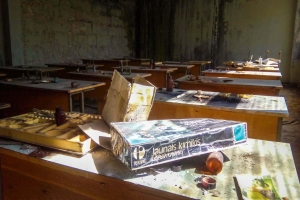

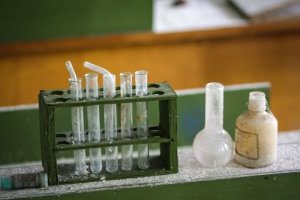
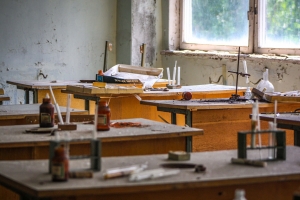


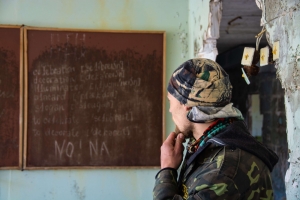


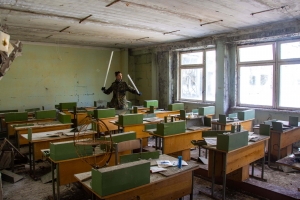

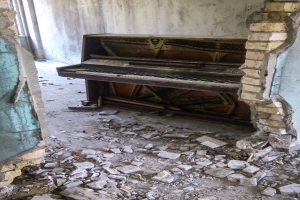
Textbooks from 1986 still lie open on the desks. Someone went home on a Friday, leaving a notebook open in the middle of a page — and never came back.
Secondary School No. 5 in Pripyat is not just an abandoned building. It is a snapshot of Soviet childhood, frozen in time one day before it ended. There is no Ferris wheel here, no dramatic rooftops — yet the school leaves the heaviest impression of anything in the ghost city.
Note. Pripyat has been closed to tourists since 24 February 2022. The Exclusion Zone was occupied and then de-occupied by Russian forces; parts of the territory are mined. Tourist access has not been restored and no official reopening date has been announced. This article describes the site — for those who have been there, and for those who hope to visit one day.
Location Card
| Location | Pripyat, Chernobyl Exclusion Zone (Kyiv Oblast) |
| Type | Abandoned site |
| Abandoned | 27 April 1986 (city evacuation) |
| Distance to Chornobyl NPP | ~3 km |
| Current status | Closed to tourists since February 2022 |
| Time needed | 30–60 minutes (previously, as part of a city tour) |
In This Article
- What this site is and why people visited
- History: the school that was never allowed to age
- What’s inside
- Legends and local lore
- Safety and radiation
- Getting there
- Frequently asked questions
What this site is and why people visited
Pripyat was a young city — average resident age 26, more than a thousand babies born every year. Schools were plentiful: several secondary schools plus primaries and kindergartens. School No. 5 was one of them, located in a neighbourhood further from the plant.
The paradox lies in that very distance. Areas further from Reactor No. 4 received slightly less radioactive fallout — which is why Schools No. 4 and No. 5 retained more of their interiors: furniture, equipment, teaching materials. That’s what made «School Five» one of the most «alive» and simultaneously most affecting sites in the city.
People came here not for a dramatic shot, but for a feeling. The Ferris wheel hits you with the scale of the disaster; the school hits you with its intimacy. Everything is human-sized: a child’s desk, a forgotten pencil case, chalk on the blackboard. Guides often placed the school at the end of the route — after it, the jokes stopped.
History: the school that was never allowed to age
The school was built alongside the city in the 1970s–80s to a standard Soviet design: wide corridors, a gym, an assembly hall, classrooms with portraits of Soviet leaders and propaganda posters. An ordinary school in an ordinary nuclear city, of which there were dozens across the USSR.
26 April 1986 was a Saturday — and a school day. Children were heading to class while three kilometres away the destroyed reactor was already burning. For the first 36 hours residents were told nothing officially. Then on Sunday 27 April at 14:00 the radio announced a «temporary three-day evacuation.»
Children were told to take only documents and the bare essentials. Notebooks, schoolbags, spare shoes, drawings on the walls — everything stayed where it was. The «three days» stretched into four decades.
Some belongings from the less contaminated Pripyat schools were later transported to Slavutych — the new city built for evacuated Chornobyl NPP workers. But much was left behind: things too dangerous to move, or simply unwanted. Then in the 1990s–2000s came looters and illegal scrap-metal collectors. What we see in the school today is a mixture of genuine 1986 traces and four decades of theft and decay.
What’s inside
Classrooms with textbooks. The school’s most powerful impression. On desks and floors: open books, exercise books, handwriting primers. Dates on the pages: 1986. On some blackboards, chalk writing is still legible.
Gas masks in the corridors. One of Pripyat’s most iconic images. Piles of children’s gas masks on the floor — these are not disaster «props»: in Soviet schools, gas masks were a mandatory part of civil defence, kept in case of war. After the accident someone emptied them from their boxes, and they became a symbol of the city.
The gym and assembly hall. Collapsed floor, bent basketball hoops, sky visible through the broken roof. Forty years of nature have done their work: trees grow directly from the floor, branches reach through the windows.
Traces of ideology. Lenin portraits, red display boards, slogans on the walls. The school was a place not only of learning but of moulding the «correct» Soviet citizen — and that ideological shell was preserved here along with everything else.
An important warning: the building has long been structurally unsafe. Floors are rotten, ceilings crumble, floors give way. School No. 1 in Pripyat has already partially collapsed; the others are following. Entering was always risky, which is why later guides led tourists into only a carefully chosen subset of rooms.
Legends and local lore
An abandoned school is ideal ground for stories. Here are three that stalkers (urban explorers of the Zone) and guides repeat most often.
1. The dolls and gas masks that «move around»
For years tourists and stalkers deliberately rearranged objects for better shots: sitting a doll on a gas mask, placing a notebook «more photogenically.» As a result, returning to the same spot a year later you might find the scene entirely different. This gave rise to the legend of objects that move on their own. The prosaic explanation is sadder than the supernatural one: it’s not ghosts — it’s people.
2. Voices at break time
It is said that in the silence of the empty school some visitors heard distant children’s voices — as if the sound of a break was coming from behind a wall. Acoustics experts explain this as wind playing through empty corridors and temperature differentials. But in a building that was once full of children, the brain very much wants to hear exactly that.
3. The school from the game
Pripyat’s schools served as prototypes for locations in the cult Ukrainian game S.T.A.L.K.E.R. For many players, the real School No. 5 is «the school from the game» — though in reality the developers drew a composite image from several buildings. This sent a whole category of tourists here specifically to walk in the game’s footsteps.
Safety and radiation
When the Zone was open, the school’s main danger was not radiation but the building itself: failing floors, glass, rusting metal. The radiation background in the city, when safety rules were followed, was moderate — the total dose from a one-day tour was comparable to a transatlantic flight.
The rules were simple and unchanging: stay with your guide, don’t sit on the ground or floors, don’t touch moss, don’t eat or drink outdoors, don’t take any objects away (they may be contaminated, and they’re state property). Today all of this is compounded by landmines laid during the war — another reason access remains closed.
Getting there
Currently — you can’t. Pripyat has been closed since 24 February 2022; there is no legal tourist access. Entering the Exclusion Zone without authorisation is dangerous (landmines) and illegal.
How it worked before. The school was part of standard city routes on one- or two-day tours from Kyiv. Visitors arrived via the Dytyatky checkpoint, completed permit formalities, and then entered Pripyat with a guide. Independent exploration was never permitted — always organised tours only.
When and under what conditions the Zone will reopen is currently unknown. Follow official announcements on the status of the Chernobyl Exclusion Zone for the latest information.
Frequently asked questions
Can you visit School No. 5 now?
No. Pripyat and the entire Chernobyl Exclusion Zone have been closed to tourists since February 2022. There is no official reopening date.
Why does the school leave the strongest impression?
Because everything in it is human-sized — child-sized: desks, exercise books, gas masks, drawings. It turns the disaster from a statistic into the personal story of every interrupted life.
Are the gas masks and textbooks in the photos genuine?
The textbooks and gas masks are genuine Soviet-era objects. However, many scenes are «staged»: tourists and stalkers spent years repositioning items for better photographs. Not everything you see in photos has been lying there since 1986.
Was it safe to go inside?
The building is structurally unsafe: rotten floors, crumbling ceilings. It was always risky, and experienced guides restricted access to the most dangerous rooms. School No. 1 in Pripyat has already partially collapsed.
What happened to the children who studied here?
The entire population of Pripyat was evacuated on 27 April 1986. Many families of Chornobyl NPP workers later settled in the newly built city of Slavutych. The generation of Pripyat schoolchildren grew up far from their home city.
School No. 5 is the quietest and most affecting site in Pripyat. It has no scale that impresses from a distance. It has detail that impresses up close: an open textbook that no one ever finished reading.
The ghost city can be toured like a film set. But step into one school classroom and Pripyat stops being a «game location.» It becomes the story of an ordinary school day that never ended. The bell from that Saturday in 1986 never rang.
JoomShopping Download & Support