


- You are here:
-
Sights by Regions

-
Ternopil region
-
Kremenets
- Water source «Corito», Kremenets
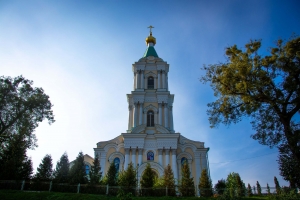
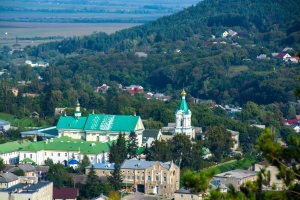


In 1633, this monastery received an official charter from the King of the Polish–Lithuanian Commonwealth allowing it to exist — complete with a brotherhood, a school, a printing press and a hospital, all at once. For an Orthodox community during a time of pressure from the Church Union, this was an almost record-breaking privilege: an entire cultural and educational complex under one roof.
Today the Epiphany Monastery (Bohoyavlenskyi Monastery) is an active convent and one of the spiritual landmarks of Kremenets, a town tucked into a valley beneath Bona Hill.
Quick facts
| Location | Kremenets, Ternopil region |
| Founded | chartered in 1633, consecrated in 1636 |
| Time needed | 30–60 minutes |
| What to bring | modest clothing (shoulders/knees covered), a headscarf for women, water |
What it is and why visit
The Epiphany Monastery is an active convent with a history stretching back almost four centuries, and an ensemble of Classicist-style buildings. It was once a powerhouse of religious, cultural and civic life; today it’s a quiet, prayer-worn corner in the heart of Kremenets.
Both pilgrims and history buffs come here. The former are drawn by the shrines and the convent’s atmosphere, the latter by the story of the brotherhood, school and printing press the monastery has been linked to since its founding. It also fits neatly into one walking route together with Bona Hill and the old town.
History
On 18 May 1633, King Władysław IV of the Polish–Lithuanian Commonwealth issued a charter allowing a new Orthodox monastery to be founded in Kremenets — together with a brotherhood, a school, a printing press and a hospital. On 13 September 1636, this hub of spiritual, cultural and civic life was consecrated in honor of the Epiphany of the Lord.
In the 17th century, an era of religious confrontation across Ukrainian lands, Orthodox brotherhoods like this one were outposts of national culture and education. The monastery’s printing press and school made Kremenets one of the important intellectual centers of Volhynia.
A brotherhood, a school, a printing press and a hospital — the monastery received all of this at once, right from its founding. This wasn’t just a convent, but a cultural and educational hub of its time.
Over the centuries the monastery lived through changes of denomination, state and purpose — just like Kremenets itself. Today the complex survives as a women’s convent, still holding its place as the spiritual heart of the town.
Local lore
Old monasteries always come wrapped in stories of miracles, protection and hard times survived.
1. The convent that survived everything
The Kremenets monastery lived through wars, changes of power and closures, yet returned to life every time. Locals say the prayer-soaked walls themselves helped the convent be reborn again and again.
2. The printing press as a “weapon” of the spirit
At a time when books were rare and precious, the monastery’s printing press carried as much weight as fortress walls. Local lore has it that the printed word was exactly what helped Kremenets hold on to its cultural identity.
What to see here and nearby
The monastery ensemble. Classicist-style buildings, the convent courtyard and its churches. An atmosphere of quiet and order.
Church of St. John the Baptist. One of the churches within the monastery’s cell blocks — part of the historic ensemble.
Bona Hill and its castle ruins. Kremenets’ main viewpoint, just a few minutes’ walk away. From up there you can spot both the monastery and the wooden Church of the Holy Cross.
Getting there
By car. Kremenets is about 70 km from Ternopil (via Zbarazh) and ~30 km from Pochaiv. The monastery sits in town — head for the center, and look for parking on nearby streets.
By public transport. Buses and minibuses to Kremenets run from Ternopil, Rivne and Pochaiv. From the bus station it’s a few minutes’ walk to the monastery. Many pilgrims combine this visit with a trip to the Pochaiv Lavra.
Traveler’s checklist
- Modest clothing — shoulders and knees covered; women should bring a headscarf.
- Quiet and tact — this is an active convent, not a museum, so behave accordingly.
- Extra time — pair the monastery with Bona Hill and the old town.
- Camera — but check first where photography is appropriate.
- What NOT to do: talk loudly, wander into staff-only areas, or photograph the nuns without permission.
Frequently asked questions
Can a regular tourist enter the grounds?
Yes, but remember it’s an active women’s convent. Dress modestly, keep quiet, and follow the monastery’s rules.
How old is the monastery?
The founding charter dates to 1633, and the consecration took place in 1636 — so the convent is nearly four centuries old.
Is it worth combining with a visit to Pochaiv?
Definitely. The Pochaiv Lavra is only ~30 km away, so many pilgrims see both sites in a single trip.
Is it safe to visit right now?
Yes, Kremenets is in western Ukraine, far from the front line. As always, keep an eye on air raid alerts during your trip.
The Epiphany Monastery represents almost four centuries of unbroken history in one place: from a 17th-century royal charter and printing press to today’s active convent. Here, the story of Kremenets isn’t read in ruins but in a living tradition that never broke — not even in the hardest times.
Climb Bona Hill afterward and look down over the town — the monastery below will remind you that Kremenets has always rested not just on the stones of its fortress, but on strength of spirit too.
JoomShopping Download & Support