


- You are here:
-
Sights by Regions

-
Lviv region
-
Skole
- Independence Square, Skole

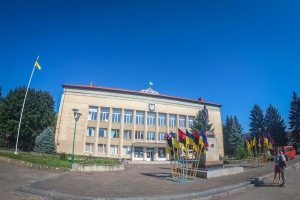

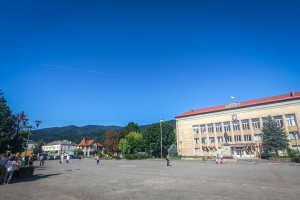
Most travellers drive through Skole without stopping: a fuel stop, a coffee, a turn toward Tukhlia or Slavske — and on into the mountains. That's a shame. Step out of the car right here, on Independence Square, and you'll find yourself in the centre of a town older than half the castles of Galicia.
This small square beneath the mountains is the best place to start exploring Skole — one of the main gateways to the Ukrainian Carpathians.
Location card
| Location | Skole, Stryi district, Lviv region |
| Distance | ≈ 120 km south of Lviv |
| Time needed | 30–40 minutes for the square itself, half a day for the town and surroundings |
| What to bring | comfortable shoes, a thermos, an umbrella (rain comes suddenly in the mountains), cash for the local market |
What it is and why people come here
Independence Square is the central square of Skole, the very spot around which the town's life has revolved for centuries: a marketplace, a church, the town hall, the buzz of people. The main streets meet here, and the shortest routes to everything worth seeing in Skole start from this point.
The town itself sits in a valley, surrounded by mountains on every side — which makes it cosy and sheltered from cold winds. The Opir River flows through Skole, and just a few minutes from the square hides a Neo-Baroque gem — the Hredel barons' palace. The square functions as a natural "kilometre zero": locals and tourists alike set off from here toward the Skole Beskydy mountains or the rock fortress of Tustan.
History
Skole is first mentioned in documents from 1397, when the Polish king Władysław II Jagiełło granted these lands to the nobleman Ivan of Tustan. That's a respectable age for Galicia — the town is older than many of its more famous neighbours.
For centuries, Skole lived off forestry, salt and trade at its main marketplace — the forerunner of today's square. A real turning point came at the end of the 19th century, when the industrialist Hrodel (Hredel) barons arrived. They built up the timber industry, brought in the railway and constructed a lavish Neo-Baroque palace that still stands near the centre today.
In the early 1930s, Skole unexpectedly became a resort town: guesthouses, tourist villas, a cinema, a tourist information office, a ski jump, beaches along the Opir, and even the first sledding track in the Carpathians all appeared. Then, in August 1991, the main square received its current name — in honour of Ukraine's declaration of independence.
More than six hundred years of recorded history — and through all of it, Skole has never stopped being a crossroads between the plains and the mountains.
Legends and lore
Like every old Carpathian town, Skole has its own tales — and they begin long before the first written record.
1. The death of a prince on the Opir
According to legend, it was here, on the banks of the Opir River, that the life of Prince Sviatoslav Volodymyrovych — son of Volodymyr the Great, who baptised Kyivan Rus — ended in 1015. The story says he was fleeing into the mountains from the army of Sviatopolk the Accursed and was caught up with somewhere in these valleys. Historians debate the details, but locals will happily point you toward "where it happened."
2. Where the name comes from
One popular version traces the name "Skole" to the word "skoloty" or "to split" — the idea being that enemy forces were "split apart" or shattered here. It's a more poetic than scholarly explanation, but it fits a town squeezed between mountain ridges like between two palms.
What to see and do
The square and town centre itself. Start here and get a feel for the scale — this is no metropolis, everything is close together. Small shops, cafés, and a local pace without big-city rush.
The Hredel barons' palace. A few minutes' walk away stands a two-storey Neo-Baroque palace from the late 19th century, looking as if a slice of imperial Europe had been transplanted into the heart of the Beskydy. The town's main architectural landmark.
The Opir River. Flows right through Skole. In summer, expect picnics and sunbathing on the rocks, and for the more adventurous, grade 1–2 rafting routes.
Historic churches. Nearby stand the wooden Church of St. Panteleimon (dated, by tradition, to 1597) and the stone Church of the Nativity of the Theotokos. Both are worth a separate walk.
Getting there
By car. From Lviv, take the M06 highway (Kyiv–Chop) south through Stryi, then on to Skole. About 120 km, roughly 1.5–2 hours. The road is busy — it's the main route to Transcarpathia.
By train. Skole sits on the Lviv–Stryi–Mukachevo railway, so both long-distance trains and local commuter trains stop here. From the station to the square is a few minutes' walk.
By bus. Regular services run from Lviv and Stryi. Get off in the centre and you're almost there.
Traveller's checklist
- Comfortable shoes — the centre is compact, but cobblestones and mountain terrain make themselves felt.
- Cash — still king at the local market and small shops.
- An umbrella or raincoat — mountain weather can change within half an hour.
- Extra time — Skole tends to tempt you into staying longer than planned.
- What NOT to do: don't expect to see "everything in 15 minutes" — this town is best savoured slowly.
Frequently asked questions
Is Skole worth a special trip?
If you're heading to the Carpathians anyway, definitely stop here. Skole makes a great base for day trips — Tustan, waterfalls and the Skole Beskydy are all close by.
When is the best time to visit?
Summer for the river and hiking routes, autumn for the colours of the Beskydy, and winter if you're heading to nearby Slavske for skiing.
What can I see nearby in one day?
The Hredel palace, the Opir River, the old churches, and further afield, the Tustan rock complex near Urych and the waterfalls of the Skole region.
Is it safe here right now?
Skole is in the far west of Ukraine, a quiet tourist town. As everywhere, it's worth keeping an eye on air raid alerts, but overall the region welcomes travellers as usual.
Independence Square in Skole won't wow you with fountains or skyscrapers — its appeal lies elsewhere. This is a place where, in a single step, you go from an ordinary road into a Carpathian fairy tale: a moment ago it was just a highway, and now, around the corner, there are mountains, a river and a town with six centuries of history.
So next time you're driving through Skole, ease off the gas. Stop at the square — and let the Carpathians begin from this little square.
JoomShopping Download & Support