


- You are here:
-
Sights by Regions

-
Lviv region
-
Lviv
- St. George's Cathedral, Lviv


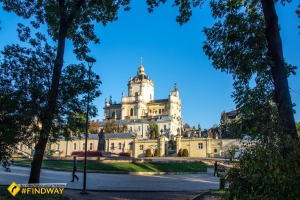




On the hill that Lviv locals simply call St. George's Hill stands a yellow-and-white Baroque ensemble visible from half the city. This is no ordinary church. For over two hundred years it was the residence of the heads of the Greek Catholic Church, it's where Metropolitan Andrey Sheptytsky once looked out over Lviv, and it's exactly where, in 1946, the Soviet authorities came to crush an entire Church.
St. George's Cathedral is one of those rare cases where an architectural masterpiece and a political center are one and the same place. And that has been true for centuries.
Location card
| Location | Lviv, Svyatoho Yura Square, 5 (St. George's Hill) |
| Distance from center | ≈ 1.5 km from Rynok Square, a 20-minute walk |
| Time needed | 40–60 minutes |
| What to bring | clothing covering shoulders and knees; cash for a donation; a wider lens — the facade won't fit in frame up close; patience for the stairs |
What it is and why visit
St. George's Cathedral (full name: the Archcathedral of St. George the Great Martyr and Dragon-Slayer) is the main church of the Ukrainian Greek Catholic Church in Galicia and one of Ukraine's most important Baroque buildings. For over two hundred years — from the mid-18th century to today, with a break during the Soviet ban — it has served as the residence of the metropolitans.
People come here for three things. First, for the architecture itself: late Baroque with Rococo touches, on a scale you won't find anywhere else in Lviv. Second, for the sculptures of Johann Georg Pinzel — a Galician genius whose works have even been exhibited at the Louvre. Third, for the feel of a place that once governed the spiritual life of millions.
The complex is more than just the cathedral. It includes the metropolitan's palace, a bell tower, the chapter house, and a terrace overlooking the city. The whole ensemble is part of Lviv's historic center, inscribed on the UNESCO World Heritage List.
History
The first church on St. George's Hill stood as early as the 13th century — a wooden monastery that, according to legend, was founded by Prince Lev Danylovych, the very prince Lviv is named after. Later came a stone Gothic church that stood until the 18th century and grew quite worn with age.
What we see today was built between 1744 and 1762. The project was commissioned by Greek Catholic Bishop Atanasiy Sheptytsky and designed by Bernard Meretyn — the same architect who built the town hall in Buchach. Meretyn didn't live to see the work completed; Sebastian Fesinger finished the cathedral.
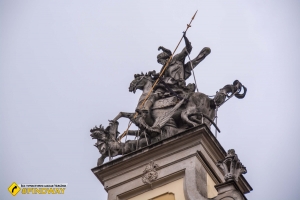
The sculptural decoration was entrusted to Johann Georg Pinzel — a master who became legendary even in his own lifetime, and whose biography remains full of gaps to this day. The equestrian statues and figures of church fathers on the facade are by his hand or his workshop.
In 1946, within the cathedral's walls, the Soviet authorities held the infamous "Lviv Council," which forcibly dissolved the Greek Catholic Church and merged it into the Russian Orthodox Church. The Church went underground for 43 years.
The Sheptytsky era
A chapter all its own belongs to Metropolitan Andrey Sheptytsky, who led the Ukrainian Greek Catholic Church from 1901 to 1944 and governed it from this very hill through two world wars, several empires, and occupations. He collected Ukrainian art, funded hospitals and schools, and hid Jews during the Holocaust. His legacy turned the cathedral into more than a church — it became a symbol of Galician identity.
After Ukraine's independence was declared, in the 1990s the cathedral returned to the Greek Catholic Church. When the church's center moved to Kyiv, St. George's remained the main church in western Ukraine and the archcathedral of the Lviv Archeparchy.
Legends and lore
A place with this much history couldn't help collecting its own stories, retold by tour guides and old Lviv residents alike.
1. The bell that falls silent before trouble
The cathedral's bell tower holds a 16th-century bell called "Kyrylo" — one of the oldest to survive to this day. Its sound is said to be special, and townsfolk once believed: if "Kyrylo" rang out of schedule, a major change was coming to the city. The bell-ringer knew this and never touched the rope without reason.
2. Underground passages beneath the hill
A persistent belief among Lviv residents holds that St. George's Hill is honeycombed with secret passages supposedly leading to the city center and even to other monasteries. No tunnel network has ever been documented, but crypts and basements really do exist beneath the cathedral — the metropolitans are laid to rest there, and that's enough for imagination to fill in the rest.
3. St. George and the dragon
The cathedral's patron is St. George the Dragon-Slayer, who, according to legend, defeated a dragon with his spear and saved a princess. The facade depicts him at exactly that moment. For Galicians, the image of a warrior striking down a serpent became almost a heraldic symbol — fittingly so, on land that had no shortage of foreign "dragons" in every century.
What to see on site
The main facade and sculptures. Start from the outside. The equestrian statue of St. George above the pediment and the figures of church fathers are by Pinzel and his workshop. Look closely at the faces — this Baroque sculpture isn't ceremonial, it's almost alive, full of movement and tension.
The interior and main altar. Inside, you'll find restrained but rich decor, icons, and the miraculous icon of Our Lady of Terebovlia, considered one of the cathedral's principal relics.
The metropolitans' crypt. The cathedral's underground holds the tombs of church leaders, including Andrey Sheptytsky. This is a place of silence, not for photos.
The metropolitan's palace and garden. Next to the cathedral stands an elegant Baroque palace with an inner courtyard. The terrace offers one of the best views of Lviv's rooftops.
Getting there
On foot. The nicest option. From Rynok Square it's about 1.5 km uphill along Horodotska Street or via Krakivska. A leisurely 15–20-minute walk past other landmarks.
By public transport. Trams and several bus routes run to the "Svyatoho Yura Square" stop, almost at the foot of the hill.
By car. If you're arriving via the road from Horodok or the airport, the cathedral is almost the first major landmark as you enter the center. Parking nearby is limited — it's better to park a bit lower and walk up.
Traveler's checklist
- Dress code. This is an active place of worship: covered shoulders and knees are the norm.
- Cash for a donation. Entry is free, but supporting the cathedral doesn't hurt.
- A wide-angle lens. The facade is massive and won't fully fit in frame up close.
- Service schedule. Touring the interior like a museum during liturgy will be awkward — check the schedule first.
- Time for the terrace. Set aside an extra 10 minutes for the view.
What NOT to do: talk loudly or use flash photography during a service, or go past barriers into the crypts without permission.
Frequently asked questions
Is it safe to visit Lviv right now?
Lviv is deep in the rear of western Ukraine, and the city carries on with everyday life — museums and churches are open. Just be aware of possible air-raid alerts: during a siren, head to a shelter.
How much does admission cost?
Entry to the cathedral is free. Specific tours or access to the palace or crypt may require a donation or a guide — check on site.
Is it suitable for children?
Yes. Kids will find plenty to enjoy both outside (the equestrian statues, the dragon on the facade) and inside. Just explain beforehand that this is an active church, where quiet behavior is expected.
When's the best time to visit?
Weekday mornings — fewer crowds and soft light on the yellow facade. On major Greek Catholic holidays the cathedral is packed and ceremonial, but you won't get a calm look around.
St. George's Cathedral doesn't try to impress with height or gilding. Its strength lies elsewhere — in the fact that this yellow-and-white ensemble on the hill has witnessed princes, empires, the banning of an entire Church, and its resurrection. It outlasted all of it.
Climb up to the terrace, look out over the rooftops of Lviv below — and you'll understand why the metropolitans chose this particular hill. From here, you really can see far.
JoomShopping Download & Support