


- You are here:
-
Sights by Regions

-
Lviv region
-
Lviv
- All Saints Church and Benedictine Monastery, Lviv
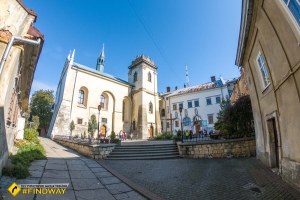

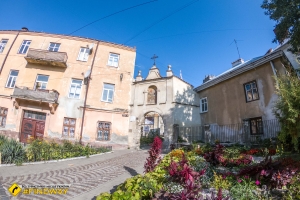

From the street it looks more like a small fortress than a convent: blank walls, a massive tower, few windows at ground level. That's no accident — when it was built, Lviv regularly saw armies camped outside its walls, so a sanctuary had to be able to defend itself.
The Church of All Saints with the Benedictine sisters' convent is one of those Lviv ensembles tourists often walk past without realizing that more than four centuries of history hide behind its walls.
Quick Facts
| Location | central Lviv, Vicheva Square |
| Era | early 17th century |
| Time needed | 30–45 minutes |
| What to bring | a camera, respect for an active sanctuary, and comfortable shoes for a walk through the old town |
What it is and why visit
This is the ensemble of the Church of All Saints and the Benedictine sisters' convent — one of Lviv's oldest convents. Its defining feature is its fortified design: unlike the lavish Baroque churches of the city center, this complex was built with defense in mind, with sturdy walls and a distinctive tower.
This is a hidden gem for travelers who want to see a different Lviv — not the polished showcase, but the stern, medieval-Renaissance one. Architecturally, the ensemble contrasts sharply with the ornate churches around Rynok Square: less decoration, more raw stone, and a sense that these walls have seen a lot. A real find for history and architecture buffs.
History
The Benedictine order arrived in Lviv at the end of the 16th century, and the church-and-convent ensemble itself took shape in the early 17th century. This was an era when the city was frequently under siege, so monasteries on the edge of the old town were built like small strongholds — thick walls, a tower, and as few weak points as possible.
For centuries, a cloistered community of nuns lived behind these walls. The Benedictine rule is “pray and work”: a measured life on a strict schedule, where labor and prayer alternate day after day, year after year. The complex survived changes of power, wars, and entire eras — and it owes much of its survival to that defensive solidity.
Over 400 years on the same spot. A church built to outlast both prayers and sieges.
Legends and lore
Old convents rarely come without stories of their own, and this one is no exception.
1. A convent-fortress
According to local lore, during sieges of the city these walls sheltered not only the nuns but local residents as well. The defensive tower and thick walls weren't decoration — they were real protection. Whether the convent ever withstood an actual assault is debated among historians, but the architecture speaks for itself: this was built to be taken seriously.
2. A world behind the wall
Closed-off convents always feed city legends: behind blank walls, people imagine secrets, underground tunnels, hidden treasure. Some of these tales are just neighborly imagination, others echo the real underground passages that genuinely existed in old Lviv. What's true and what isn't — that's for each visitor to decide.
What to see on site
The defensive tower and walls. The main architectural highlight. They're what give away the former stronghold hiding inside this “church” and make the ensemble instantly recognizable.
The church facade. Restrained, with minimal ornamentation — a rare example of Renaissance-defensive architecture for central Lviv.
Vicheva Square around it. The location itself is a good excuse to wander a less touristy part of the old town and see the city from a different angle.
How to get there
On foot. The ensemble sits in central Lviv, on Vicheva Square, just a few minutes' walk from Rynok Square.
By public transport. Trams and buses run through the city center. Plan the nearest stop using a local public transport app.
Tip. This is an active sanctuary and convent grounds, so some areas may be closed to casual visitors. It's worth checking service times and access in advance.
Traveler's checklist
- Dress code: this is an active church — dress respectfully.
- Time: a quick visit, easy to pair with a walk through the city center.
- Photos: the standout shot is the tower and blank defensive walls.
- Access: check whether the church is open to visitors on the day you go.
- What to avoid: being loud or disrupting services — this convent is still a living community, not just a landmark.
Frequently asked questions
Why does the convent look like a fortress?
Because it was built in an age of sieges. The defensive walls and tower were meant to protect the community — and sometimes local residents — during attacks on the city.
Can you go inside?
This is an active sanctuary and convent grounds, so access may be limited. It's best to check the schedule and visiting options in advance.
How much time should I plan for a visit?
From the outside — 30–45 minutes. Easy to combine with a wider walk around central Lviv.
Is it interesting for kids?
Older kids who enjoy fortresses and siege stories — yes. For younger children it's more of a brief stop along a walk.
Is Lviv safe to visit right now?
Yes, the city is in western Ukraine, far from the front line. Follow general safety precautions and respond to air raid sirens.
The Church of All Saints with its Benedictine convent is a reminder that in the days it was built, even prayer needed thick walls. This ensemble won't dazzle you with gold and stucco, but it shows an honest, different side of Lviv: stern, fortified, built to hold its ground.
If you want to escape the crowds on Rynok Square, head to Vicheva Square instead. History speaks more quietly here — but it carries more weight.
JoomShopping Download & Support