


- You are here:
-
Sights by Regions

-
Lviv region
- Devil Stone, Pidkamin
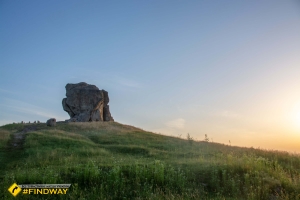
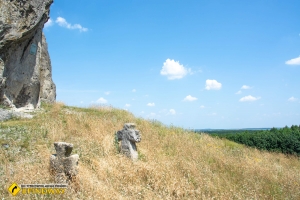


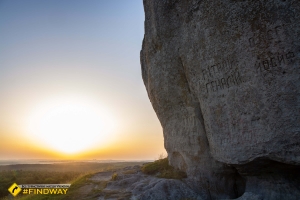




They say the devil was carrying this boulder across half of Volyn to smash it into the monastery at Pochaiv. He didn't make it before dawn: a rooster crowed over the field, the evil spirit lost its power — and the rock crashed down right here, on a hill above what would become a small town.
That's how locals explain how a 16-meter stone giant ended up in the middle of a flat field near Brody. Geologists tell a duller story, but an interesting one too.
Quick facts
| Location | Pidkamin, Zolochiv district, Lviv region |
| Distance | ≈ 120 km from Lviv, ≈ 25 km from Brody, ≈ 12 km from Pochaiv |
| Time needed | 1–2 hours (half a day with the monastery) |
| What to bring | comfortable shoes, water, a camera, and a bit of skepticism toward legends |
What it is and why people come
The Devil's Rock is a huge sandstone outcrop standing alone on a hill near the small town of Pidkamin. It rises to about 16 meters, and the town's name comes from it: people settled "under the rock" (pid kamin).
To a geologist, it's a remnant of an ancient seabed. A few million years ago, a warm Miocene sea lapped here, and tough sandstone built up on the bottom. The sea retreated, the softer rock around it weathered and washed away over time, and the hard monolith was left jutting above the plain. To everyone else, it's simply astonishing: a boulder the size of a five-story building sitting in the middle of a field, practically begging you to touch it.
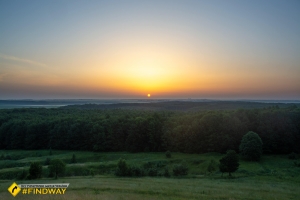
People come here for three things at once: the photo, the panorama (from the top of the hill you can see the surrounding villages and the monastery's domes), and the legends — of which there are more than there are tourists.
History
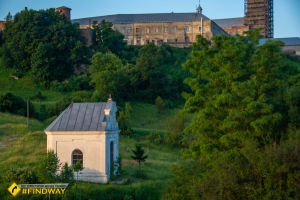
Pidkamin has been mentioned in documents since medieval times, and the rock has been its main landmark the whole time — visible from far away. Nearby, on an adjacent hill, a powerful Dominican monastery with defensive walls rose in the 17th century: in turbulent times it more than once became a refuge for the surrounding area.
The pairing isn't accidental. Wherever nature leaves behind something as strange as a giant rock, people have spent centuries searching for meaning in it — sacred or demonic. The monks "tamed" the place in their own way: according to legend, a cross was placed on the rock so the evil spirit could never return for its load.
The town wasn't named after a prince or a saint, but after the rock. A rare case where a geological oddity gave its name to an entire settlement.
Legends and lore
Ask five locals where the rock came from, and you'll get at least three different stories. Here are the most popular ones.
1. The devil and the rooster
The best-known version. The devil decided to destroy a holy place — depending on who's telling it, either the monastery at Pochaiv or a local church. He grabbed the enormous rock and carried it across the night sky. But he misjudged the time: at dawn a rooster crowed, the evil spirit instantly weakened, and the rock slipped from its claws right over Pidkamin. Some guides will point out "claw marks" on it.
2. A petrified army
Another legend says the rock is a cursed army or convoy that dared to desecrate a holy place and was turned to stone for it. It's a typical motif for many "devil's rocks" across Ukraine, but here it has taken especially deep root.
3. The rock that grows
Old-timers insist the boulder is slowly "growing" out of the ground. Geologically, it's almost the opposite: the rock itself isn't rising — the soil around it is slowly settling and washing away, so a little more of it is exposed each year. But "the rock is growing" sounds far more mysterious — and that's the version passed down to grandchildren.
What to see on site
The Devil's Rock itself. The main reason to come. You can climb onto the boulder — from the top there's a view over the fields and the town. The climb is easy, but sandstone gets slippery in the rain, so take it slow.
The Dominican monastery. A few minutes away — a massive monastery complex with defensive walls on the neighboring hill. It also offers good views, and the building itself is worth a separate walk.
The Devil's Cave. Nearby is another "devilish" site — a small cave with its own legends. It makes sense to see both in one trip.
How to get there
By car. From Lviv, head east toward Brody (M06 highway), then turn off toward Pidkamin. The drive takes about two and a half hours. From Brody to the town is another half hour or so. In Pidkamin itself, head for the hill with the monastery — the rock is right next to it.
By public transport. The easiest way is to take a train or bus to Brody, then transfer to a local bus or minibus to Pidkamin. It's worth checking the suburban schedule in advance — services aren't frequent.
From Pochaiv. If you're on a pilgrimage to the Pochaiv Lavra (Ternopil region), Pidkamin is right nearby — about twelve kilometers. Easy to combine the two.
Traveler's checklist
- Comfortable shoes — a field path to the rock, and climbing once you're there.
- Water and snacks — there's no infrastructure near the rock.
- A camera — the boulder's scale reads best with a person in the frame.
- Extra time — to also cover the monastery and the cave.
- What NOT to do: climb wet sandstone after rain, or leave trash on the hill.
Frequently asked questions
How much does it cost to visit?
The rock itself is free to visit — it's a natural open-air site. A separate fee may apply only on monastery grounds for certain tours.
Is it suitable for kids?
Yes, the walk is easy. Just keep an eye on children while climbing the rock and near the edge — the height is noticeable.
When's the best time to go?
Best on a dry, clear day from late spring to early autumn. The sandstone isn't slippery then, and the view from the top stretches the farthest.
What else can I see nearby?
The Dominican monastery in Pidkamin, the Devil's Cave, and — twelve kilometers away — the Pochaiv Lavra in the Ternopil region.
The Devil's Rock is one of those places where science and folklore peacefully coexist. A geologist sees the remnant of an ancient sea, a grandmother from the next village sees a boulder dropped by the devil, and a tourist sees a great shot and a panorama over half the Lviv region.
And here's the thing: none of these versions get in the way of the others. You can climb to the top, breathe out in the wind, and decide for yourself what really happened that ancient night when the rooster crowed.
JoomShopping Download & Support