


- You are here:
-
Sights by Regions

-
Kyiv region
-
Kyiv
- Yard with crows, Kyiv

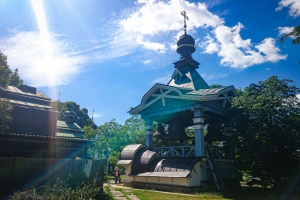


On Soviet maps this was simply part of the Botanical Garden. In reality it was one of the largest monastic communities in pre-revolutionary Kyiv, hidden among flowerbeds and greenhouses for half a century.
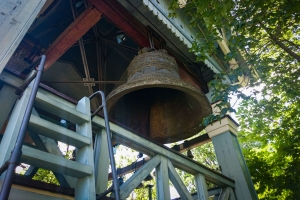
The Holy Trinity Ioninsky Monastery stands on the Zvirynets hillside, surrounded on all sides by the Hryshko National Botanical Garden. A blue Trinity church, a bell tower, and old monks’ cells — all just minutes from the metro, amid lilac that in spring is visible from half the city.
Location Card
| Location | Kyiv, Pecherskyy district, 1 Tymiriazevska St (Botanical Garden grounds) |
| Founded | 1866 (by St Iona of Kyiv) |
| Status | active men’s monastery |
| Admission | free to the monastery grounds; Botanical Garden requires a ticket |
| Time needed | 1 hour (half a day if combined with the garden) |
What It Is and Why It’s Worth Coming
Ioninsky is a rare metropolitan gem where a living monastery and a botanical park have grown into one. You walk past collections of roses and magnolias — and suddenly the blue domes of the Trinity church rise between the trees.
People come for two things at once: the quiet, prayerful atmosphere of an ancient cloister, and the finest flowering spectacle in Kyiv. In late April and May the hillsides around the monastery are submerged in lilac, drawing half the city with cameras.
History
In the 1860s a monk from the nearby Vydubichi Monastery, St Iona of Kyiv, settled on this then-uninhabited hillside. According to tradition, St Seraphim of Sarov appeared to Iona in a vision and instructed him to found a monastery here. Official permission was granted only in 1866.
In 1871 the cathedral church of the Holy Trinity was built — the heart of the future complex; the church was enlarged in 1898. By 1917 the Ioninsky Monastery, with a brotherhood of 800 monks, was the second largest in Kyiv after the Kyiv-Pechersk Lavra.
A Garden Instead of a Cloister
In 1935 a Botanical Garden (now the Hryshko National Botanical Garden) began to be established on Zvirynets hill, and the monastery estate was simply absorbed into its grounds. In the late 1950s during replanning, some buildings were demolished and others were adapted for the institution’s needs. The surviving Trinity church, monks’ cells, clock tower, and brick buildings led a double life for decades — officially listed as garden outbuildings.
The Return
In 1993 the relics of St Iona were discovered here, and in 1995 he was canonised — the same year the monastery became independent again. Today it is a living cloister sharing its hillside with the botanical collections.
Legends and Local Lore
A place with this kind of history could hardly escape gathering its own stories.
1. The Vision of St Seraphim of Sarov
According to monastery tradition, St Seraphim of Sarov appeared to Iona in a vision and showed him the site for the future cloister. That is why Ioninsky has always been closely linked to the veneration of the Sarov saint — the same figure in whose honour a wooden church was built a few kilometres away in Pushcha-Vodytsia.
2. The Underground Passages of Zvirynets
The Zvirynets and Pechersk hills are riddled with ancient caves and tunnels, so it is no surprise the monastery acquired legends of underground galleries allegedly reaching all the way to the Lavra. This has never been documented, but the story stubbornly persists among Kyivans.
What to See on Site
The Trinity Church. The monastery’s centrepiece: blue walls, golden domes, and an interior in the style of late 19th-century academic religious painting. It is the first thing you see emerging from the garden trees.
The relics of St Iona. Kept in the monastery; pilgrims come from across Kyiv to venerate them.
The lilac hillside. Technically part of the Botanical Garden, but visually the lilac and the monastery form one postcard. Best time: second half of April through May.
Before 1917, some 800 monks lived here — only the Kyiv-Pechersk Lavra housed more. Today the scale of those days is recalled only by the long monastic wings stretching between the flowerbeds.
Getting There
Metro. The most convenient option is Pecherska or Druzhby Narodiv station, then on foot to the Hryshko Botanical Garden entrance on Tymiriazevska Street.
By car. Head for 1 Tymiriazevska St. Parking is available near the garden entrances but fills up quickly on spring weekends.
Note. You can reach the monastery either through its own entrance or through the Botanical Garden — in the latter case you will need a garden ticket.
Visitor Checklist
- Modest clothing: this is a functioning monastery — women are expected to cover their shoulders and knees and bring a headscarf.
- Garden ticket: if you plan to combine with a walk through the Botanical Garden, bring cash for the entrance fee.
- Lilac season: late April through May offers the most spectacular scenery.
- What NOT to do: speak loudly near the church or photograph monks and services without permission.
Frequently Asked Questions
Can visitors enter the monastery freely?
Yes, the monastery is active and open to visitors during daytime. Behave quietly and respectfully, as in any place of worship.
Is there an admission charge?
Entry to the monastery grounds is free. If you approach through the Botanical Garden, you need a garden ticket.
When is the best time to visit?
For the views — during lilac season (late April through May). For quiet and prayer — any weekday morning.
Who was St Iona?
The founding monk who settled here in the 1860s. His relics were discovered in 1993 and he was canonised in 1995; the monastery bears his name.
Ioninsky Monastery is Kyiv at its most quietly hidden in plain sight. A once-enormous cloister dissolved into botanical collections, blue domes among magnolias and lilac — and the feeling of having found a place thousands of people walk past every day without ever realising it is there.
JoomShopping Download & Support