


- You are here:
-
Sights by Regions

-
Kyiv region
-
Kyiv
- Yard with crows, Kyiv

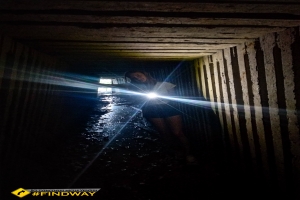
Above ground: the shop windows of Khreshchatyk, crowds of people, advertising. But four meters below the asphalt, a real river flows, locked inside a concrete pipe since the century before last. Kyiv has a second, damp and dark floor that most of its residents don't even know exists.
"Underground Kyiv" isn't a single spot on the map — it's a whole subculture: the world of "diggers" who descend to where the capital's hidden rivers still run.
Quick facts
| Location | Kyiv, underground collectors in the city center and Podil |
| What it is | the city's hidden rivers, enclosed inside underground collectors (large stormwater tunnels) |
| Time needed | 1–3 hours as part of a guided tour |
| Difficulty | guide required; dangerous without one |
| What to bring | rubber boots, a headlamp, a backup light source, warm clothing, a fully charged phone |
What it is and why people go down there
Kyiv sits on hills cut through by ravines and streams. As the city grew, small rivers got in the way of construction — so they were channeled into underground collectors. That's how a whole network of tunnels formed beneath the modern streets, and water still runs through them today.
This is where "diggers" — explorers of underground structures — descend. What draws them isn't treasure but the space itself: 19th-century brick vaults, concrete galleries, echoes, total darkness, and the sense of being in an entirely different city. This is a Kyiv you'll never find on a postcard.
History of underground Kyiv
The first serious underground drainage structures were built back in the mid-19th century. The Mykolaivska drainage system was laid out in 1848 — a bold piece of engineering for its time.
In 1860, the Hlybochytsia River in Podil was hidden inside a collector — today this collector is considered a landmark of engineering architecture. Other waterways gradually went underground too: the Lybid, the Klov, and the streams that fed the Khreshchatyk valley. It was this underground river that originally carved out the ravine which later became the capital's main street.
Beneath the country's main street flows a river that was sealed inside a pipe more than a century and a half ago. You can hear it if you stand on the right grate and listen.
Underground legends
Darkness and echo are perfect breeding ground for myths, and Kyiv's underground is thick with them.
1. Askold's underground passage
One of the longest underground passages was, according to legend, built where Prince Askold — one of Kyiv's earliest rulers linked to the spread of Christianity — was supposedly killed. There's no historical certainty here, but the name stuck and keeps fueling diggers' imaginations.
2. Secret passages beneath the monasteries
For centuries, the city has told stories of underground galleries supposedly connecting Kyiv's monasteries and churches. Some passages really do exist (the caves of the Lavra, the Zvirynetski Caves), while the rest is folklore that's hard to either prove or disprove.
3. The "creature" under the fountains
Among diggers, there are tales of strange noises and "something" living in the collectors beneath the central fountains. Usually it's just ordinary tunnel acoustics — but no one passes up the chance to retell the "creature" story to a friend in the dark.
What to see underground
The Hlybochytsia collector. Mid-19th-century brick vaults — the most beautiful "interior" of underground Kyiv.
The Khreshchatyk collector. The very river that shaped the valley of the main street — history and geology in a single tunnel.
The Mykolaivska drainage system. The starting point for many routes — an engineering structure nearly 180 years old.
How to get there (the right and safe way)
With a guide only. Going down into the collectors on your own risks drowning in a sudden flood, gas poisoning, or simply getting lost. Kyiv has guided tours of the Podil underground with experienced guides — the only sensible way to see this world.
Typical routes. The most popular tours start in Podil (along the former bed of the Hlybochytsia) and in the city center. They usually last 1–3 hours, with part of the route through water.
Weather matters. After rain or a downpour, no one goes down into the collectors at all — water levels can rise sharply and unpredictably.
Traveler's checklist
- Rubber boots or waders: nobody comes out of there dry.
- Headlamp + backup light source: in total darkness, you can't move without light.
- Warm clothing: it's cool and damp underground even in summer.
- Charged phone in a waterproof bag: there's often no signal, but you'll need the flashlight and clock.
- A vetted guide: the most important item — without it, nothing else matters.
What NOT to do: go alone, descend during rain, open random manholes on the street, or smoke underground (risk of gas buildup).
Frequently asked questions
Can you go down into the underground on your own?
Absolutely not recommended. The collectors carry risks of flooding, gas, and getting disoriented. Only descend with an experienced guide.
What's actually flowing under Kyiv?
Small rivers and streams that were hidden in collectors as the city was built up: the Hlybochytsia, the Lybid, the Klov, and the waterways of the Khreshchatyk valley.
Is it legal?
Organized tours operate legally. Unauthorized entry into technical underground structures is not legal, and it's also life-threatening.
When is the best time to go?
In dry weather, outside the rainy season and snowmelt. Going down into the collectors during rain is dangerous because of how quickly water levels can rise.
Underground Kyiv isn't about treasure or ghosts. It's about the fact that even the most familiar city has a layer you've never seen: cold, damp, with the echo of footsteps and the sound of water that's been flowing here for a century and a half.
The entrance to the underground is a manhole cover — and once you're through it, Khreshchatyk above your head becomes just a ceiling.
JoomShopping Download & Support