


- You are here:
-
Sights by Regions

-
Kyiv region
-
Kyiv
- Yard with crows, Kyiv


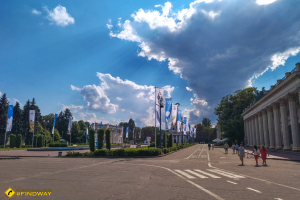




In 1958, this place was filled with show sheaves of wheat, tractor models and portraits of model workers, all to prove the advantages of socialism to the world. In the 2020s, people come here for music festivals, craft food markets and dinosaur exhibitions. Same grounds — a completely different era.
VDNG (VDNKh) in Kyiv is the capital's largest exhibition and park space, where pompous Stalinist pavilions stand next to modern festivals. A place where you can study Soviet architecture and sip coffee at an open-air food court at the same time.
Quick facts
| Location | 1 Akademika Hlushkova Ave, Holosiivskyi district, Kyiv |
| Opened | 1958 (as an exhibition of achievements) |
| Area | about 287 ha (710 acres), over 180 buildings and pavilions |
| Today | park, exhibition centre, festival venue |
| Time needed | 2–4 hours (more during festivals) |
| What to bring | comfortable shoes, water, cash/card for the food court, a blanket in warm season |
What it is and why people come here
VDNG (the Exhibition of Achievements of the National Economy, today the Expocenter of Ukraine) is almost 290 hectares (715 acres) of parkland with over a hundred pavilions in the central-southern part of Kyiv. In Soviet times it showcased the economy's "achievements"; today it's one of the city's main venues for large-scale events.
People visit for two reasons. The first is a walk through the green grounds, taking in the monumental Stalinist-era architecture: columns, spires, stucco, fountains. The second is a specific event — a music festival, a fair, an exhibition, a market, a sports event.
It's essentially a shape-shifting park: a quiet place for a walk or a run on weekdays, and a loud epicentre of city life on festival weekends.
History
VDNG opened in 1958 as a showcase of the Soviet economy of the Ukrainian SSR, modelled directly on Moscow's VDNKh: gather the "achievements" of industry and agriculture in one place and present them to visitors as proof the system worked. To house it, a grand (for its time) ensemble of pavilions was built in the Stalinist Empire style — columns, porticoes and lavish decoration.
Each pavilion represented its own industry: machine-building, livestock farming, the food industry and so on. The grounds were richly landscaped, with avenues and fountains — a kind of ceremonial park-museum of the Soviet economy.
Almost 290 hectares and over 180 buildings — in scale, it's a city within a city. Except instead of residents, it once housed record-breaking sheaves of wheat and combine-harvester models.
After the collapse of the USSR, the exhibition lost its ideological purpose and spent years searching for a new role. It found one in independent Ukraine: the grounds were gradually turned into a modern public space — a park, an exhibition centre and a venue for festivals and events.
What to see on site
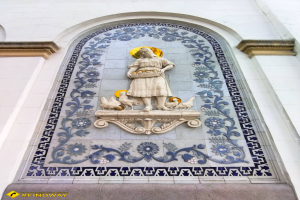
Stalinist pavilions. The main architectural draw: an ensemble of 1950s buildings with columns, spires and stucco mouldings. Photogenic and atmospheric, even with no exhibition inside.
Central avenue and fountains. The grand axis of the grounds, setting the scale for the whole design — perfect for an unhurried stroll.
Park and recreation areas. Trees, lawns, benches, space for a picnic, a run or a bike ride. A large green expanse within the city.
Festivals and events. In season, the grounds host music festivals, food markets, exhibitions and family events. Check the events calendar before you go — it determines which version of VDNG you'll experience.
How to get there
Metro. The nearest station is "Vystavkovyi Tsentr" (Exhibition Centre, blue line), a few minutes' walk from the entrance. This is the most convenient option.
Surface transport. Buses and minibuses serve the area; the landmark is Akademika Hlushkova Avenue.
Car. There's parking near VDNG, but during major festivals spaces fill up fast — on those days the metro is more convenient.
Entry. Access to the park grounds is usually free; individual exhibitions and festivals may have their own tickets. Check the schedule and access conditions in advance, including any restrictions related to martial law.
Traveller's checklist
- Comfortable shoes — the grounds are huge, you can easily clock up several kilometres.
- Water and a snack — or cash/card for the food court during events.
- A blanket — perfect for a picnic on the grass in warm weather.
- Check the events calendar in advance — so you don't accidentally miss (or run into) a festival on your visit day.
What NOT to do: drive in on the day of a major festival without leaving extra time for parking, and don't expect to cover all 290 hectares in an hour.
Frequently asked questions
What is VDNG today?
It's Kyiv's largest exhibition and park space (the Expocenter of Ukraine) — almost 290 ha (715 acres) with 1950s pavilions, now home to festivals, exhibitions, markets and events, as well as a place to simply walk in the park.
Do you have to pay to get in?
Access to the park grounds is usually free. Individual exhibitions, festivals and attractions may have their own tickets.
How do you get to VDNG?
The most convenient way is the metro — "Vystavkovyi Tsentr" (Exhibition Centre) station, blue line, a few minutes from the entrance. There's also parking for cars.
When's the best time to visit?
It depends on your goal: for a quiet walk among the architecture and greenery, go on a weekday; for energy and events, go on a festival-season weekend. Check the events calendar before you go.
VDNG is a story about a second life. A space built to glorify a system that vanished long ago wasn't demolished or abandoned — it was simply filled with new meaning. The columns stayed; the ideology was swapped for music, coffee and markets.
Come here twice: once on a quiet weekday morning for the architecture and the silence, and again for a festival. It will feel like two different cities on the same patch of land.
JoomShopping Download & Support