


- You are here:
-
Sights by Regions

-
Kyiv region
-
Kyiv
- Yard with crows, Kyiv


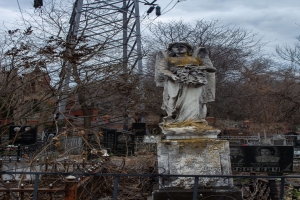


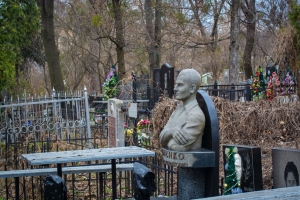

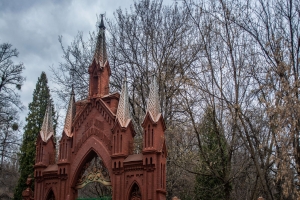


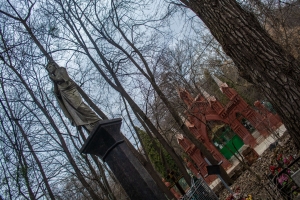

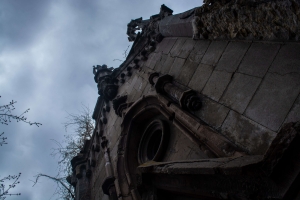
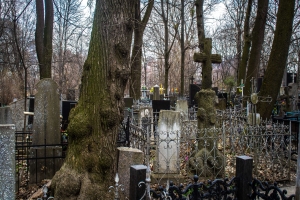

On this hillside, side by side, rest the poet who wrote «The Forest Song» and the coach under whom Dynamo Kyiv dominated European football. Baikove is not merely a cemetery — it is Kyiv’s open-air pantheon, mapped into the city itself.
Baikove Cemetery (the Baikove Necropolis) is Ukraine’s principal burial ground, with almost two hundred years of history and official monument status. Here you find historic vaults, a neo-Gothic church, and hundreds of names you know from the school curriculum and the sports headlines.
Location card
| Location | Kyiv (Holosiivskyi district, Baikova Street) |
| Founded | 1833 |
| Status | Historic monument of Ukraine (since 2001) |
| Entry | free |
| Time needed | 1–2 hours |
What it is and why visit
Baikove is both a burial ground and an open-air museum: Ukrainian history written in stone, sculpture and architecture. Dozens of distinguished figures from many eras rest here — from Lesia Ukrainka, one of the country’s greatest poets, to the legendary Dynamo Kyiv coach Valerii Lobanovsky.
People come to pay their respects, to admire the historic vaults and funerary sculpture, and for the particular stillness of an old necropolis at the heart of a metropolis. The site demands quiet respect: voices lower here instinctively.
History
The official founding year is 1833, though burials began even earlier. The cemetery was first called Novostroienske, but the land belonged to Major-General S. V. Baikov — and his name eventually prevailed.
Baikove comprised separate Orthodox, Catholic and Lutheran sections. It was Kyiv’s first cemetery where people of all faiths were buried together — a progressive idea for the 19th century.
In the 1930s the Soviet authorities demolished or closed many Kyiv cemeteries; Baikove, by contrast, was expanded and made the principal official necropolis not just of the city but of the entire Ukrainian SSR. In 2001 it was designated an outstanding historic monument of Ukraine.
Legends and local lore
Any old necropolis accumulates stories — and Baikove is often called one of the most mysterious places in the capital.
1. The ghosts of the old vaults
The oldest section with its ancient family vaults has produced many tales of «shadows» and figures reportedly glimpsed by visitors at dusk. Sceptics have a simpler explanation: old trees, mist and twilight turn any vault into a set for the imagination.
2. The weeping lady
Like many historic European necropolises, Baikove has its own «white lady» — the silhouette of a woman by the gravestones, said to appear at dusk. Classic cemetery folklore that travels from city to city.
Who is buried here
Lesia Ukrainka. One of Ukraine’s most celebrated poets — her grave is one of the key points of pilgrimage at Baikove.
Valerii Lobanovsky. The legendary Dynamo Kyiv coach; fans still regularly bring flowers and club scarves to his headstone.
Dozens of artists, scientists and statespeople from different eras — which is why Baikove is called Ukraine’s national pantheon.
Baikove was Kyiv’s first necropolis where people of all faiths were buried side by side. For the 19th century, that was almost a revolutionary concept.
How to get there
By public transport. The easiest approach is via metro stations near Baikova Street (Holosiivskyi district), then on foot or a few stops by surface transport.
By car. Navigate to Baikova Street. Parking is usually available near the main entrance.
Traveller’s checklist
- Respect and quiet: this is first and foremost a place of mourning, not a tourist attraction.
- Comfortable shoes: the grounds are extensive, hilly and crossed by old paths.
- Visit in daylight: come during the day to see everything properly.
- What NOT to do: make noise, take posed photos near recent burials, or enter unsafe vaults.
Frequently asked questions
Can you walk freely around Baikove?
Yes, entry is free during the day. But this is an active necropolis, so quiet and respectful behaviour is expected.
Whose graves are the most famous?
Among the best-known are the graves of Lesia Ukrainka and Valerii Lobanovsky. In all, hundreds of distinguished Ukrainians are buried here.
Is there an entry fee?
No, entry is free.
When was the cemetery founded?
Officially in 1833, though burials started even earlier. It has held the status of a historic monument of Ukraine since 2001.
Baikove is Kyiv written in stone. Walk its avenues and you see not dates but lives: poets, scientists, athletes — a whole century of Ukrainian history on a single hill. The place is melancholy — but it is here that you feel most sharply how many great names this city has given the world.
The topics of death and burial can be sensitive. If this is difficult for you — that is completely understandable. Take care of yourself and those close to you.
JoomShopping Download & Support