


- You are here:
-
Sights by Regions

-
Kyiv region
-
Bila Cerkva
- Dam and Abandoned Water Mill, Bila Tserkva
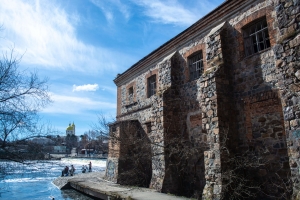


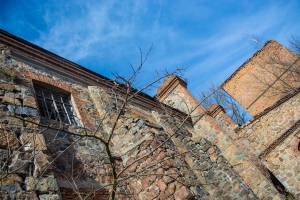
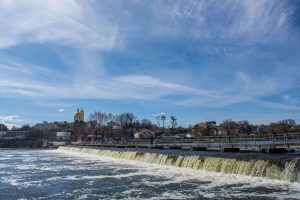
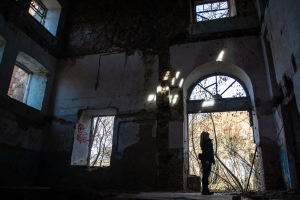
A two-storey stone mill has stood above the Ros River for nearly two hundred years. Once its millstones ground flour for an entire town; now wind drifts through the empty walls, and the old stone dam beside it murmurs over the rocks.
The dam and abandoned watermill in Bila Tserkva are one of the town’s most picturesque corners: stone, water, and a panorama of the Ros with a view of an old church on the opposite bank.
Location Card
| Location | Zamkova St., Bila Tserkva, Kyiv region |
| What it is | old watermill and dam on the Ros River |
| Age | first half of the 19th century |
| Time needed | 30–60 minutes |
| What to bring | camera, comfortable shoes, water |
What It Is and Why Visit
A watermill is living history from the pre-industrial age, when rivers provided the power. In Bila Tserkva that mill has survived in stone: a massive two-storey structure above the Ros, with a small but very photogenic stone dam alongside.
People come here not for thrills but for old-world atmosphere and beautiful views. The mill has long ceased working and is in a state of decay — which only adds to its charm: old stone, water rushing over the dam, and a panorama of the river with the Church of St Mary Magdalene framed on the far bank.
The mill holds the status of a locally listed architectural monument. This is not merely an «abandoned building» but a protected heritage site with almost two centuries of history.
History: From the Branytsky Era to Dereliction
The mill and dam appeared in the first half of the 19th century. From the 1770s Bila Tserkva was owned by the magnate Branytsky family — its construction is most often associated with their era (though an alternative account credits a local sugar-factory entrepreneur). The stone dam was built across the Ros at the same time, with the two-storey mill rising above it.
The mill operated as intended until the 1970s — a respectable lifespan for a structure of this kind. Production then stopped, and the building gradually fell into disrepair. By 2020 the mill was in a dangerous structural state, despite holding listed monument status.
Legends and Local Lore
Old watermills are among the richest sources of folklore in Ukrainian tradition. A mill was always considered a «boundary» space between worlds.
1. The Miller and the «Unclean Forces»
In old folk belief, every mill had its «master» — a water spirit or mill brownie with whom the miller supposedly «made a deal» for a good grind. This is not local lore specific to Bila Tserkva but a pan-Ukrainian layer of folk belief that fits the old mill on the Ros perfectly.
2. The Sound That «Remembers» the Millstones
Local legend says: stand by the dam in a quiet moment and in the lapping of the water you can «hear» the rhythm of the old millstones. In reality it is imagination and the sound of the current over rocks — but beside a two-hundred-year-old mill, the illusion comes easily.
What to See and Do
The mill building. A massive two-storey stone structure — the main draw. View it from outside: the interior is structurally unsafe.
The stone dam. Small but highly photogenic: water rushing over rocks, old stone boulders along the banks.
Panorama of the Ros. From the mill side there is a lovely view of the river and the Church of St Mary Magdalene on the opposite bank.
Walk along the Ros. The spot pairs well with a stroll along the embankment and a tour of the historic town centre.
Getting There
By car. Head for Zamkova Street in Bila Tserkva — the historic centre above the Ros. Bila Tserkva is roughly an hour’s drive from Kyiv.
By public transport. Buses and minibuses run regularly from Kyiv to Bila Tserkva; take city transport to the centre, then walk to the river.
Combine with «Alexandria». Bila Tserkva is also home to the famous Alexandria Arboretum — the mill fits naturally into a day that includes the park and the historic centre.
Traveller’s Checklist
- Camera: this location is primarily about the views.
- Comfortable shoes: the banks are rocky and slippery near the water.
- Water: no facilities at the mill itself.
What NOT to do: enter the unsafe mill building, clamber down slippery stones to the water’s edge, or leave rubbish on the banks of a listed heritage site.
Frequently Asked Questions
How old is the mill?
The mill and dam date from the first half of the 19th century — roughly two hundred years old. The mill remained in operation until the 1970s.
Can I go inside?
Best avoided: the building has been in a dangerous structural state in recent years. Viewing the mill is safe only from the outside.
What else is there to see nearby?
Alexandria Arboretum, the historic centre of Bila Tserkva, the Church of St Mary Magdalene, and the Ros embankment. All can be combined comfortably in a single day trip.
Is it safe to visit during wartime?
Kyiv region is a relatively rear-area region, but shelling is possible anywhere in Ukraine. Monitor air-raid alerts and follow the current situation.
The watermill on the Ros is a quiet encounter with the 19th century right inside a modern town. Stone, water, a dam, and two hundred years of history in a single frame.
Stand by the dam, listen to the water on the rocks, photograph the river panorama with the church across the water — then move on without disturbing the old masonry. Heritage sites of this age deserve to be preserved, not «explored» to pieces.
JoomShopping Download & Support