


- You are here:
-
Sights by Regions

-
Kirovohrad region
- Church in honor of the Ascension (1898), Bobrynets
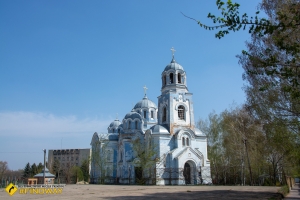

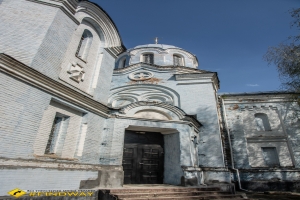

This church became the last project of architect Yakiv Pauchenko — one of the finest masters of brick Art Nouveau (tsehlianyi modern) of his era. The most prominent architect of the Yelysavethrad region put the final full stop on his own career right here, in the small steppe town of Bobrynets.
And what a full stop it was: a five-domed cathedral soaring upward as if this small county town had suddenly decided to build a metropolitan-scale cathedral. In a way, that’s exactly what happened.
Location card
| Location | Bobrynets, town centre, Kirovohrad region |
| Distance from Kropyvnytskyi | ~50 km (31 mi) south |
| Founded / consecrated | founded in 1898, consecrated in 1912 |
| Architect | Yakiv Pauchenko (his last work) |
| Time needed | 30–40 minutes, including a walk around the centre |
What it is and why visit
The Church of the Ascension of the Lord is an Orthodox cathedral in the centre of Bobrynets and an architectural landmark from the late 19th — early 20th century. This is no ordinary village church but a true cathedral: a five-domed, deliberately tall structure that dominates the surrounding buildings.
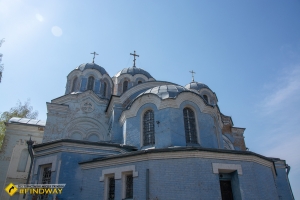
The floor plan is cross-shaped. The central dome sits on a twelve-sided drum, while the other four rest on octagonal drums. This composition creates the «soaring» effect that makes the trip worthwhile: from a distance, the cathedral reads as a vertical landmark that organises the entire town around it.
History
The cathedral was founded in 1898 in the central part of Bobrynets’ market square — right where the town’s trading life buzzed. Construction turned into a marathon: the church was built over fourteen years.
It was consecrated in 1912, in honour of the Ascension of the Lord — the first service was held precisely on that feast day. That’s how a date on the church calendar shaped both the cathedral’s name and its patronal feast.
Fourteen years of construction — and the final project in the career of an outstanding architect. For the small county town of Bobrynets, this was a project on the scale of a capital city.
A master of brick Art Nouveau
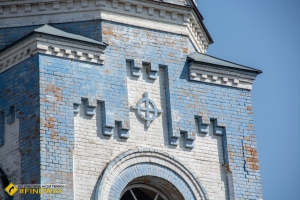
The project was designed by Yakiv Pauchenko — one of the key figures of Yelysavethrad architecture, a master who treated brick as a delicate material. Brick Art Nouveau means decoration isn’t applied on top — it’s «laid» into the brickwork itself, through texture, rhythm and relief. The Bobrynets cathedral became his swan song.
Legends and curious details
Big cathedrals accumulate stories the way old bells accumulate patina.
1. The feast that gave it its name
According to local lore, the name wasn’t chosen in advance — it followed events: the church was consecrated and held its first service on the feast of the Ascension itself, and the name stuck for good. A neat example of how chance becomes tradition.
2. A cathedral on the marketplace
Locals smile when recalling that the church was built right in the middle of the market square: a spiritual landmark rose up where people traded, haggled and counted their kopiykas every day. The sacred and the everyday ended up side by side — and that’s still how it is today.
What to see on site
Five domes and drums. Look closely at the difference: the central drum is twelve-sided, while the side drums are octagonal. This gradation is what gives the cathedral its sense of slenderness.
Brickwork detailing. The main draw is the masonry itself. Walk around the church and see how the master «drew» with brick, with no excess applied ornamentation.
The historic centre of old Bobrynets. The cathedral stands in the heart of town, so you can easily combine a visit with a walk through the historic centre — once a notable county hub in its own right.
How to get there
By car. The most convenient option. About 50 km (31 mi) south of Kropyvnytskyi; once in Bobrynets, head for the centre — the cathedral is visible from afar thanks to its height and domes.
By public transport. Buses run regularly from Kropyvnytskyi to Bobrynets; from the bus station it’s a few minutes’ walk to the centre.
Tip. To see the interior, plan your visit around service times or check the schedule in advance.
Traveller’s checklist
- Wide-angle camera: the tall, five-domed cathedral only fits the frame from a distance.
- Modest dress: this is an active church, so dress appropriately if you plan to go inside.
- Time for the centre: set aside an extra half hour for a walk around old Bobrynets.
- Cash: useful more often than cards in this small town.
What NOT to do: fly a drone over the active church during a service, or photograph parishioners without permission.
Frequently asked questions
How much does it cost to visit?
Entry is free. This is an active cathedral, not a ticketed museum.
What makes this cathedral special?
It’s the last work of the outstanding architect Yakiv Pauchenko and a striking example of brick Art Nouveau — a five-domed, cross-shaped, soaring cathedral.
How much time should I plan for a visit?
20–30 minutes for the cathedral itself, and up to an hour with a walk around the centre of Bobrynets.
Is it safe to travel there now?
Bobrynets is in central Ukraine and life there continues as usual. As everywhere in the country, follow air raid alerts and local guidance.
Architects rarely know which project will be their last. Pauchenko placed his final full stop not in a provincial capital, but in the steppe town of Bobrynets — and that’s exactly why the cathedral here reads as the summary of an entire creative life, built in brick.
Come, step back a few paces so all five domes fit into view — and you’ll see how one of the finest masters of brick Art Nouveau ended his journey.
JoomShopping Download & Support