


- You are here:
-
Sights by Regions

-
Khmelnytskyi region
- Ancient cemetery, Otrokiv
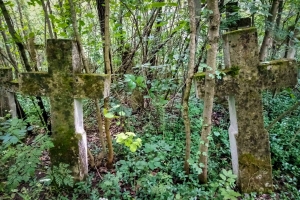

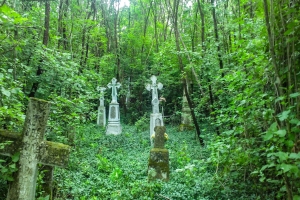
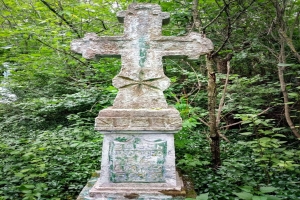
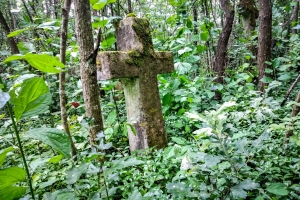


«No one's been buried here for a long time — except family, next to the grandparents,» an elderly woman remarks in passing as she walks the path past the old crosses. At the old cemetery in Otrokiv, time seems to have thickened: the stones are covered in moss, the inscriptions have faded, and the silence is so complete you can hear your own footsteps in the grass.
This is a small, almost unknown spot — the kind that never makes it into guidebooks, yet offers the strongest sense of touching the past of a Podillia village.
Location card
| Location | Otrokiv village, Chortkiv district, Ternopil region |
| What it is | old village necropolis, stone crosses |
| Time needed | 20–40 minutes |
| What to bring | sturdy shoes, water, a camera, respect for the place |
What it is and why people come here
The old cemetery in Otrokiv is a village necropolis where, alongside more recent burials, old stone crosses have survived. Cemeteries like this are scattered across Podillia, and each one is a small archive of an entire village: the surnames on the gravestones tell you who lived here, what families there were, and how the eras changed.
This place draws people who care less about attractions and more about atmosphere and history "from below" — not from palaces and castles, but from the lives of ordinary people. It's a spot for a quiet visit, photography, and reflection, not for loud guided tours.
A history written in stone
The villages of the Podillia region have a long and complicated history: states, borders, and communities have changed here, while the cemeteries have remained almost the only stationary witnesses to those changes. The old gravestones in such places are often older than any surviving house in the village.
Carved stone crosses, some with barely legible dates and inscriptions, are part of Podillia's folk memorial tradition. Local stonemasons made them from local stone, and each cross is both a memorial to a specific person and a sample of village craftsmanship from its era.
An old village cemetery often outlives everything else: the church, the manor house, even the names of the streets. Stone remembers longer than paper.
Local lore and atmosphere
As with any old cemetery, this one has its own village stories.
1. Crosses that "know" the family
In the villages, people believe that an old family cross protects the lineage, so even as new burials appeared nearby, the older ones were left undisturbed. That's how several generations of one family end up resting on the same patch of ground.
2. A silence that "rings in your ears"
Locals say that at midday there's a particular silence here — even the birds go quiet. Some put it down to the acoustics of the hill, others to the "character" of the place. Best to check it out in daylight, and not alone.
What to see on site
The old stone crosses. The main reason to come. Take a close look at the carving and shapes, and try to make out the dates and names — it's the best way to immerse yourself in the village's history.
The view of the village. Village cemeteries were often placed on high ground, so there's frequently a beautiful view of the surrounding area and the fields of Podillia from here.
The road itself. The drive to Otrokiv through the villages and fields of Podillia is part of the experience — beautiful in an everyday, unassuming way.
How to get there
By car. The most convenient option. Head for the village of Otrokiv in the Chortkiv district of the Ternopil region; it's best to plot the route with GPS navigation, since the location is rural and unsigned. The final stretches of road may be unpaved — take care if it's been raining.
By public transport. Buses run from Ternopil and Chortkiv to nearby villages and district centers, but there may not be a direct convenient connection to Otrokiv. Check the schedule in advance and be ready to walk part of the way.
Traveler's checklist
- GPS navigation with offline maps — the village is small and signage is scarce.
- Sturdy shoes — expect grass, uneven ground, and overgrowth in places.
- A camera — the old crosses amid greenery are very striking.
- Respect for the place — don't touch or move anything, and keep your voice down.
- What NOT to do: visit after dark or leave litter behind — both unethical and unsafe on uneven ground.
Frequently asked questions
Is it worth a special trip just for this cemetery?
This spot is for fans of quiet, atmospheric places and everyday history. Traveling far just for it is an acquired taste; it makes more sense to fold it into a wider route through Podillia.
Is it freely accessible?
Yes, village cemeteries are open. The main thing is to behave respectfully, since this is an active burial site.
When is the best time to visit?
During the day and in dry weather. In spring and summer, the greenery makes the place picturesque, and dry ground makes it easier to walk around.
Is it safe to travel there right now?
Yes, it's in western Ukraine, far from the fighting. As always, it's worth keeping an eye on air raid alerts while traveling.
The old cemetery in Otrokiv isn't for those who collect famous landmarks. It's for those who can read history in worn letters on stone and hear how much a village's silence can say.
Sometimes the most genuine impression of a trip comes not from a castle or a palace, but from an old cross under ivy, beside which you suddenly fall silent yourself.
JoomShopping Download & Support