


- You are here:
-
Sights by Regions

-
Kharkiv region
- Place an underground nuclear explosion "Fakel", Hrestysche
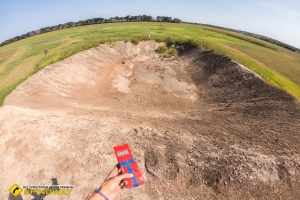
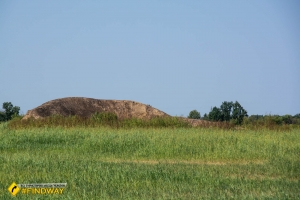
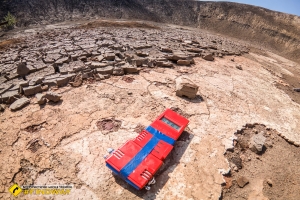

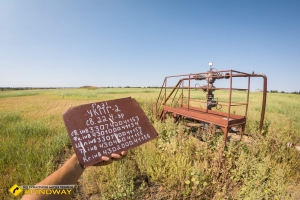

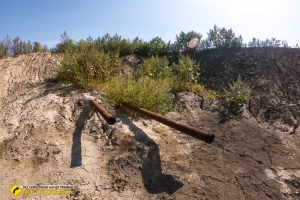


On 9 July 1972, the earth shook beneath a field near the village of Khrestyshche, more than two kilometres underground. The USSR had detonated a real nuclear bomb — not at a test site, not as a weapons trial, but to extinguish a gas blowout that engineers had failed to control for nearly a year.
The site of Operation Fakel is the location of the first industrial nuclear explosion on Ukrainian SSR soil. Today the surface offers almost no visible trace of the event, yet the story itself is one of the most astonishing and least-known chapters of the Soviet era in Kharkiv region.
Location card
| Location | near Khrestyshche village, Krasnohrad district, Kharkiv region |
| What it is | site of the first industrial nuclear explosion in the Ukrainian SSR |
| Date | 9 July 1972 |
| Yield | ~3.8 kilotons, at a depth of ~2,400 m |
| What to bring | curiosity for history (almost nothing to see on the surface) |
Before you go: safety
Khrestyshche is in Kharkiv region, which has been under threat of strikes since 2022. Before any trip, check the current security situation and official guidance for the region. This is primarily a historical «mind’s-eye» destination: there are no dramatic ruins here on the surface.
What it is and why it is extraordinary
«Peaceful nuclear explosions» (PNEs) was the USSR’s term for a programme of using nuclear devices for civilian purposes: creating underground storage cavities, seismic surveying, and — yes — sealing emergency gas wells. Khrestyshche was exactly that kind of case: engineers decided that the only way to stop a raging gas blowout was a nuclear detonation deep underground.
People come here not for a photo opportunity, but for a story that is genuinely hard to believe: a nuclear bomb was detonated beneath this field — and it worked.
This was the first industrial nuclear explosion on the territory of the Ukrainian SSR — 3 kilometres from the village of Khrestyshche.
History: the blowout that burned for a year
In 1968, a large gas condensate field was discovered near Khrestyshche, with reserves estimated at around 300 billion cubic metres. By late 1971, seventeen production wells were operating there — most under conditions of abnormally high reservoir pressure exceeding 400 atmospheres.
In July 1971, while drilling a new well, a powerful condensate blowout occurred. The 400-atmosphere pressure flung two engineers from the top of the rig, and the gas blowout became a torch dozens of metres high, burning around the clock. At night, the area around the well was lit almost like daytime. Conventional methods failed — the blowout burned on for months.
The nuclear solution
A directional well roughly 2,400 metres long was drilled alongside the blowout column, and a cylindrical special device — a nuclear explosive of approximately 3.8-kiloton yield — was lowered into it. On 9 July 1972, it was detonated. The underground shock shifted the rock strata and sealed the gas channel. The blowout was extinguished.
Consequences
The blast was felt across a wide area. In the nearby village of Pervomayske, the shock wave blew out windows and caused cracks and damage to many homes — repairs took more than a year. Like other Soviet «peaceful» nuclear experiments, Operation Fakel was kept classified for decades, and its environmental consequences remain debated.
Rumours and local lore
The classified nature of the event meant rumours circulated for decades.
1. «Light like daytime»
Locals talked for years of the gas torch’s glow, visible dozens of kilometres away. In Soviet times, when the accident went officially unacknowledged, this was the only «evidence» that something major had happened.
2. The shadow of radiation
As with all Soviet PNEs, there are local stories of an «invisible threat» in the soil and water. The site was officially declared safe, but local wariness is understandable: trust in Soviet assurances was not exactly high.
How to get there
By car: Khrestyshche is in the Krasnohrad district of Kharkiv region, to the south-west of Kharkiv. The actual detonation point is in a field a few kilometres from the village.
Important: there is no «attraction» on the surface — this is a destination for those who value history and context over visuals. Plan any trip only after checking the security situation.
Frequently asked questions
Why was a nuclear bomb detonated here?
To seal an emergency gas blowout that had been burning for nearly a year and defied all conventional methods. The underground blast shifted the rock strata and closed off the gas channel.
Is the site safe from a radiation standpoint?
The site was officially declared safe, but the environmental consequences of such explosions are still debated. In any case, there is nothing to «walk around» — everything happened deep underground.
What can visitors see at the site?
Almost nothing on the surface: a normal-looking field and traces of gas extraction. The value of this location is historical, not visual.
«Fakel» near Khrestyshche is a story about an era that believed in the limitless power of the atom and chose to «cure» an industrial accident with a nuclear bomb. The blowout was sealed, the village was repaired, the event was classified. And the field is silent still — as if the earth beneath it never shook at all.
This article refers to nuclear devices and their consequences. This is a sensitive subject; we provide historical context only, with no technical details of any kind.
JoomShopping Download & Support
Attention! Part of Ukraine was occupied during Russia's unfounded military aggression against us and other democratic countries!
russia is a terrorist country, russians are murderers, thieves and rapists.
Russia's unhuman aggression against Ukraine since 2014 has led to the loss of homes and lives not only of many Ukrainians, but also of citizens of other countries and nationalities.
We consider any military actions against any state in the 21st century unacceptable and stupid, but unfortunately the Russians do not think so, and therefore many democratic countries, including Moldova, Georgia and our homeland, suffer from barbaric aggression.
Therefore, until the occupied parts of Ukraine are demilitarized and returned to our state, we remind users about the real danger of visiting the territories occupied by russia.